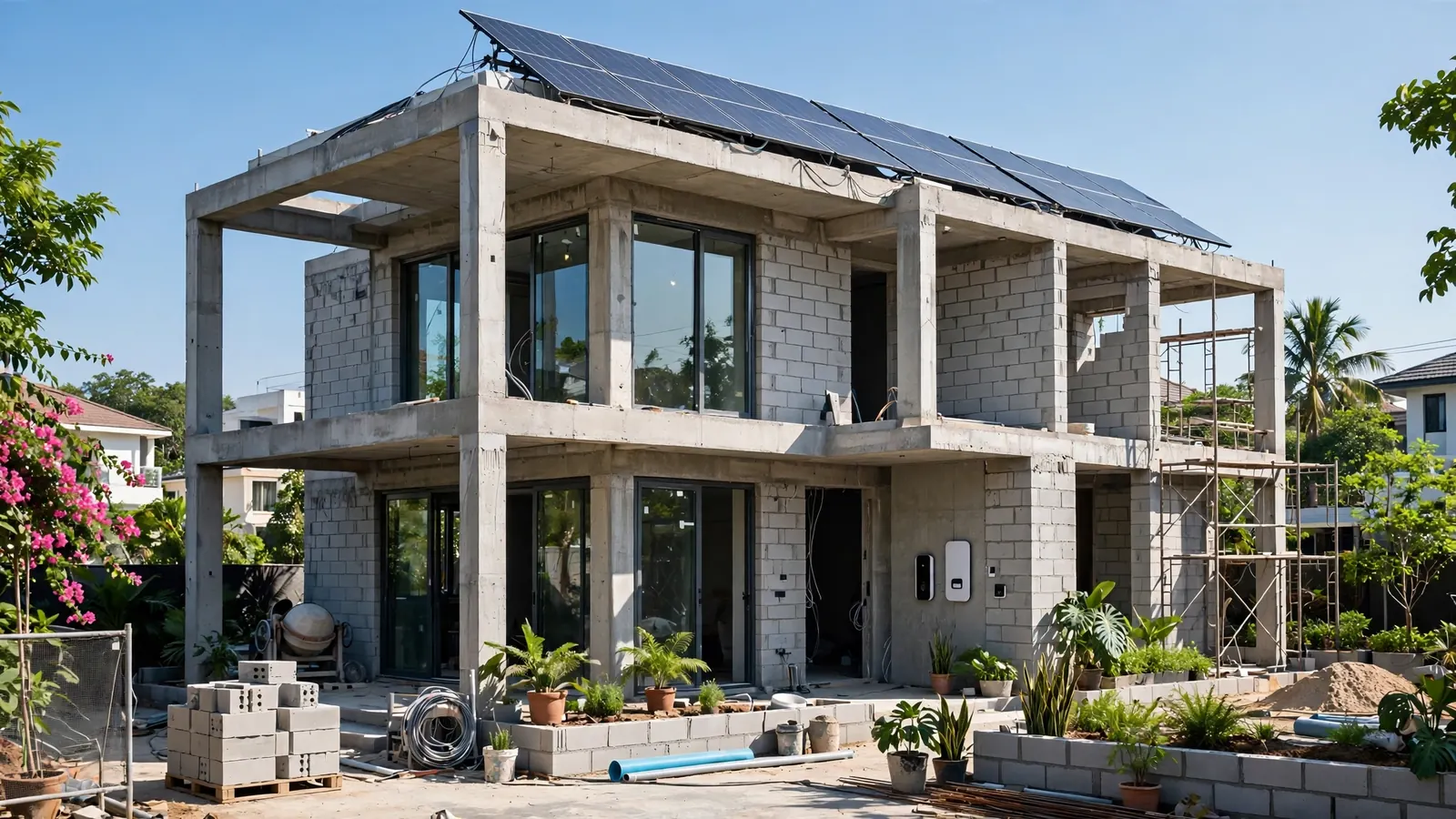
A turnkey house is the simplest promise in Indian home construction: one contractor, one written rate, and a ready-to-move-in home at the end. You hand over a bare plot and a set of drawings; you get back a house with the paint dry, the taps running and the keys in your hand.
The promise only works if the paper behind it is exact. A turnkey quote that does not list what is included, what is excluded, which brands go in, and when each payment falls due is not a fixed price — it is a starting price that grows later. This guide explains what turnkey home construction in India covers, what it costs, how it differs from a labour contract, and how to choose a contractor you can hold to the paper.
1. What turnkey construction actually means
"Turnkey" means the contractor turns the key over to you at handover — the house is finished, cleaned and ready to live in. One firm takes responsibility for the whole chain: design, approvals support, structure, services, finishes and snagging. If the paint peels or a tap leaks in the first month, there is one phone number to call, not five tradesmen blaming each other.
In a labour contract, you buy the materials and hire each trade yourself, and you carry the risk when a stage goes wrong. In a turnkey contract, the contractor buys the materials, manages the labour and owns the sequence — and you pay more per sq ft for that transfer of risk.
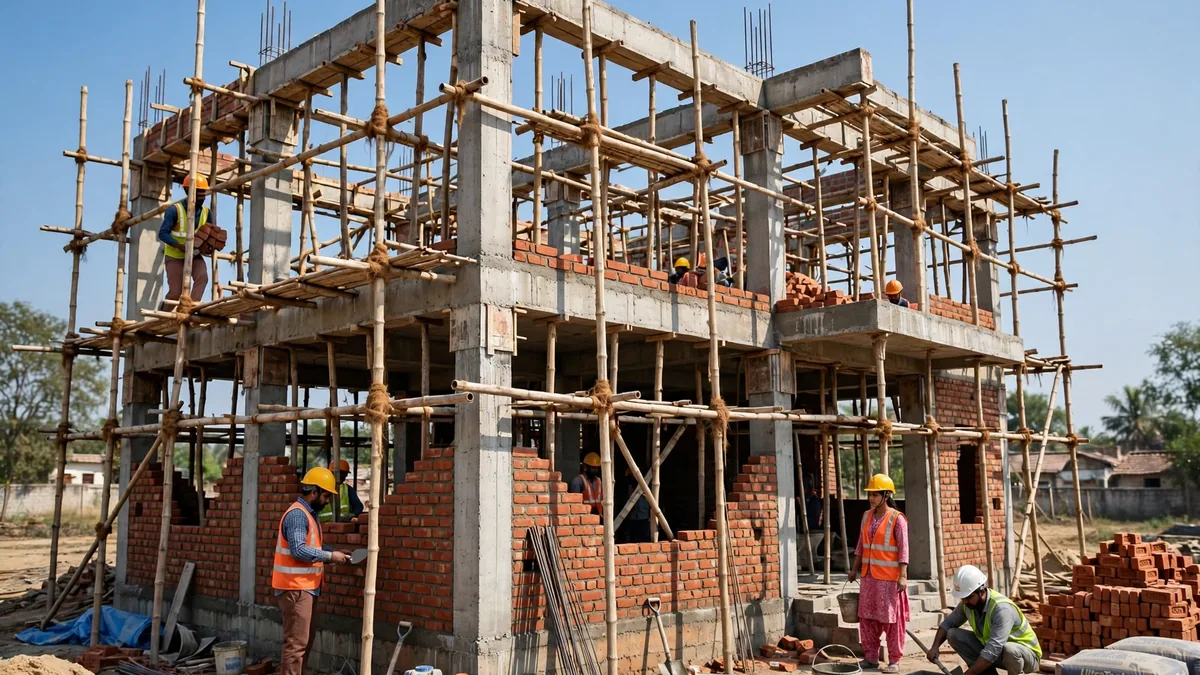
A genuine turnkey package normally covers architectural 2D and 3D design, structural drawings, soil testing, excavation and foundation, the RCC frame, masonry, waterproofing, plumbing and electricals, flooring, doors and windows, painting, sanitaryware, and final cleanup and snagging. What it does not cover is just as important — Section 2 lists it.
2. What is included — and what is usually not
Compare them by reading the inclusion list line by line — a quote that says "complete house construction" without a list is not comparable to anything.
| Usually included | Usually NOT included | Why it matters |
|---|---|---|
| Design, 2D/3D drawings, structural drawings | Government and authority fees | Charged by the authority, not the builder |
| Soil test, excavation, foundation, RCC frame | Electricity and water connections | Paid to the utility |
| Masonry, plaster, waterproofing | Compound wall, sump, lift | Often priced separately |
| Plumbing, electrical, flooring, paint | Modular kitchen and loose furniture | Beyond the package spec |
| Doors, windows, sanitaryware, cleanup | Landscaping, borewell, solar panels | Need their own quote |
Three items deserve a closer look. First, the brand list. A package that says "branded TMT steel" and "branded cement" has said nothing. The contract should name the steel grade (for example Fe 550 or Fe 550D), the cement grade (43 or 53 grade OPC or PPC), the pipe make and the switchgear make. Package specs seen in 2026 name brands such as Tata Tiscon and JSW for steel, UltraTech and ACC for cement, and Polycab or Havells for wiring — examples of the detail to demand, not a shopping list.
Second, the finishing spec. Flooring, tiles, sanitaryware, doors and paint decide most of the price gap between an essential and a luxury package. The contract should state the tile size and brand range, the sanitaryware make, the door material and the paint system — not just "premium fittings". Without that, the contractor can fit the cheapest option that matches the words and still be within the contract.
Third, GST. Ask in writing whether the quoted rate includes GST — some packages add it later, and the difference on a Rs 50 lakh house is several lakh rupees. Our BOQ guide explains how to read the itemised estimate behind any turnkey price.
Final member sizing, reinforcement and foundation selection need project-specific assessment by a qualified structural engineer. A turnkey package does not remove that need — it should name the engineer who signs the drawings.
3. What it costs in India in 2026
Turnkey packages are usually quoted per sq ft of built-up area. The ranges below are illustrative — they come from builders' published package tiers seen in web search results on 12 November 2026, not from a live rate survey, and they move 10–20% with the plot, access, design complexity and material prices. Use them to judge a quote's band, not as a price to hold anyone to.
| Package tier | Indicative range (per sq ft) | What changes |
|---|---|---|
| Essential / basic | ₹1,650–₹1,999 | Standard materials, basic finishes |
| Premium / standard | ₹1,950–₹2,400 | Better brands and fittings |
| Luxury | ₹2,450–₹2,800+ | Premium finishes and fittings |
| Delhi NCR premium | ₹2,400–₹3,200 | Metro labour and material costs |
| Delhi NCR luxury | ₹3,200–₹5,500+ | High-end specs, custom design |
For a real house: a 2,000 sq ft home at an illustrative Rs 2,000 per sq ft is Rs 40 lakh for the package, before the Section 2 exclusions; at Rs 2,500 it is Rs 50 lakh. The Rs 10 lakh gap is almost entirely finishes and brands — which is why the finishing spec matters more than the headline rate.
Where does the money go? A Delhi NCR guide seen in search results splits it roughly like this: structure 35–40%, finishes 30–35%, MEP (plumbing, electrical, HVAC) 15–20%, architectural and engineering fees 6–10%, statutory and soft costs 2–5%, contingency 5–8%. A quote that breaks none of these out usually omits the last three — which surface later as extras. For a full per-sq-ft breakdown, see our house construction cost guide.

4. Turnkey vs labour contract: which fits your situation
The alternative is a labour contract: you buy all the materials, the contractor supplies only labour, and you manage the site yourself. The choice depends on how much time you can spend on site and how much risk you can carry.
Turnkey contract
- Best fit: You live away from the site
- Trade-off: Higher rate; less control over materials
- Site check: Itemised BOQ and stage-wise payment first
Labour contract
- Best fit: You can be on site often
- Trade-off: You carry price, wastage and sequencing risk
- Site check: Daily supervision and your own material testing
Turnkey suits most first-time homeowners: one contract, one responsible party, a fixed written price. A labour contract can work out cheaper on paper, but only if you can buy materials at good rates, store them safely and be on site when each stage is done. Most people underestimate the time — a house build is a part-time job for 8–12 months, not a weekend hobby.

5. How to choose a turnkey contractor
Choosing a turnkey contractor is a verification exercise, not a price comparison: a quote 15% below the market is a warning that something in the spec is missing. Run these five checks before you sign anything.
1. Ask for an itemised BOQ before signing. The BOQ (bill of quantities) is the estimate behind the headline rate — every item, its quantity, unit rate and specification, down to the steel brand and switchgear model. A contractor who will not give you one is asking you to buy a price, not a house. Our BOQ guide shows how to read one like an engineer.
2. Visit two completed houses, not one showroom. Ask for two houses finished at least a year ago and visit them: check the paint, tile joints, bathroom ceilings below and the terrace. A house that looks good on handover day and bad a year later tells you more than any brochure. Ask the owners what went wrong and how fast it was fixed.
3. Check the drawings and the engineer. A turnkey package should include structural drawings signed by a qualified structural engineer, a soil test for your plot and a sanctioned plan. If the contractor cannot name the engineer, the structure is being built on habit, not design. See our building plan approval guide.
4. Read the payment schedule, not the total. Payments must be tied to completed, inspectable stages — plinth, lintel, roof slab, brickwork, plaster, finishes, handover — with the money always sitting slightly behind the work. A schedule that demands 60% before the roof slab is cast is a loan to the contractor, not a building contract. Our construction contract guide explains stage-linked payments and the clauses to strike.
5. Get the warranty in writing. Ask for two numbers in the contract: the defect-liability period (one 2026 package offers 12 months — an example, not a standard) and the structural warranty (one builder offers a 10-year RCC warranty — again an example, not a rule). Both must be stated, with a response time for defect complaints. A warranty that exists only in a sales conversation does not exist.

6. How long it takes, and how the payments should flow
A standard 2,500–4,500 sq ft house takes 8–12 months from excavation to handover. A complex design, a difficult plot, monsoon stoppages or a late decision on tiles can stretch it — but what stretches it most is decisions made late.
The stages follow a fixed order, and the payment schedule should follow it:
| Stage | Work complete | Illustrative share | Check before paying |
|---|---|---|---|
| Design + sanction | Drawings approved, plan sanctioned | 5–10% | Sanctioned plan in hand |
| Foundation + plinth | Footings and plinth beam cast | 10–15% | Footing levels checked |
| Structure | Columns, beams and slabs to roof | 25–30% | Cube test results checked |
| Masonry + plaster | Walls, plaster, waterproofing | 15–20% | Waterproofing flood-tested before tiling |
| Finishes | Flooring, doors, paint, fittings | 20–25% | Brands match the spec |
| Handover | Snag list closed, keys handed over | 5–10% | Snag list closed in writing |
Two rules protect you. First, never pay for a stage before it is done and inspected — pay only against a written demand naming the stage, and keep a meaningful sum unpaid until handover. Second, hold retention money: commonly 5% of each running bill, released only after the defect-liability period ends. Without retention, the builder's incentive to return for a leaking toilet is a favour, not an obligation. See the RCC slab casting checklist for what to inspect at the build's most expensive stage.
7. Red flags, and handover: the last 5% is the real test
Walk away from a contractor who shows any of these: a quote with no itemised BOQ; a price far below every other quote with no explanation; payments in cash or into a personal account; no completion date, defect-liability period or retention money in the contract; or pressure to sign today because "the rate changes tomorrow". A genuine contractor can wait a week while you read the paper.
Handover is where a turnkey package is judged. Do not accept the keys on a handshake: walk the house with a written snag list — every room, every tap, every switch, every door and window — and do not sign until the list is recorded in writing with dates for fixing each item. A snag on a signed list is a job the contractor has already accepted. Our handover checklist covers the 40 checks to run before you take the keys.

A turnkey contract is worth exactly what its paper says. Read the inclusion list, the brand list and the payment schedule before you read the price — if any of the three is vague, the price is not a price yet. Planning a house in Uttar Pradesh or Delhi NCR? Start with our house construction cost guide, then talk to the RTPL team about a turnkey package with a written BOQ, a named structural engineer and a stage-linked payment schedule.
Last reviewed: 12 November 2026. All costs are illustrative figures from web search results, not a quote.