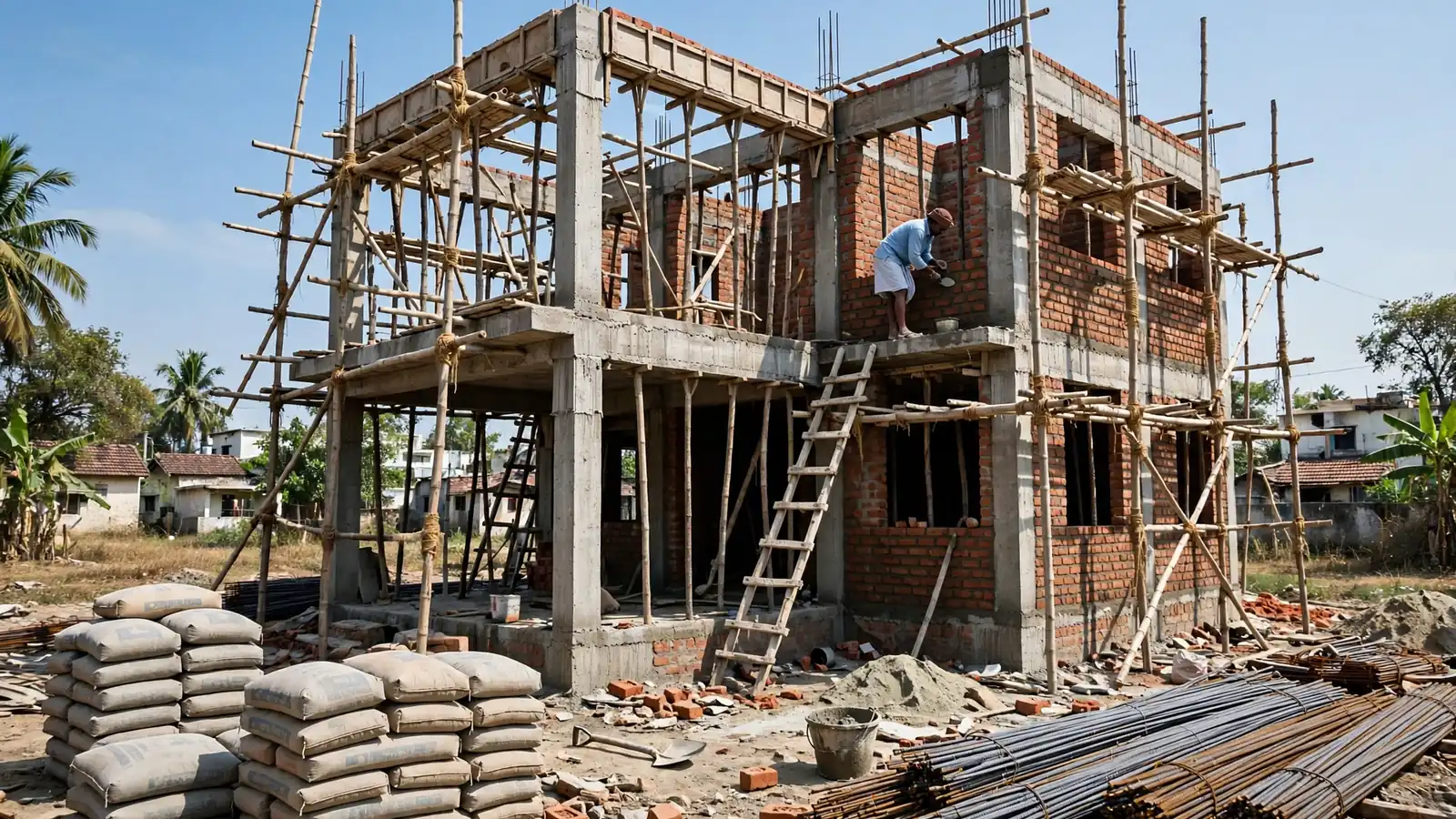
Your contractor hands you a 14-page estimate, and the total at the bottom is the only number you actually read. That is how a house budgeted at Rs 45 lakh ends up costing Rs 58 lakh — not through one big cheat, but through 200 small rows nobody read. The BOQ, or Bill of Quantities, decides what your house really costs.
This guide explains a BOQ the way a site engineer reads one: what each column means, how quantities are measured from your drawings, and the checks to run before you sign. You need a pencil, your drawings, and twenty minutes.
1. What a BOQ actually is — and what it is not
A BOQ is an itemised list of every measurable piece of work in your house — one row per item, each carrying a description, a unit, a quantity, a rate and an amount. Earthwork, PCC, RCC, steel, brickwork, plaster, flooring, doors and windows, painting, plumbing, electrical — every trade in build sequence. The BOQ is the contract's price list: what is written there is what you pay for, and what is missing becomes an extra later.
Three words get mixed up constantly. A quantity takeoff is the measurement working itself — someone going through your drawings and calculating lengths, breadths and depths (L × B × D) for every item. The BOQ is that working organised into a priced, itemised list. An estimate is the BOQ with rates added, plus overheads, profit and taxes. A quotation is a contractor's offer — usually built on a BOQ, but sometimes just a lump-sum figure with no breakdown, a price you cannot check.
2. Anatomy of a BOQ row: five columns that decide your bill
Every BOQ row has the same five columns. Read a row left to right and ask one question per column.
| Column | What it says | Example | What to check |
|---|---|---|---|
| Item no. | Serial number | 4.2 | Grouped by trade, in build sequence |
| Description | What the rate covers | RCC M25 in columns, including shuttering and curing | Vague descriptions hide extras |
| Unit | How it is measured | cu.m, sq.m, kg, nos., running metre | Must match the work |
| Quantity | How much your house needs | 42.5 cu.m | Check against your drawings |
| Rate / Amount | Price per unit; quantity × rate | Rs 7,800/cu.m → Rs 3,31,500 | Compare across contractors |
The description column costs the most money when it is vague. "Plastering, 12 mm thick, 1:6 cement mortar" tells you exactly what you are paying for; plain "plastering" lets the contractor later claim the rate covered only labour or one coat — and charge you again. Anything not written in the description becomes an extra later. Watch the unit column too: concrete in cubic metres, steel in kilograms, painting in square metres, doors in numbers.

3. How quantities are measured — and how to check them yourself
Quantities are not guesses. They are calculated from your drawings — length × breadth × depth for concrete, length × breadth for plaster and flooring, weight from bar lengths and diameters for steel. In India this measurement follows IS 1200, which also sets out deductions: openings above a certain size are deducted from plaster and painting areas, so a BOQ charging full wall area including every door and window overcharges you.
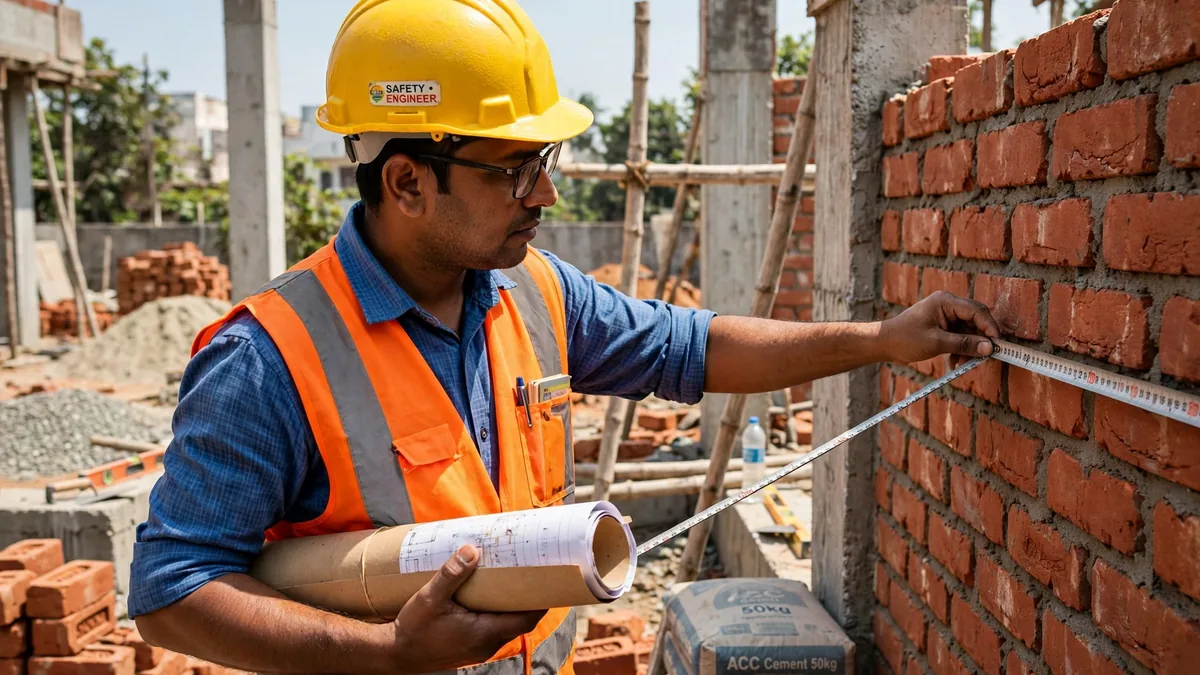
You do not need to re-measure the whole house. Check the five biggest rows first — they usually carry 60% or more of the total. Do one rough check per row from your drawings: slab area × thickness for concrete; wall length × height × thickness, minus openings, for brickwork. For steel, ask for the bar bending schedule — the sheet listing every bar's length, diameter and count — because a steel quantity with no schedule behind it cannot be verified at all.
Two rules of thumb help you smell a wrong number. Painting area for a full repaint is roughly 3.5 times the carpet area — if your BOQ shows 5 times, ask why. And compare like with like: line up quantities from two or three contractors' BOQs for the same drawings. Rates will differ; quantities should be close.
4. Item-rate vs lump-sum: the contract type changes what the BOQ means
The same BOQ behaves very differently under the two common contract types in India, and most disputes come from homeowners not knowing which one they signed.
Item-rate contract
- How it works: Quantities are provisional; work is re-measured as executed.
- Trade-off: The final bill moves with actual quantities.
- Site check: Joint measurement at each billing stage, quantities recorded and signed.
Lump-sum contract
- How it works: The quoted sum stands regardless of quantities.
- Trade-off: Scope changes become variations priced at the contractor's rates.
- Site check: Re-measure the BOQ before signing; after signing, errors are locked in.
Neither type is better in the abstract. Under item-rate, verify the rates and control the measurement. Under lump-sum, verify the scope and the quantities before you sign — after signing, the BOQ is history. Whoever prepared the BOQ, it is not neutral just because it looks technical — get it checked by an independent engineer. Our guide to house construction cost in India shows how the BOQ total connects to the per-square-foot rates contractors quote.
5. Seven red flags in a contractor's BOQ
1. Vague descriptions. "Plumbing work — lump sum" tells you nothing. Every row should name the material, the specification and what is included.
2. Missing items. The most common trick is leaving an item out entirely — waterproofing, termite treatment, overhead water tank, compound wall, septic tank, earthing. Compare the BOQ against your drawings room by room.
3. Inflated quantities. Check the five biggest rows against your drawings, as in Section 3: painting at 5× carpet area, concrete that ignores deductions for openings, steel without a bar bending schedule.
4. Rates too low to be true. A rate far below the others usually means the description quietly excludes something — primer, curing or scaffolding. Illustrative 2026 metro ranges: painting roughly Rs 25–38 per sq ft, gypsum ceiling Rs 95–150, bathroom waterproofing Rs 180–320.
5. Provisional sums with no basis. A provisional sum is a placeholder for undecided work — sanitary fittings are a common one, where the BOQ carries Rs 60,000 "provisional" and the fittings later cost Rs 1.5 lakh. Each one should state what it covers.
6. No contingency, or one that never comes back. Around 5% of the total is reasonable for the unknowns every build throws up — but the contract should say in writing that unspent contingency returns to you.
7. No mention of taxes, or taxes added twice. Check whether rates are inclusive of GST and whether GST appears once, at the end, on the subtotal — and ask for the tax treatment in writing.

6. The 20-minute audit: check your BOQ in five steps
Step 1 — Add up the top five. Sort the BOQ by amount, largest first. The top five rows usually carry 60% or more of the total.
Step 2 — Check one quantity per big row. Do the rough check from Section 3 for the biggest row. If it checks out within a few percent, the takeoff was done properly.
Step 3 — Read every description in the top twenty rows. Does each say the material, the specification and what is included? Mark every vague one and ask the contractor to rewrite it.
Step 4 — Compare with a second quotation. Get a BOQ from another contractor for the same drawings and compare quantities row by row. Rates will differ; quantities should be close.
Step 5 — Hunt for the missing items. Walk your drawings room by room: waterproofing, termite treatment, overhead tank, compound wall and gate, earthing, septic tank. Get anything missing priced now.
7. Variations, extras and the final-payment rule
Even a good BOQ cannot cover everything, because houses change during construction. Every change that maps to no BOQ item is a variation, and the rule is simple: no variation is built without written approval and an agreed price first. The contractor submits the change in writing; you approve it in writing; only then is the work done.
The same discipline applies to the final payment: the last 5–10% should be released only after the snag list is closed and the house is handed over. Keep every measurement sheet, approved variation and bill in one file — when a dispute arises, they are the evidence. Our new house handover checklist covers the 40 checks to run before that final payment is released.
8. Homeowner checklist: before you sign the BOQ
- The BOQ is priced from your approved drawings.
- Every row has a clear description, a correct unit, a verifiable quantity and a rate.
- The five biggest rows have been checked against your drawings.
- Rates have been compared with another quotation.
- Missing trades — waterproofing, termite treatment, tank, compound wall, earthing — have been priced.
- Provisional sums state what they cover.
- The contingency is around 5%, and unspent money returns to you.
- GST treatment is stated in writing, charged once.
- The variation procedure and final-payment rule are written into the contract.
- An independent engineer has reviewed the BOQ.
A BOQ is not a formality — it is your price list, your checklist and your evidence, all in one. Read it the way this guide describes, and the estimate stops being a number you hope is right and becomes a number you can defend. Planning a build in Uttar Pradesh or Delhi NCR? Talk to the RTPL team.
Last reviewed: 11 November 2026. Rates here are illustrative 2026 metro ranges from web search results, not live verified quotes. Contract statements here are general practice, not legal advice.