Cement is the smallest line item in a house budget and the one that decides whether the structure lasts. A wrong pick does not show up on the day of the pour — it shows up months later as cracks in the plaster, a leaking slab, or concrete that never reached its design strength. The choice is not really "OPC or PPC". It is which grade, for which part of the house, cured for how long.
Most Indian homeowners buy whatever the contractor or the shopkeeper hands them — fast-setting OPC 53 in plaster that needed slow, crack-free PPC, or PPC in a column whose shuttering had to come off in three days. This guide explains cement grades in India, what OPC and PPC actually are, and which cement belongs in your foundation, slab, columns, brickwork and plaster.
1. What cement grades actually mean
A cement grade is not a quality ranking. It is a number: the minimum compressive strength, in megapascals (MPa, also written N/mm²), that a standard mortar cube made with that cement must reach after 28 days of curing. A 53-grade cement must reach 53 MPa at 28 days; a 43-grade, 43 MPa. That is all the number promises — nothing about durability, finish or suitability for your slab.
OPC comes in three grades under IS 269:2015 — 33, 43 and 53. The standard's minimum strengths are:
| Cement | 3 days | 7 days | 28 days |
|---|---|---|---|
| OPC 33 grade | 16 MPa | 22 MPa | 33–48 MPa |
| OPC 43 grade | 23 MPa | 33 MPa | 43 MPa minimum |
| OPC 53 grade | 27 MPa | 37 MPa | 53 MPa minimum |
| PPC (single class) | — | 22 MPa minimum | 33 MPa minimum |
Read the table the right way round. OPC 53 is the fastest: it reaches 70–80% of its final strength within 7 days, which is why contractors like it for fast striking. OPC 33 is the slowest of the OPC family and is rarely used for load-bearing RCC today. PPC has only one strength class: 33 MPa at 28 days.
A higher grade does not make a stronger house by itself. The concrete's actual strength comes from the mix design, the aggregates, compaction and curing — a well-made M20 mix with OPC 43 beats a badly made M25 mix with OPC 53. Our M sand vs river sand guide covers the other half of that equation.

2. OPC: what it is, and where it wins
Ordinary Portland Cement is clinker — limestone and clay superheated to about 1,450°C in a rotary kiln — ground fine with a small amount of gypsum. That purity is its character: it hydrates fast, gains strength fast, and gives off a lot of heat while it sets.
OPC 53 is the workhorse of fast-track RCC: 27 MPa by day 3 and 37 MPa by day 7 as a minimum, so formwork can be struck on schedule. OPC 43 is the general-purpose grade for residential RCC in ordinary M20–M25 mixes — slabs, beams and columns where the schedule allows a normal striking time. OPC 33 is now mostly a plaster and masonry cement.
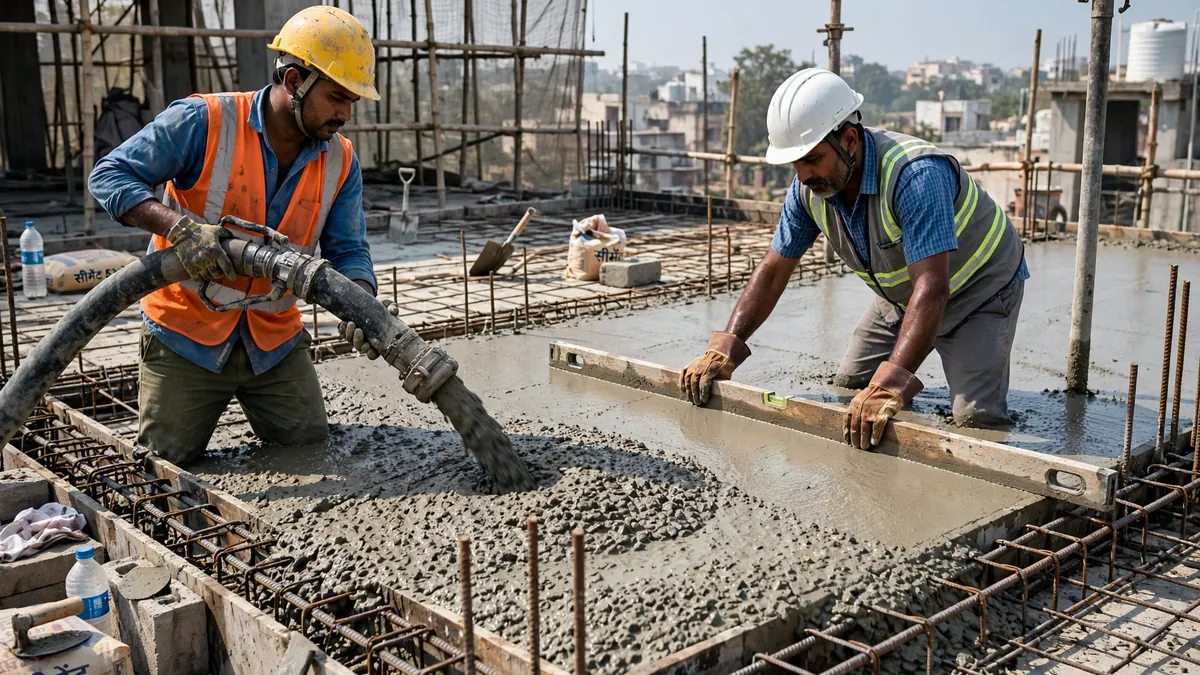
The speed has a price. OPC hydrates rapidly and releases significant heat of hydration. In a large pour, that heat has nowhere to go, and thermal micro-cracks open across the surface if curing water is not applied diligently. In practice, OPC 53 needs 10–14 days of careful curing even though the code minimum is 7 days, and it is a poor choice on its own for mass concrete: the BIS compendium lists blended cements, not OPC, for dams, bridge piers and large foundations. OPC also sets faster, so the mason has a shorter window to place and finish the concrete.
3. PPC: what it is, and where it wins
Portland Pozzolana Cement is OPC clinker blended with a pozzolanic material — most commonly fly ash, a by-product of coal-fired power plants. IS 1489 (Part 1) sets the fly-ash share at 15–35% by mass; Part 2 covers PPC made with calcined clay. The fly ash is not a filler: it reacts slowly with the lime released as cement hydrates, forming extra binding gel over weeks, so PPC keeps gaining strength long after OPC has levelled off.
That slow reaction is both the advantage and the condition. PPC gains strength slower in the first week — its 7-day minimum is 22 MPa, against 37 MPa for OPC 53 — and catches up by 28 days, improving to 90 days. It produces 20–30% less heat of hydration than OPC, so large pours crack less, and it stays workable for longer, which masons like for plaster and brickwork. The finished surface is smoother, with better resistance to shrinkage cracks and efflorescence — the white salt patches (shora) on plastered walls.
The condition is curing. IS 456 asks for at least 10 days of wet curing for PPC, against 7 days for OPC. The pozzolanic reaction needs sustained moisture — stopping PPC curing at 7 days can leave 28-day strength 15–20% below design values. In practice, pond a PPC slab for at least 10 days — 14–21 days for a roof slab. A PPC slab cured for only a week is worse than a properly cured OPC slab. PPC is also the greener and usually the cheaper bag: it uses less clinker per tonne, and the fly ash would otherwise be waste.

4. OPC vs PPC: the head-to-head
| Property | OPC | PPC |
|---|---|---|
| Composition | Clinker + gypsum | Clinker + 15–35% fly ash |
| Grades / classes | 33, 43, 53 (IS 269) | Single class, 33 MPa (IS 1489) |
| Early strength (7 days) | OPC 53: 37 MPa min — fast | 22 MPa min — slow, catches up by 28–90 days |
| Heat of hydration | High — crack risk in large pours | 20–30% lower — safer for slabs |
| Minimum curing (IS 456) | 7 days | 10 days |
| Workability / finish | Sets faster, shorter working window | Stays workable longer, smoother plaster finish |
| Durability | Good with proper curing | Denser, resists sulphate and chloride |
| Best for | Columns, beams, fast de-shuttering | Slabs, foundations, brickwork, plaster |
| Illustrative price (50 kg bag) | ₹380–₹500 (Nov 2026) | ₹350–₹430 (Nov 2026) |
A third type, PSC (Portland Slag Cement, clinker blended with blast-furnace slag), is the slowest to gain early strength and the toughest against sulphate and chloride attack — ask your structural engineer about it if your plot is coastal or in a high-water-table area.
IS 456 Clause 5.1 allows both OPC and PPC for RCC slabs, beams and columns — the code does not pick a winner. Final cement selection, mix design and striking times need project-specific assessment by a qualified structural engineer, based on your soil report, exposure conditions and construction schedule.
5. Which cement for each part of the house
| House element | Recommended cement | Why |
|---|---|---|
| Foundation / footings | PPC (OPC 53 if time-critical) | Low heat; resists sulphate attack from soil |
| Columns | OPC 53 (PPC also allowed) | Fast strength, quick de-shuttering |
| Beams | OPC 53 or OPC 43 | Early strength for striking |
| Roof / terrace slab | PPC preferred | Lower heat, fewer cracks, more watertight |
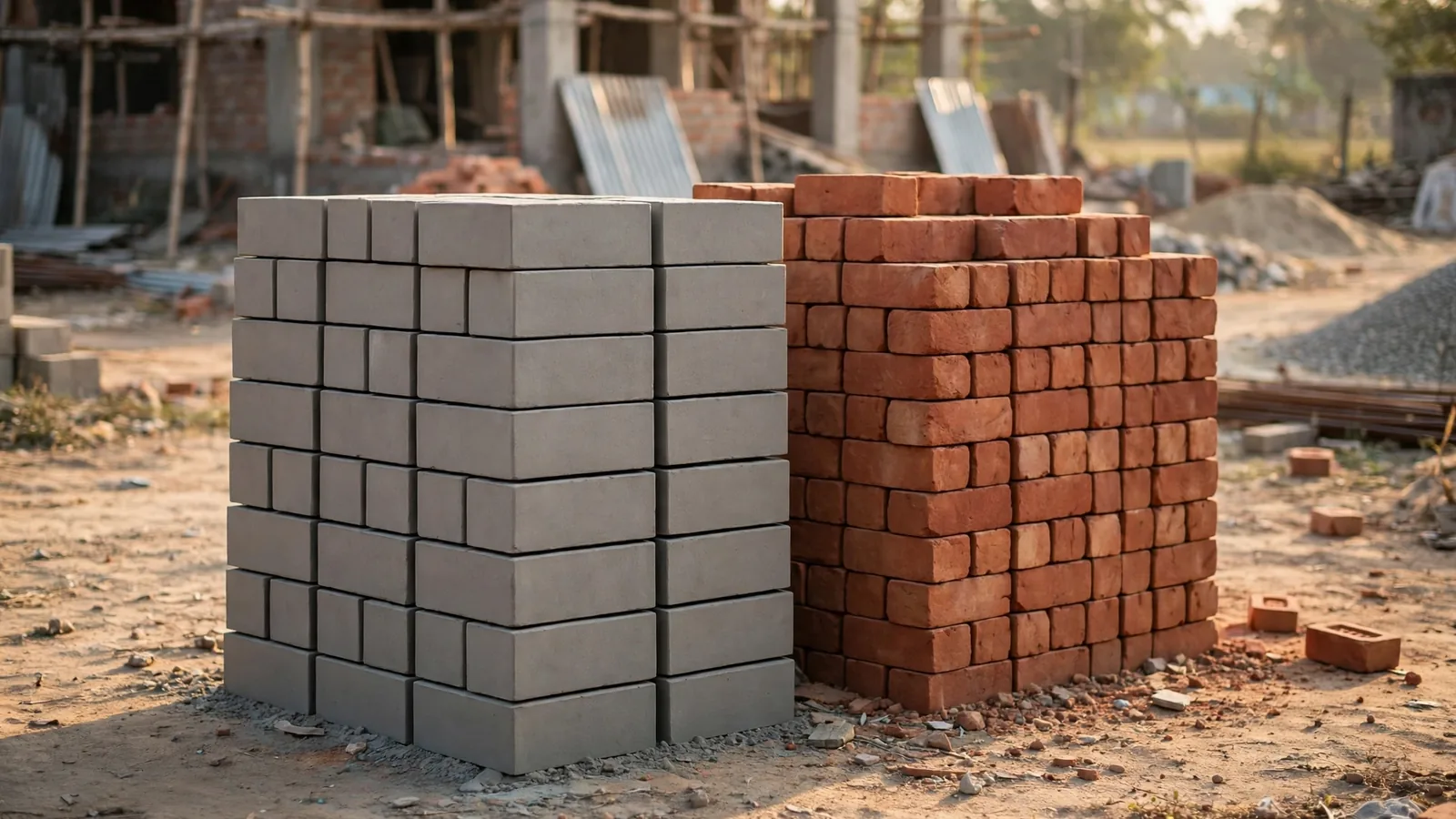
| Brickwork / masonry | PPC | Better workability and finish |
| Internal plaster | PPC | Smoother finish, less efflorescence |
| External plaster | PPC | Better monsoon resistance |
| Coastal / water-prone zones | PSC (ask your engineer) | Best sulphate/chloride resistance |
For a typical G+1 or G+2 house, the pattern is simple: OPC 53 for the verticals, PPC for the horizontals and finishes — two cements on site, each with a named job.
Do not mix OPC and PPC in the same batch or the same element — they hydrate at different rates and cure unevenly. Use one cement type per element, per pour; a switch from OPC columns to a PPC slab happens at a construction joint, not in the mixer.

6. What it costs in India in 2026
Cement is 15–20% of a house's structural cost — small enough that saving ₹30 a bag is rarely worth a cracked slab. The figures below are illustrative, from price guides and a retailer listing seen 10–13 November 2026. Treat them as a band for judging a quote, not as a price to hold anyone to.
| Cement | Illustrative price (50 kg bag) | Source seen |
|---|---|---|
| UltraTech OPC | ₹400 | Retailer listing, 10 Nov 2026 |
| UltraTech PPC | ₹370 | Retailer listing, 10 Nov 2026 |
| OPC 43 (general) | ₹380–₹460 | Price guides, Nov 2026 |
| OPC 53 (general) | ₹410–₹500 | Price guides, Nov 2026 |
| PPC (general) | ₹350–₹430 | Price guides, Nov 2026 |
On a single bag, PPC runs about ₹30 cheaper than OPC from the same brand — about 7–8%. On a house needing 400–600 bags, that is ₹12,000–₹18,000: real money, but small next to re-plastering a cracked wall or re-casting a leaking slab. Choose the cement by the element, not by the bag price. Ask whether the quoted rate includes GST and transport — a bag price at the dealer's godown is not the price at your site.
7. Site checks before you buy — and how to store it
Bad cement is rarely a bad brand. It is usually an old bag, a damp bag, or a fake bag. Run these checks on every delivery, not just the first one.
1. Check the ISI mark and the standard number. The bag should carry the ISI mark with IS 269 (OPC) or IS 1489 (PPC), the grade, the manufacturer's name and the batch number. A bag with a smudged print or a grade that does not match what you ordered goes back on the truck.
2. Check the manufacturing date. Cement loses strength with age as it absorbs moisture from the air. Use it within three months of manufacture. A bag that has sat in a dealer's godown through a monsoon is not a bargain at any price.
3. Feel the bag. Good cement feels smooth and cool rubbed between your fingers. Lumps that do not break apart under finger pressure mean the cement has already set in the bag — reject it.
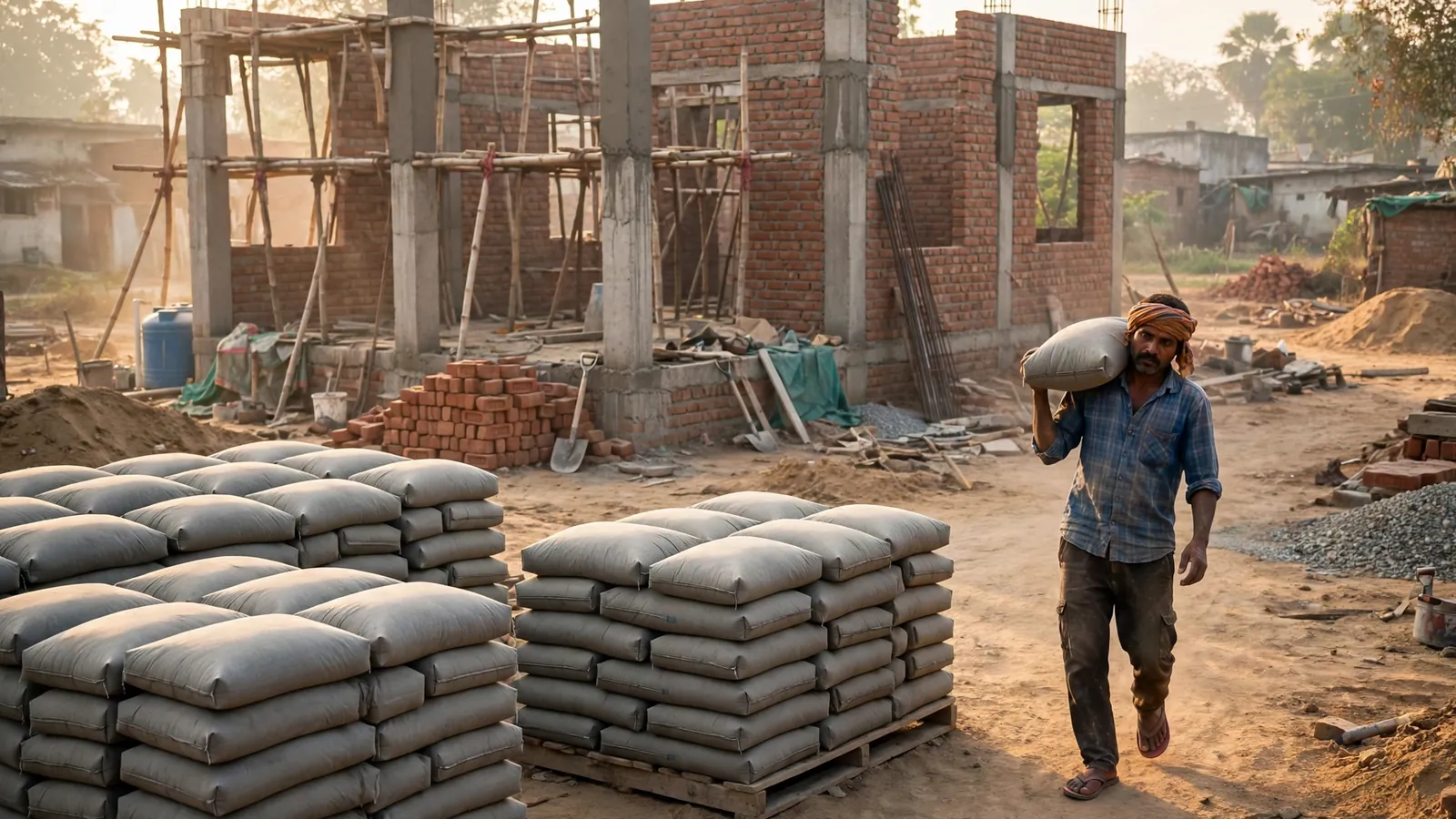
4. Store it like it matters, because it does. Stack bags on a raised wooden platform at least 150 mm off the ground, under a waterproof cover, away from walls. Never stack more than 10 bags high, and never store cement on bare earth. Our RCC slab casting checklist covers the pour day, and the AAC blocks vs red bricks guide covers the masonry above.
5. Cure for the cement you actually used. OPC needs at least 7 days of wet curing under IS 456; PPC needs at least 10. For a roof slab, pond water for 10 days with OPC and 14–21 days with PPC. A slab that dries out in the first week never reaches design strength, whatever grade was on the bag.

There is no single best cement for a house — there is a best cement for each part of it. OPC 53 for columns and beams where early strength sets the schedule; PPC for slabs, foundations, brickwork and plaster, where low heat, long curing and a smooth finish pay off for decades. Buy ISI-marked bags, check the date, store them dry, and cure for the cement you used. Planning a house in Uttar Pradesh or Delhi NCR? Start with our house construction cost guide, then talk to the RTPL team about a build with a written BOQ and a named structural engineer.
Last reviewed: 13 November 2026. All costs are illustrative figures from web search results, not a quote.