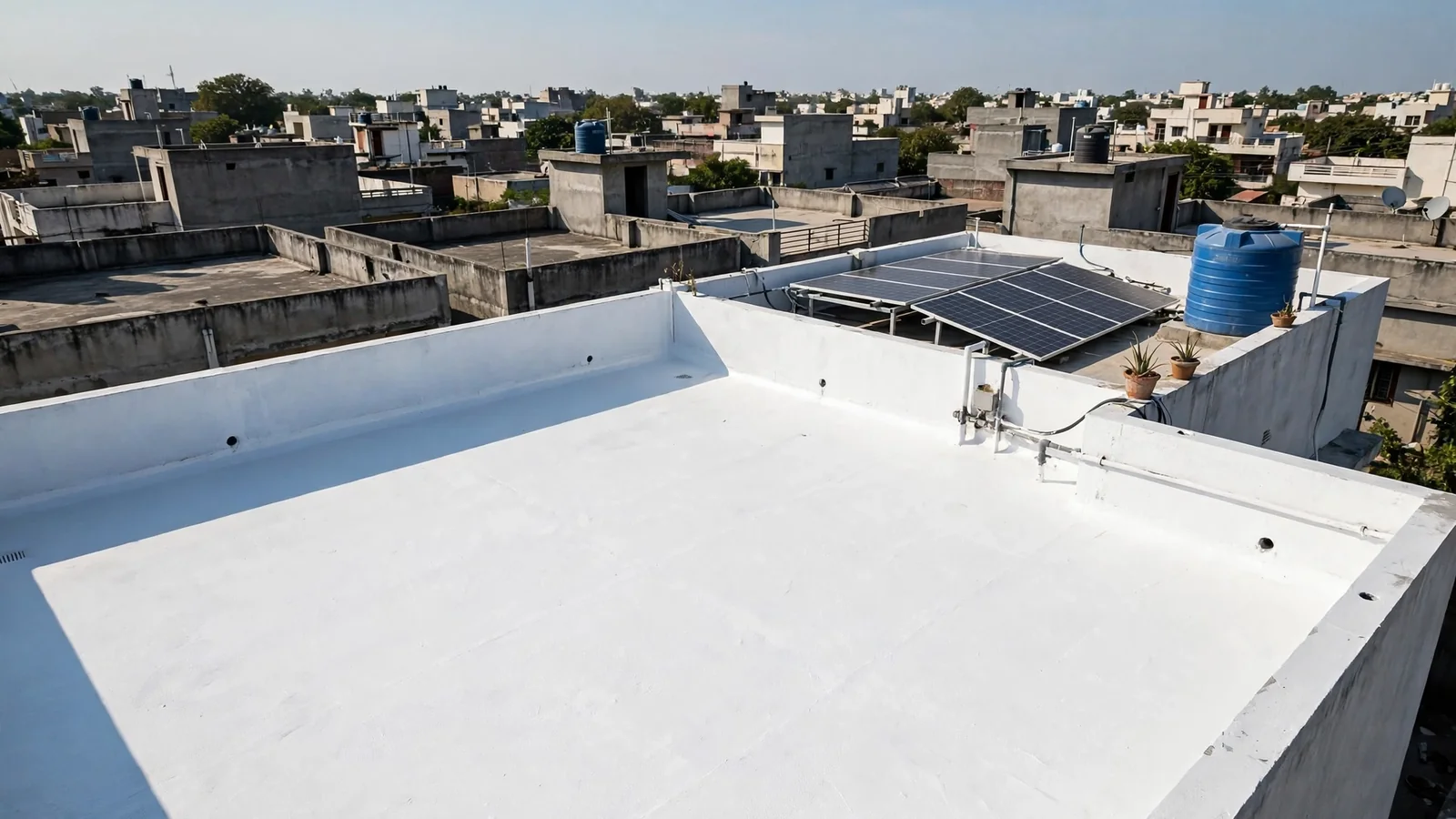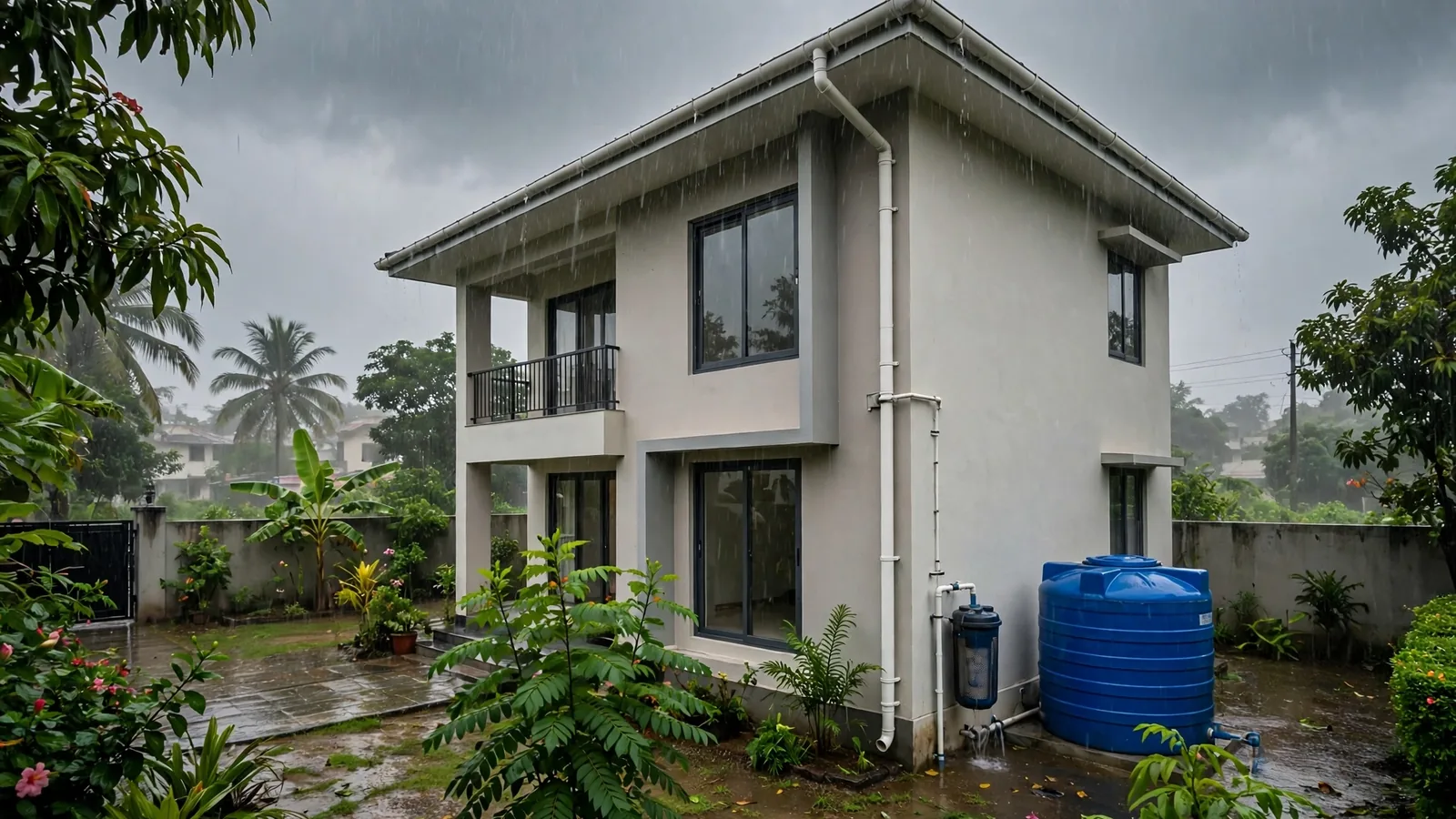
Every monsoon, thousands of litres of rain fall on your roof and run straight into the drain. A 100 sq m roof with 800 mm of annual rain can collect about 64,000 litres — enough to cut tanker bills and refill the groundwater your borewell drinks from. Rainwater harvesting is the system that catches that water instead of wasting it.
In many Indian cities it is no longer optional: Tamil Nadu requires it for every building, Delhi for roofs over 100 sq m, Bengaluru fines homes that do not comply.
Why your roof is a water source India cannot waste
India receives about 4,000 billion cubic metres of rain a year, yet only around 48% of it is considered utilisable. Meanwhile the Central Ground Water Board counts 256 of India's 700 districts as having critical or over-exploited groundwater. Haryana extracts 137% of its annual recharge and Rajasthan 147% (CGWB, 2024).
Your roof sits in the middle of that gap: a clean, hard catchment that already exists, collecting roughly a litre of water per square metre for every millimetre of rain. Harvesting will not solve a city's water problem alone, but for one house it cuts tanker dependence, keeps the borewell alive longer, and refills the aquifer the street draws from.
The sizes and costs here are planning figures from published guides seen in November 2026, not a design for your plot. Get them sized by a qualified engineer, and confirm the rules with your local authority before building.
How much water can your roof collect?
Do this calculation before you spend anything:
Harvestable water (litres) = roof area (sq m) × annual rainfall (mm) × runoff coefficient.
Roof area is the flat top-down footprint in square metres; annual rainfall is your city's normal-year figure from the IMD's climatological tables. The runoff coefficient is the share that actually reaches the pipes. The CGWB's Manual on Artificial Recharge gives 0.70 for concrete, 0.75 for tile and 0.90 for GI sheet; most Indian guides use 0.8 to 0.85 for concrete (RCC). Use the lower figure.
| City (IMD normal, 1991–2020) | Rainfall | Litres from 100 sq m roof |
|---|---|---|
| Bengaluru | 1,078 mm | ~91,600 |
| Delhi (typical year) | ~800 mm | ~68,000 |
| Mumbai (Santacruz) | 2,502 mm | ~2,12,700 |
Two things the annual number hides. Most rain arrives in three or four monsoon months, so a tank sized on the yearly total overflows in July and sits empty in April — size it on monthly rainfall and daily use. And the first rain of each shower is the dirtiest: a first-flush diverter discards roughly the first 1–2 mm before clean water is collected. A family of four uses around 500 litres a day for non-drinking needs, so a 100 sq m roof at 800 mm of rain covers roughly a third of that demand — a large share, not all of it.
Store it or send it underground? Choose your system
Most good systems do both: store what you can use, send the overflow underground. Storage gives you water on tap; recharge refills the aquifer your borewell draws from.

| System | Best for | Indicative cost | What you get |
|---|---|---|---|
| Storage tank | Homes buying tanker water | ₹15,000–₹60,000 | Water on tap |
| Underground sump | Larger homes, apartments | ₹80,000–₹2,50,000 | Large hidden storage |
| Recharge pit | Open plots, small homes | ₹5,000–₹15,000 | 50,000–80,000 L recharged/season |
| Recharge shaft / borewell recharge | Hard-rock areas, failing borewells | ₹8,000–₹45,000 | 1–1.5 lakh L recharged/season |
| Hybrid (tank + pit) | Most independent houses | ₹20,000–₹80,000 | Usable water + recharge |
The hybrid is the default for an independent house: a tank sized for 3–5 days of non-drinking use — about 2,500 litres minimum for a family of four — with the overflow routed to a recharge pit. If your plot is small and fully paved, storage alone is the practical choice. If your borewell is failing, recharge matters more than storage, because a tank cannot help a dry borewell. See our cool roof guide for another way to make the same roof work harder in summer.
The five parts every working system needs
A harvesting system is five parts in a line, and skipping any one of them is the most common reason a system stops working after the second monsoon. The roof is the catchment. Gutters and downpipes carry the water down — on a flat concrete roof, a parapet channel and a 100–110 mm downpipe with a mesh leaf guard at the outlet usually do the job.
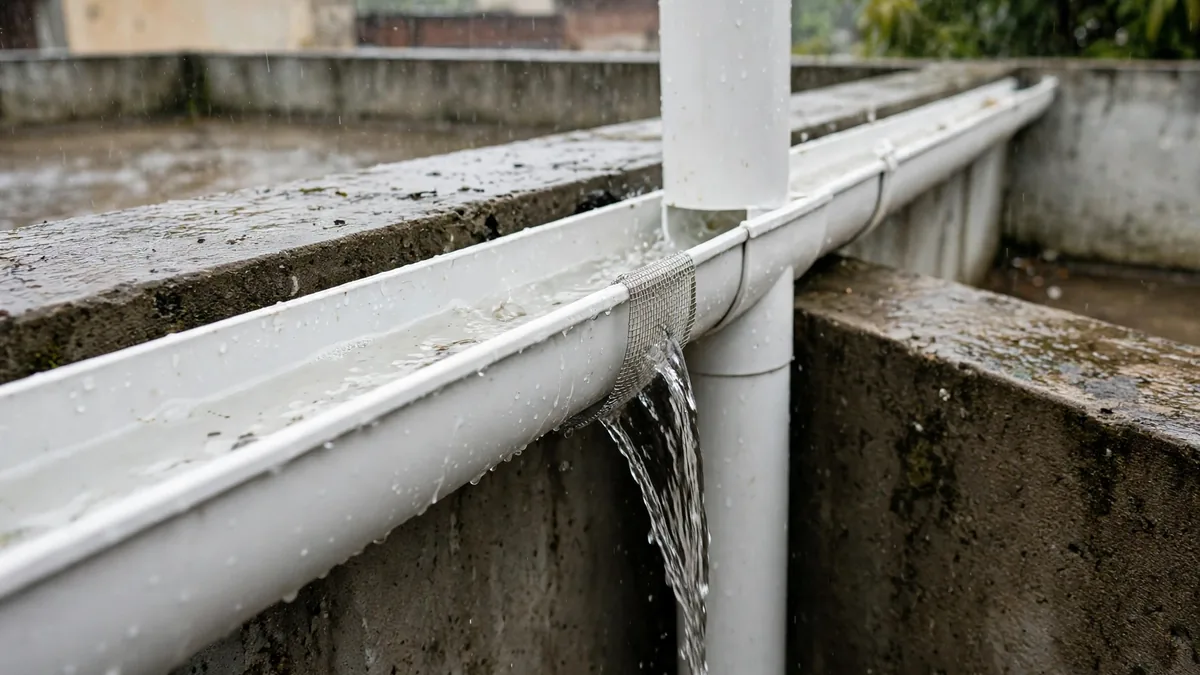
The first-flush diverter is the part most DIY systems miss: the first rain of a shower washes months of dust and bird droppings off the roof, so the diverter sends that first 1–2 mm to waste before letting water through to the filter. Without it, the filter clogs in weeks.
The filter stands between the roof and your tank or pit: a chamber of graded media — pebbles, coarse sand, activated charcoal — or a ready-made rooftop filter for roughly ₹1,500–₹5,000. The storage tank must be covered, with a mosquito screen on every opening and an overflow pipe to the recharge pit or a drain — an uncovered tank breeds mosquitoes and grows algae within weeks. A tank without an overflow floods the plinth in the first heavy shower. Our terrace waterproofing guide covers what standing water does to a roof slab.
What a recharge pit actually looks like
A recharge pit filters the water again and gives it somewhere to go. A typical household pit is 1–1.5 m in diameter and 2–3 m deep, lined with brick or concrete and covered with a slab that has a manhole for cleaning. Inside, the layers run coarse to fine — boulders, gravel, coarse sand — so the water slows and drops its remaining silt as it sinks.

Before the water reaches the pit it passes through a silt trap — a small chamber where suspended solids settle — and the first-flush diverter. A recharge shaft is the same idea taken deeper: a 30–45 cm bore drilled 3–8 m down and filled with gravel, for hard-rock soil where a shallow pit cannot absorb fast enough.
One rule is absolute: never pour raw, unfiltered runoff straight into a borewell casing. It carries silt and droppings into the aquifer, and a clogged borewell costs far more to fix than a filter chamber costs to build. Water must pass through the silt trap and filter first, entering through the annulus — the ring around the casing — not down the open pipe.
What rainwater harvesting costs in India
Costs move with the city, soil, water-table depth and roof size, so the figures below are illustrative ranges from guides seen in November 2026 — a starting point, not a quote. Get local quotes before you commit.
| Item | Illustrative cost | Notes |
|---|---|---|
| Basic recharge pit | ~₹15,000 | Pit + media, no storage |
| Borewell recharge pit | ₹18,000–₹45,000 | Inlet + silt trap + filter |
| Typical residential system | ₹20,000–₹80,000 | Filter + pit, most common range |
| Storage system, 10,000 litres | ₹25,000–₹50,000 | Tank + fittings; plastic tank ₹7–12/L |

Two things push the price up. The first is depth: in parts of Delhi, a recharge pit with a 120 ft bore costs ₹1.1–₹1.7 lakh including GST for a 100 sq m roof, because the bore is the biggest cost. The second is storage: every extra 1,000 litres of tank costs roughly ₹5,000–₹10,000 including fittings and labour. Against that, weigh what you already pay — a household buying tanker water through the dry months can recover a basic system in a few seasons. Read our house construction cost guide before budgeting, and our building plan approval guide if the system is part of a new build.
Is rainwater harvesting mandatory?
There is no single national law: water is a state subject, so each state sets its own rule — and most have now set one. The Model Building Bye-Laws 2016 ask for a harvesting proposal on plots of 100 sq m or more, and the National Building Code 2016 (Part 9) carries the same expectation.
The strictest rules are the ones homeowners meet. Tamil Nadu was the first state to make rooftop harvesting compulsory for every building under a 2003 ordinance — water and sewer connections are withheld from non-compliant new buildings. Delhi has required it since a 2001 order for new buildings with a roof over 100 sq m. In Bengaluru, BWSSB rules require it for new buildings on sites of 1,200 sq ft and above and existing buildings on 2,400 sq ft and above; non-compliance adds 25% to water and sanitary charges for three months and 50% after that. Check your city's municipal corporation or water board for the exact threshold on your plot.
Maintenance: the schedule that keeps it working
Most harvesting systems fail not because they were badly designed, but because nobody cleaned them: a filter full of silt passes no water, a gutter full of leaves overflows onto the wall, a pit full of silt recharges nothing. The maintenance is light, but it starts before the monsoon, not during it.

| When | What to do | Why it matters |
|---|---|---|
| Before every monsoon | Clean roof, gutters, downpipes; check first-flush diverter | A clean catchment is the whole system working |
| After every major downpour | Clear filter screens; check pipes for blockages | One clogged screen starves the tank |
| Every 3–6 months | Clean or replace filter cartridges and mesh | Silt builds up silently between monsoons |
| Once a year | Drain and clean the tank; desilt the recharge pit | A silted pit recharges nothing |
| Once a year | Change filter media (sand, gravel, charcoal) | Spent media filters nothing |
| Every inspection | Check tank covers and mosquito screens are intact | An open tank breeds mosquitoes |
The simplest test costs nothing: during the first heavy rain, water should flow into the tank or pit and the overflow should run clear. If the gutters overflow or the pit takes no water, something upstream is blocked — start at the mesh guard and work down. Our new house handover checklist has the same pre-monsoon checks for the rest of the house.
Do not drink harvested rainwater from the tank. Roof runoff carries dust, bird droppings and airborne pollutants, so it suits flushing, washing and gardening — not drinking or cooking. To drink it, the water needs sediment filtration, activated carbon and UV or chlorine disinfection, tested against IS 10500. A UV unit on the tank outlet is the usual addition — but test the water first, and again after the first monsoon.
Mistakes that kill a harvesting system
- No first-flush diverter: the dirtiest water of every shower enters the filter and tank, which clog and silt up in one season.
- No filter at all: leaves and silt reach the pit, and a silted pit recharges nothing.
- An uncovered tank: sunlight grows algae and open water breeds mosquitoes.
- No overflow route: the first heavy shower floods the plinth, because the tank had nowhere to send the extra water.
- A pit with no silt trap: the pit itself becomes the filter, and it fails within two monsoons.
- Raw runoff into a borewell: silt goes straight into the aquifer — the shortcut that can ruin the water source.
- Building it and forgetting it: a system with no maintenance calendar works for one monsoon and then quietly stops.
Rainwater harvesting pays in water, in money and in compliance at the same time — but only if the whole chain is built: catchment, first flush, filter, storage or recharge, and overflow. Size it on your roof and rainfall, build the filter properly, and clean it before every monsoon. If you are building a new home, talk to RTPL Constructions about including harvesting in the design from the start — and read our turnkey construction guide if you want the whole build handled end to end.