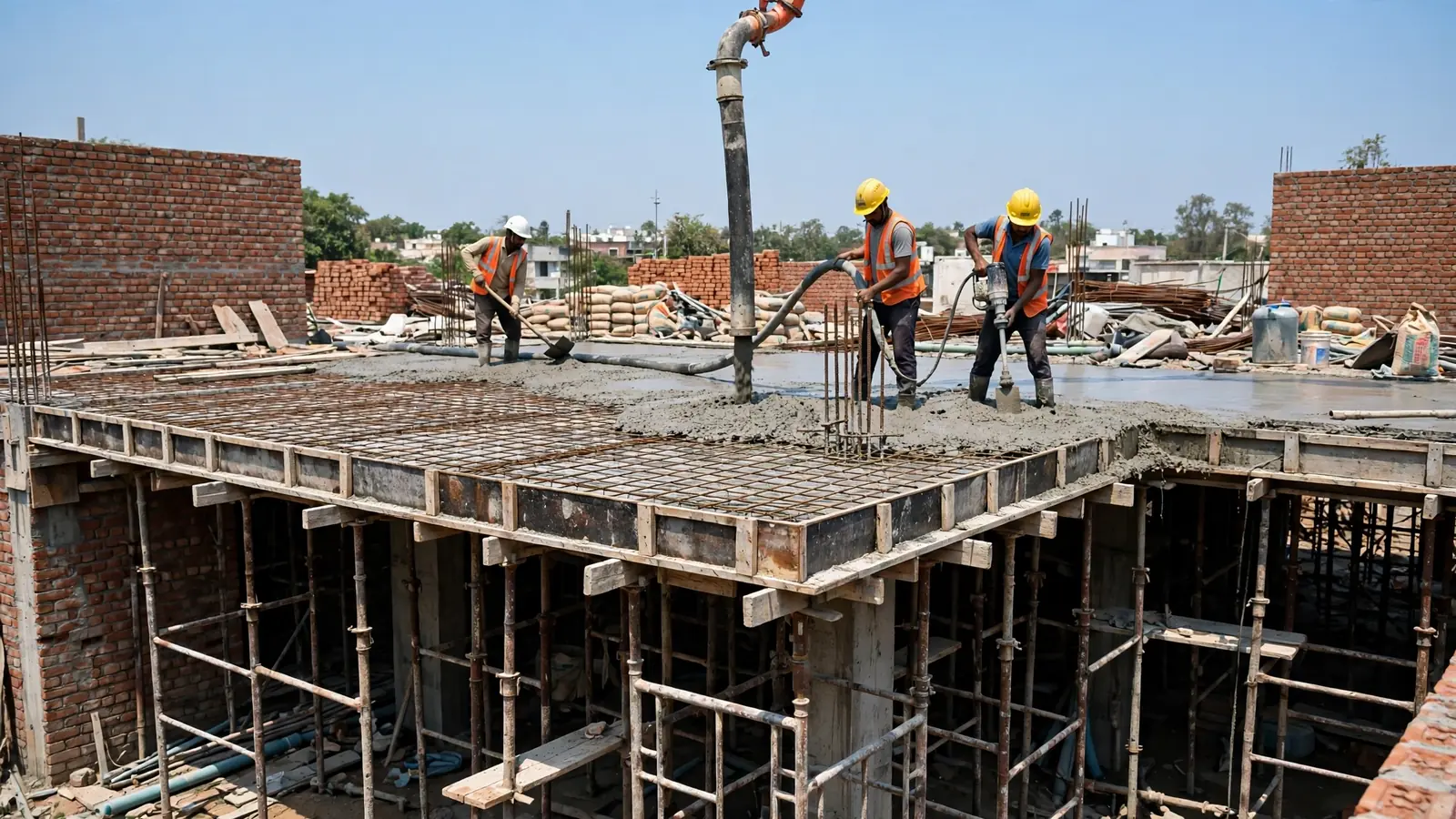
In May, the top floor of an Indian home can feel like a different city from the ground floor. The ceiling radiates heat long after sunset, the fan pushes warm air around, and the air conditioner runs for hours. The cause is usually above your head: a bare concrete roof that has spent the whole day absorbing the sun.
A concrete terrace commonly reaches 55 to 65°C in peak summer, and the slab releases that heat slowly into the room below, which is why the top floor stays hot at 10 pm. A cool roof breaks this cycle at the source: it reflects more sunlight and releases absorbed heat faster, so the slab never gets as hot. This guide compares the cool roof options for Indian homes that actually work, with honest costs, realistic temperature drops, and the checks to run before you spend anything.
1. Why the top floor suffers most
Heat enters a house through the walls, the windows, and the roof, but the roof takes the worst of it: it faces the sun all day at close to a right angle, while walls get direct sun for only part of the day. A 100 mm concrete slab stores a full afternoon of heat and releases it through the evening, which is why top-floor bedrooms feel hottest at night.
2. How a cool roof works: reflectance, emittance, and SRI
A cool roof does two things. First, it reflects sunlight instead of absorbing it: a white surface reflects most of the sun's energy, while dark grey concrete absorbs most of it. Second, it releases whatever heat it does absorb back to the sky quickly. The two are combined into one number, the Solar Reflectance Index (SRI), which runs from 0 for a black surface to 100 for a white one.
When you compare products, SRI is the number to ask for, not marketing words like "heat proof" or "cool coat". A published SRI tested to ASTM E-1980 is verifiable; a product with no test data has only a label. India's Energy Conservation Building Code (ECBC) 2017 says a cool roof on a low-slope roof, under 20 degrees, should have an initial solar reflectance of at least 0.60 and an initial emittance of at least 0.90. The LEED benchmark is stricter: an SRI above 78 for low-slope roofs and above 29 for steep-slope roofs. ECBC covers commercial buildings, not homes, so treat these as benchmarks, and remember SRI describes the surface, not your room.
Fix waterproofing before you fix heat: a cool coating is not a waterproofing layer. If the terrace leaks, repair it first, then coat over a dry, sound surface, otherwise you will trap moisture under a white coat and peel both jobs off together.
3. Option 1: Heat-reflective paint and coatings
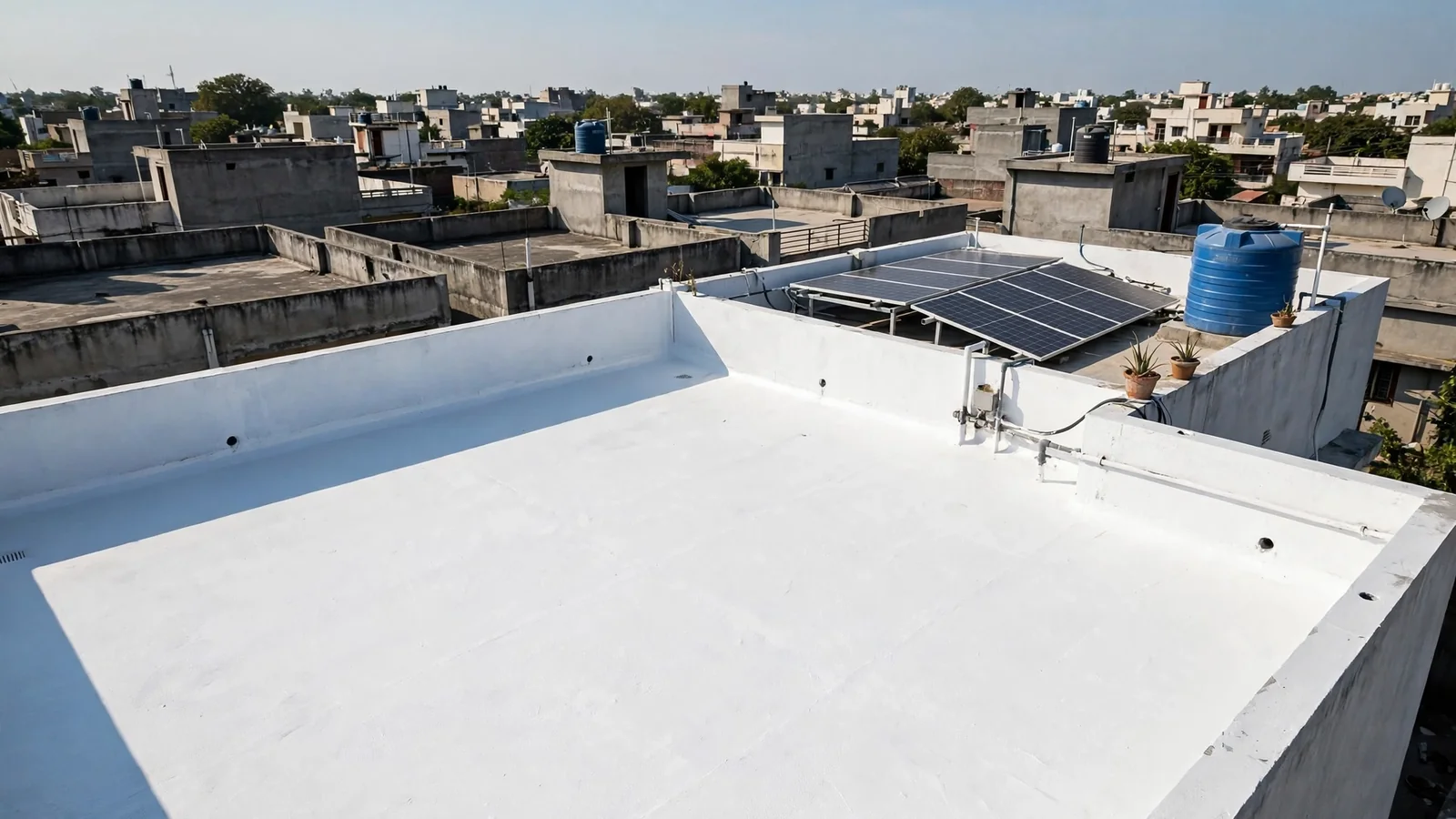
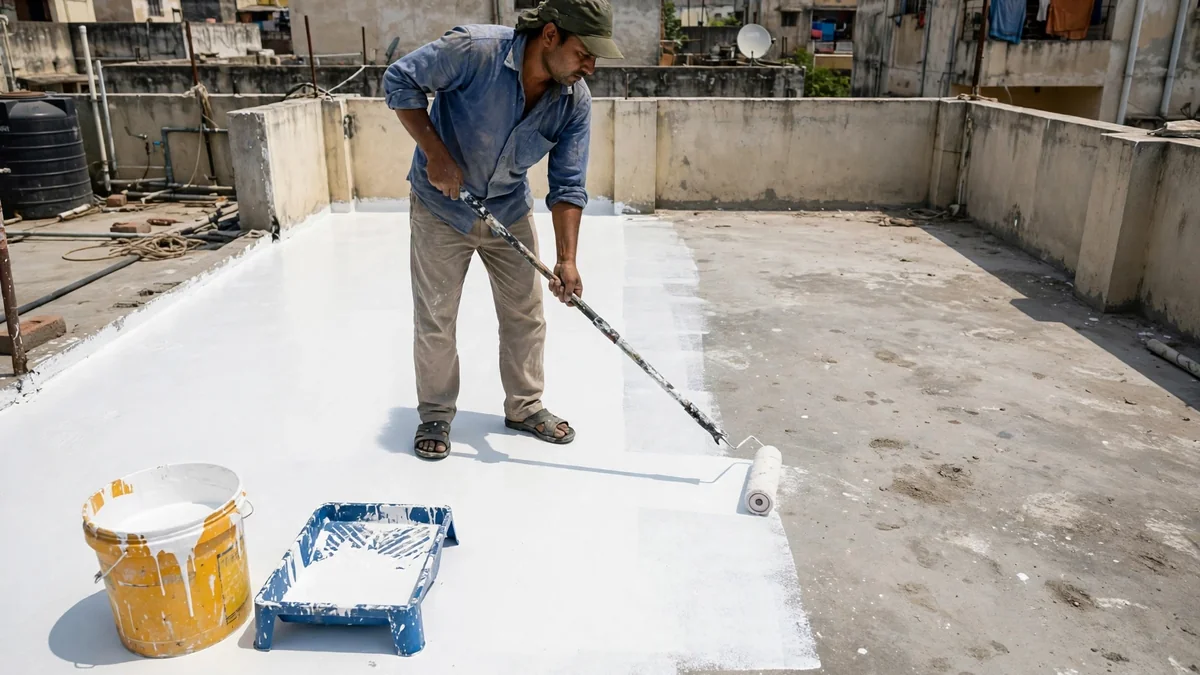
This is the most common cool roof option in India, and the easiest to start with: a white, high-SRI paint made with reflective pigments, usually acrylic or elastomeric, applied in two coats. It works on concrete slabs, metal sheets, and asbestos or cement sheets, which makes it the default choice for an existing house.
Clean the surface, fill cracks, and let the first coat dry before the second goes on. Thinning the paint to stretch coverage is the most common way homeowners waste money: a thin coat does not reach the advertised reflectance. Apply in the cooler months or in the morning, not on a 45°C slab at noon.
Reported results: roof surfaces 10 to 20°C lower than bare concrete, and indoor rooms 2 to 6°C cooler, though the actual drop depends on the slab and the ventilation. Basic acrylic cool paints run about ₹20 to ₹40 per sq ft for material, premium elastomeric or ceramic coatings about ₹50 to ₹100 per sq ft, and professional application takes the total to roughly ₹46 to ₹65 per sq ft. A 20-litre pack costs about ₹1,500 to ₹3,500 and covers roughly 1,800 to 2,200 sq ft in two coats. All figures are illustrative, from web listings checked on 10 November 2026. Re-coat every 3 to 5 years, and wash before each summer, since dust kills reflectance.
4. Option 2: Cool roof tiles, china mosaic, and heat-insulation tiles
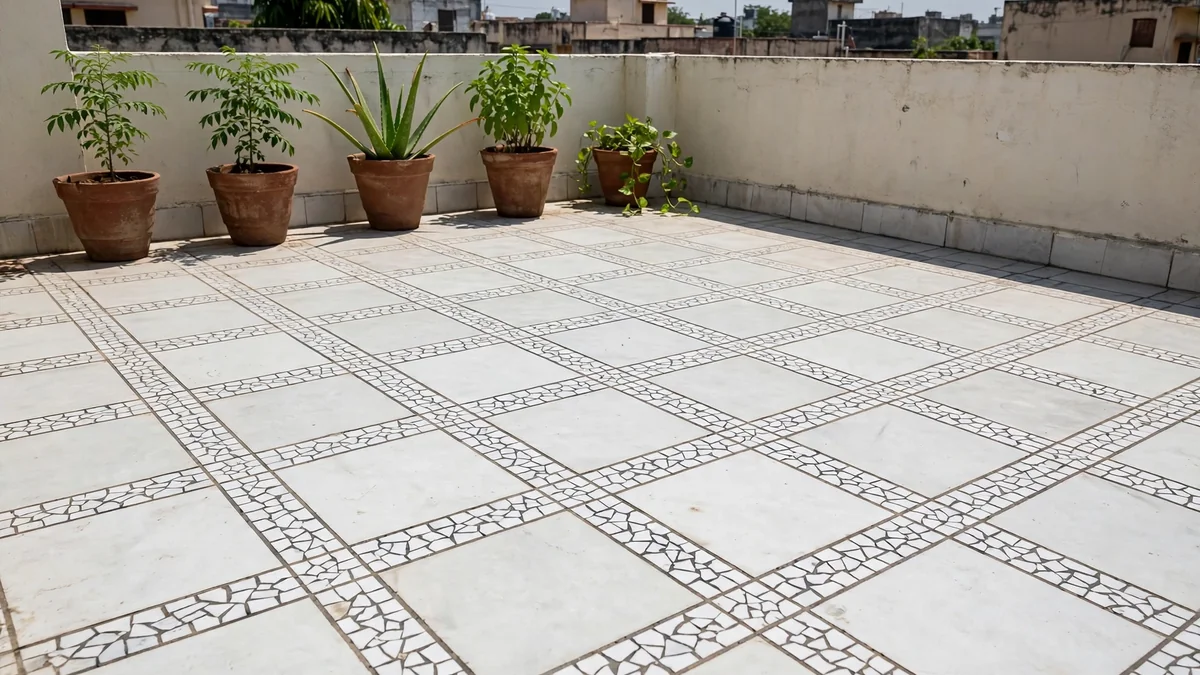
If you want a cool roof that also gives you a usable terrace, tiles are the better answer. Light-coloured vitrified or ceramic tiles, broken white china mosaic set in cement, and purpose-made heat-insulation tiles all do the same job: a pale, hard surface that reflects sun and adds a layer between the sun and the slab. Air moving through the joints between tiles also carries heat away instead of letting it soak into the concrete.
Broken china mosaic is the old, proven Indian version: waste ceramic pieces set in a cement mortar bed, grouted with white cement. It is cheap, lasts for decades, and stays walkable and washable. Its weakness is workmanship: poorly laid mosaic with hollow spots or cracked grout lets water in, so the waterproofing underneath and the quality of the laying matter more than the tile itself. Heat-insulation tiles are the factory-made version: hollow tiles designed to insulate, laid on a mortar bed with proper slope to the drains.
Two practical points decide whether tiles suit your roof. First, height: tiles plus mortar add a layer, so check drains and thresholds still work. Second, cost: tile prices vary so widely that no single per-square-foot figure is honest, so take two or three local quotes including mortar bed, grout, and skirting. Tiles last ten years or more and survive foot traffic and the monsoon far better than a coating.
5. Option 3: Mud phuska and lime wash, the traditional cool roofs
Mud phuska is a layer of mud mixed with straw or bhusa, laid over the terrace and finished with a lime plaster coat. The thick earth layer insulates, and the pale lime finish reflects the sun. It is the lowest-cost option of all.
The trade-offs are real. Mud phuska adds weight to the slab, so a structural engineer should confirm the slab can carry it, especially on an older house. It needs re-application every year or two, and a cracked layer can hold water against the slab. Lime wash is simpler still: slaked lime and binder, brushed on in coats. A widely shared demonstration in May 2026 showed a lime-binder coat dropping a roof surface by about 15°C and indoor rooms by 4 to 6°C, for roughly ₹850 of material on a 1,000 to 1,200 sq ft roof. That is one demonstration, not a laboratory test, and whether the coat survives a full monsoon is still open. Treat lime wash as a cheap seasonal experiment, not a permanent system.
6. Option 4: Green roofs and terrace gardens
A green roof cools by evaporation as well as shade: plants and wet soil absorb sunlight, and water evaporating from the leaves carries heat away from the slab. A terrace garden with potted plants gives you part of this benefit with far less risk: pots along the parapet and shade over the seating area.
A full planted green roof is a different job: waterproofing membrane, root barrier, drainage layer, filter fabric, growing medium, and plants, all detailed at every drain and parapet. The weight is significant, so a structural engineer must confirm the slab capacity first. For most homes, pots and planters on a cool-coated or tiled terrace are the sensible middle path.
7. Option 5: Shade the slab with solar panels
Anything that keeps direct sun off the slab cools the room below, and rooftop solar panels do this while generating electricity. The panels shade a large part of the terrace, which is why the combination is popular even though cooling alone would not pay for them. Check the current rooftop solar subsidy on the MNRE portal before budgeting, and allow cleaning access and wind-load structure.
If you are building new, two construction-stage options are worth knowing. A filler slab replaces part of the slab concrete with hollow terracotta pots or tiles, cutting weight and creating air pockets that slow heat flow. Both it and inverted earthen pots are far cheaper at construction stage than as retrofits.
8. Costs compared: what each option really takes
The table below uses illustrative ranges from web listings checked on 10 November 2026; use them to compare options, not to fix a budget.
| Option | Illustrative cost | Reported indoor drop | Life and upkeep |
|---|---|---|---|
| Reflective paint, basic acrylic | ₹20–₹40 per sq ft, material only | 2–6°C | Re-coat every 3–5 years; wash before summer |
| Reflective coating, premium | ₹50–₹100 per sq ft, material only | 2–6°C | Longer life than basic; still needs washing |
| Cool tiles / china mosaic | Get 2–3 local quotes; varies widely | 2–5°C | 10+ years; re-grout when joints crack |
| Mud phuska / lime wash | Lowest material cost; mostly labour | 4–6°C in one reported demo | Re-apply every 1–2 years; check slab load |
| Green roof / terrace garden | Highest cost; specialist quote needed | Varies with planting and watering | Needs watering, drainage, engineer check |
| Solar panels as shade | Pays back through power, not cooling alone | Shaded area stays cooler | 25-year panel life; clean regularly |
For a 1,000 sq ft terrace, a basic reflective coating is roughly a ₹20,000 to ₹40,000 material job, and one 20-litre pack covers about 1,800 to 2,200 sq ft in two coats.
9. Before you coat: the checks that decide whether it works
Most cool roof failures are preparation failures, and every one of them is preventable with an hour of checking. First, waterproofing: if the terrace leaks, fix it before the cool roof goes on. A coating over a leaking slab peels, and tiles over a leaking slab hide the leak until the damage is worse. Our terrace waterproofing guide covers the repair sequence.
Second, surface and slope. The roof must be clean, dry, and sound, with cracks filled. Check that water still drains to the outlets after the new layer goes on. Third, timing: work in the cooler months, between October and February. Coatings need dry weather to cure, and one applied just before the monsoon may not bond. On a terrace used daily for drying or play, choose tiles: foot traffic wears a coating fast. Finally, colour discipline: white is the point. A grey or cream coating reflects noticeably less than true white. Wash yearly before summer, and re-coat on schedule.
10. Which option suits your home?
Pick paint if you want the fastest, cheapest result
- Best fit: Rented homes, tight budgets, a roof you need cooler this summer
- Trade-off: Re-coat every 3–5 years; looks dirty without washing
- Site check: Waterproofing sound, surface clean, two full coats
Pick tiles if the terrace is a living space
- Best fit: Family terraces, heavy foot traffic, long-term homes
- Trade-off: Higher upfront cost; check drains after the added layer
- Site check: Waterproofing below, proper slope, sound grout
If budget is the only question, start with paint this winter and plan tiles when the next big terrace job comes up. If the terrace is where the family sits every evening, tiles plus potted plants give the best daily result. For terrace work, also read our false ceiling cost guide and our house construction cost guide.
Homeowner checklist before you start
- Confirm waterproofing is sound; repair leaks first.
- Measure the terrace area and note drains and thresholds.
- Ask for the product SRI, tested to ASTM E-1980.
- Get two or three written quotes with material, labour, and coats.
- For mud phuska, green roofs, or earthen pots, get a structural engineer to confirm the slab can carry the added weight.
- Schedule dry weather, keep the roof traffic-free while it cures, wash before every summer.
Final member sizing, reinforcement, and retrofit decisions require project-specific assessment by a qualified structural engineer. RTPL Constructions & Engineering can help you plan terrace and roofing work for your home.