Every house in India is built with one of two concretes: one mixed in a plant and delivered by truck, or one mixed on your plot with a drum mixer and a measuring box. The slab does not care which you chose — only whether the mix hit its grade. That is decided long before the pour starts.
1. The short answer
For a house slab or any pour above roughly 30 cubic metres, ready mix concrete (RMC) usually wins — not because it is stronger, but because a plant controls the mix. Site mixing still wins for small pours, plots a transit mixer cannot reach, and remote sites. The price gap is smaller than most homeowners think: RMC typically costs ₹500–800 more per cubic metre than site-mix material alone, and that gap often disappears once labour, wastage and rework are counted. Whichever you choose, cube-test every slab pour.
2. What each one actually is
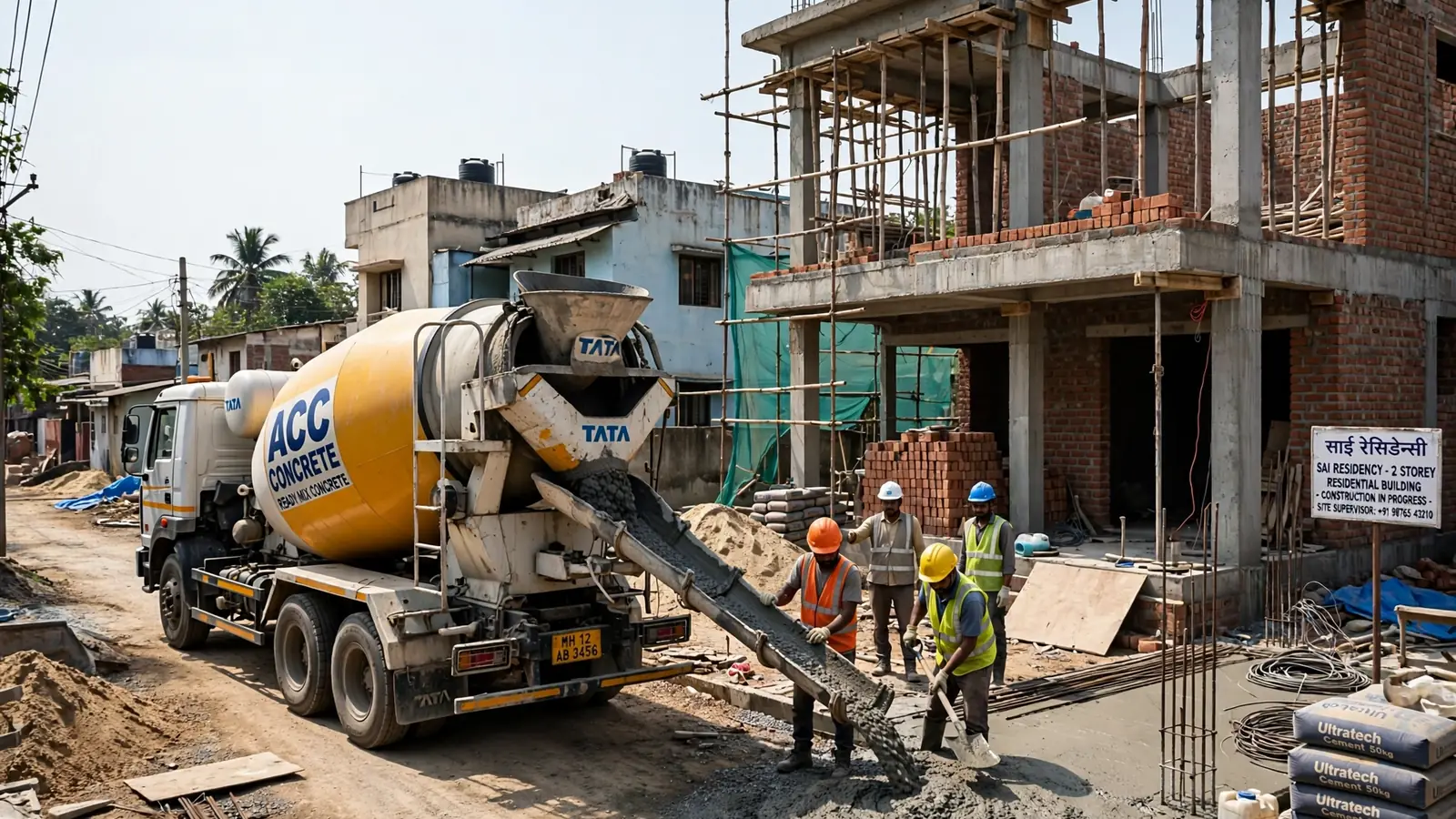
Ready mix concrete is manufactured in a batching plant to a pre-set mix design. Cement, aggregates, water and admixtures are weighed precisely by computer and delivered in transit mixers that typically carry 6–9 cubic metres. RMC in India is governed by IS 4926:2003 (revised 2024); mix design follows IS 10262, structural design IS 456:2000.

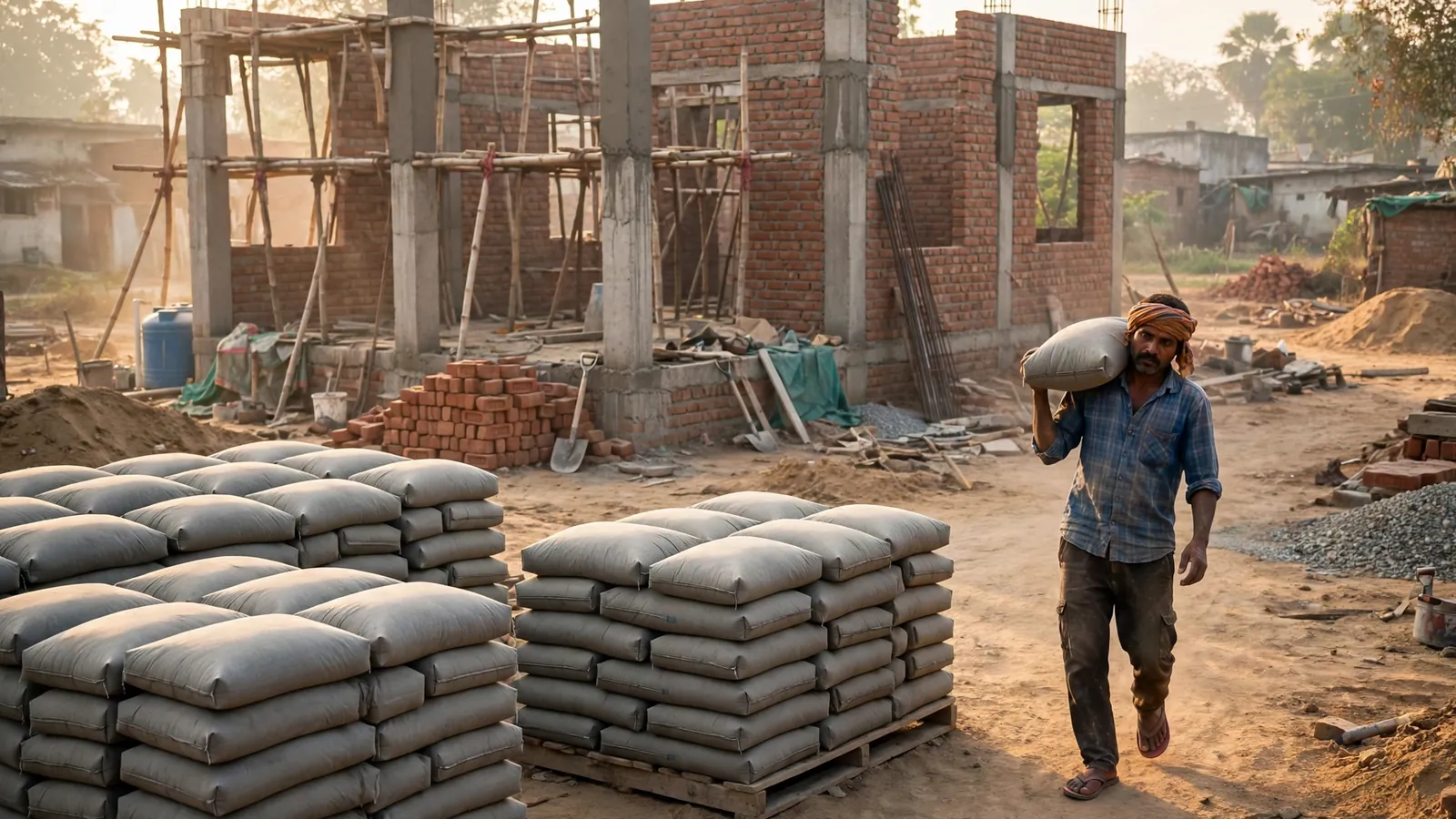
Site-mixed concrete is prepared directly at your plot from cement bags, sand, aggregate and water, mixed manually or in a small drum mixer. The mix is proportioned volumetrically — cement by the bag, aggregate by the measuring box — with no formal mix design behind it. The standard grade is M20, roughly 1 part cement to 1.5 sand to 3 aggregate (1:1.5:3) by volume. That ratio is simple to write down and surprisingly hard to hold steady across a whole day of mixing.
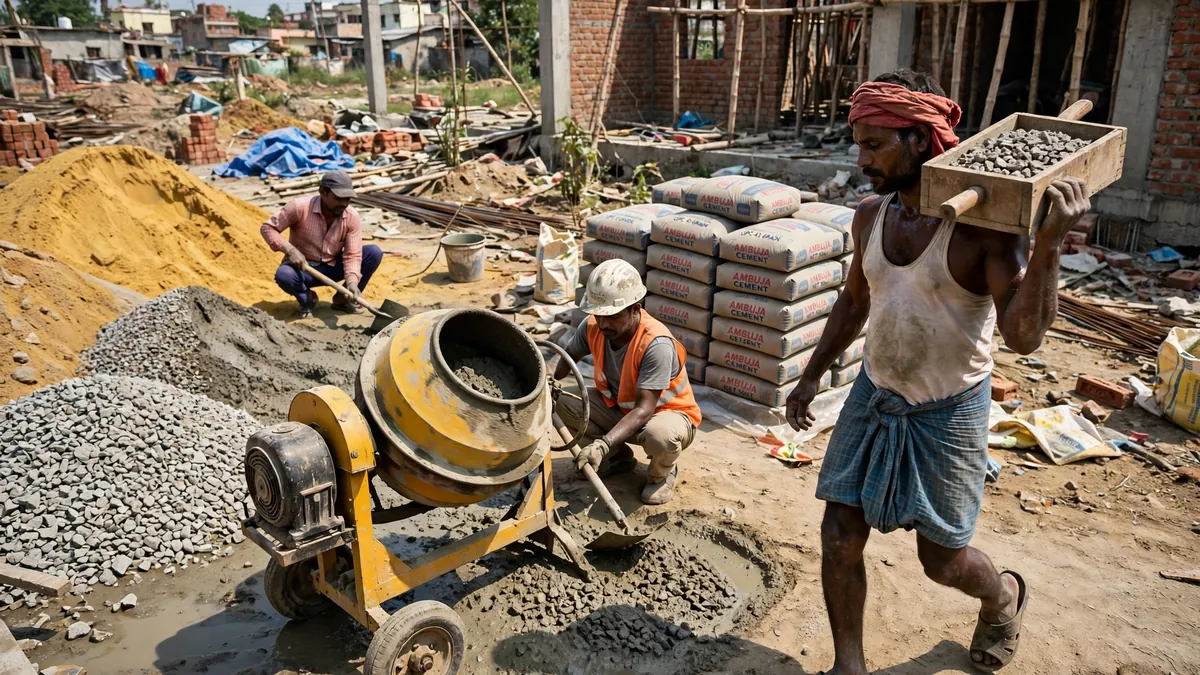
Both use the same ingredients, and on paper both can reach the same strength. The difference is who controls the proportions, the water and the testing — and how consistently, batch after batch.
3. The quality difference: who controls the mix
RMC's advantage is control, not chemistry. A plant weighs every ingredient by mass, corrects water for moisture already in the aggregates, and cube-tests continuously. Every batch has a high probability of hitting its grade because the process removes the two variables that ruin site concrete: too much water and wrong proportions. As one cement manufacturer's guide puts it, on paper both can reach the same strength — on site they rarely do.
Site mixing fails in small, ordinary ways. A labourer adds an extra mug of water because the mix looks stiff. The measuring box is heaped instead of level. The sand is damp after rain and nobody reduces the added water. None of these shows on the surface — but each one moves the water-cement ratio, which decides the strength of the hardened concrete. A mix that is too wet finishes smoothly, then never reaches its grade.
The honest framing is reliability, not superiority. Site mix can be perfectly good when supervised properly — measured boxes, fixed water, cube tests — but it needs supervision every single batch, and that is what slips on a busy site. If your contractor cannot answer "how do you control the water?", the plant is the safer choice.
4. What it costs: the per-cubic-metre gap is not the whole bill
Every figure below is an illustrative range from web listings checked on 20 November 2026, for the cities and grades named. Rates vary by city, distance, grade and date — confirm the current rate with your supplier; see our house construction cost guide for how concrete fits into the full budget.
In Bhopal, one source lists site mix at ₹3,800–4,500 per cubic metre, RMC at ₹4,500–5,500. Another worked example, for an M20 pour of 50 cubic metres, puts RMC at ₹3,800–4,500 per cubic metre all-inclusive — against site-mix materials alone at ₹4,795–5,175 per cubic metre, before any labour. Its material maths: 8–9 bags of cement, about 0.45 m³ of sand and about 0.9 m³ of 20 mm aggregate per m³. A 2026 manufacturer guide lists M20 at ₹4,500–5,500, M25 at ₹5,200–6,200 and M30 at ₹5,800–6,800, pumping adding ₹800–1,200 per cubic metre — a typical 100 cubic metre slab at roughly ₹5.5–7 lakh. A second 2026 guide lists M25 at ₹4,800–5,200 and M30 at ₹5,200–5,800.
| Item | Ready mix concrete | Site-mixed concrete | What to check |
|---|---|---|---|
| M20 per m³ | ₹3,800–5,500 | ₹3,800–4,500 + labour | Includes labour? |
| M25 per m³ | ₹4,800–6,200 | Materials + labour | Must match the drawing |
| Pumping | ₹800–1,200 per m³ extra | Labour to carry and place | Pump vs head-load |
| Material wastage | Negligible, under 1% | 10–15% | Spillage, leftover batches |
| Quality control | Plant lab, batch records | Your supervision, batch by batch | Cube tests either way |
Three costs hide inside the site-mix price. Labour: mixing, carrying and placing by hand is slow. Wastage: site mix typically wastes 10–15% of materials through spillage and batches that set before they are placed, against under 1% for RMC. Rework: a batch that fails its cube test, or a slab that honeycombs, costs far more to fix than the saving on the day. The sources agree: above roughly 30 cubic metres in a city, RMC is usually more economical on total cost. Below that size, the maths flips — see Section 6.
Two costs to ask about before ordering RMC: minimum order quantity and pumping. Most plants have a minimum order, often a full transit mixer load, so a 2 cubic metre pour can cost nearly as much as a 6 cubic metre one. Pumping to an upper floor adds ₹800–1,200 per cubic metre — still usually cheaper than head-load, and much faster.
5. How to check quality when the truck arrives — or the mixer starts
Quality control is three checks you can watch on your own site, and they apply to both methods.
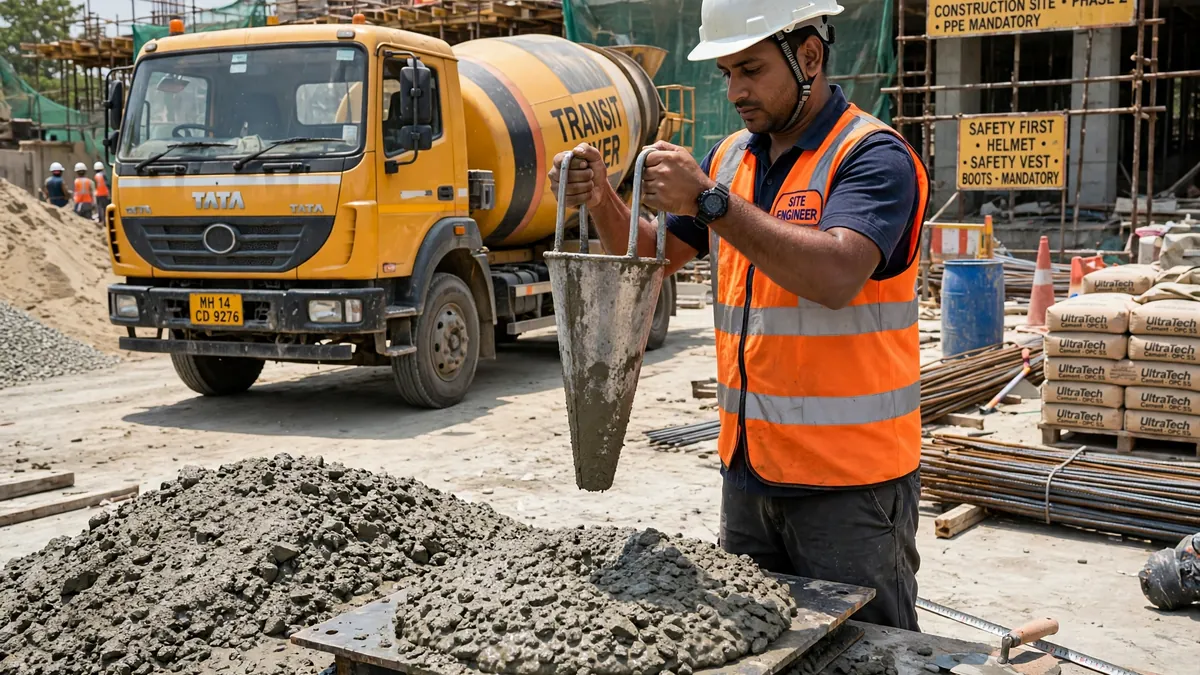
The slump test. When an RMC truck arrives, a slump test is mandatory before placing. A cone of fresh concrete is filled and lifted, and the concrete slumps by a measured amount — for M20 RCC, typically 75–100 mm. Too little slump and the mix will not flow around the reinforcement; too much and somebody has added water, which weakens the concrete. A slump outside the agreed range is grounds to reject the load — be present for the test rather than hearing about it afterwards.
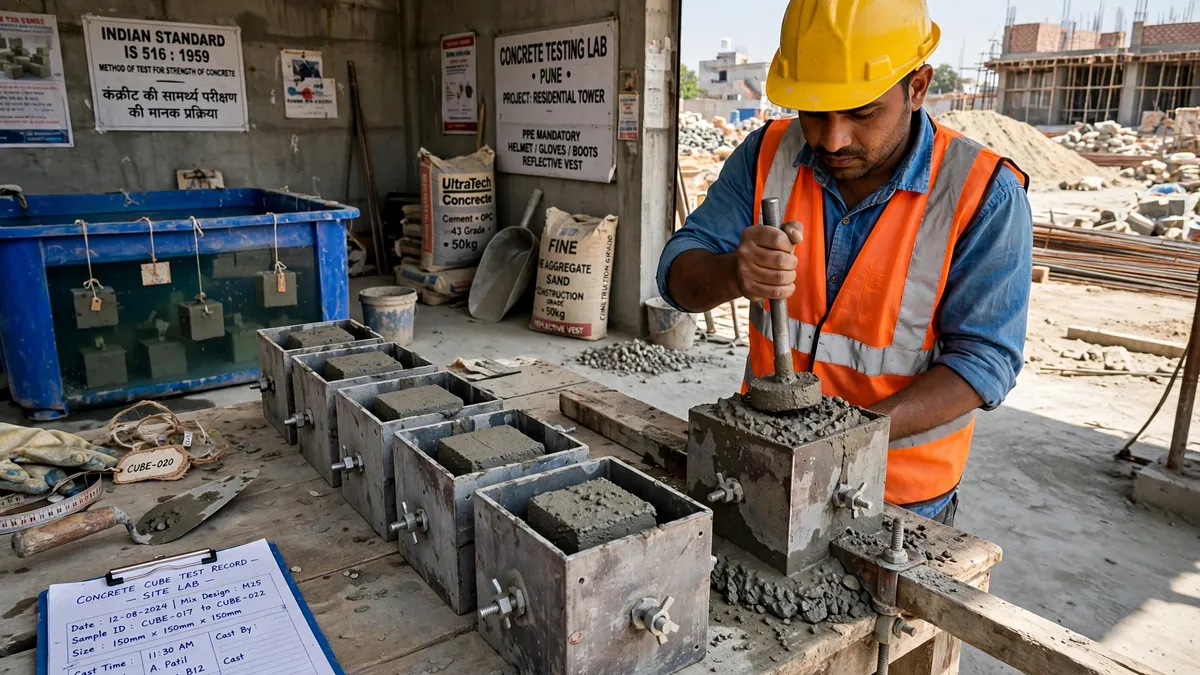
The cube test. Cube samples — 150 × 150 × 150 mm moulds filled from the concrete being placed — are the only objective proof of grade. Cast them from the batch that goes into the slab — RMC or site mix — and test at 7 and 28 days. The 7-day result is an early indicator; the 28-day result confirms design strength. File the results and check them before the next floor's work proceeds. The plant's report does not replace a cube cast on your site.
Transit time. RMC must be placed within 90 minutes of batching (IS 4926) — the clock starts at the plant, not your gate. A plant 30 km or more away needs a retarder admixture, or the concrete arrives stiff. Rejections run 1–3% of trucks, rising to 8–10% in summer heat and monsoon, usually for slump loss, segregation or exceeded transit time. If a load is rejected, do not let anyone "fix" it with extra water on site — that is how a good mix becomes a weak slab.
For site mix, the checks are simpler but just as strict: the same slump test and cube samples, plus two things only you can enforce — a fixed measured quantity of water per batch, and the same measuring box, filled level, every time. If the operator is eyeballing water from a hose, you have no mix design at all.
6. When site mixing still wins
Site mix is the right answer in three situations. First, a small pour: a few cubic metres for a lintel, a small footing, a repair or a single column. Ordering a full mixer for 2 cubic metres wastes most of the load. Second, access: a transit mixer is large and heavy, and many Indian residential lanes are narrow, with tight turns, low wires and soft shoulders. If the truck cannot reach your plot or turn around to leave, RMC is not an option — check this with a site visit by the plant's supervisor before you order, not on the morning of the pour.

Third, a remote site with no batching plant nearby. Beyond the 90-minute transit limit, RMC cannot be delivered in usable condition, and a retarder only buys so much time. Then site mix with strict supervision is the honest answer: a fixed mix ratio, measured water, the same aggregate source all day, and cube tests on every pour.
7. When RMC wins: slabs, columns and tight schedules
RMC is the default for a roof slab. A slab is a single large pour — often 40–100 cubic metres for a house — where grade consistency matters across the whole area, and slow batch-by-batch site mixing risks cold joints between batches that set at different times. Our RCC slab casting checklist covers the shuttering, reinforcement and pouring sequence. Columns are the same story: congested reinforcement, a vertical pour, and honeycombing if the mix is stiff or poorly compacted.
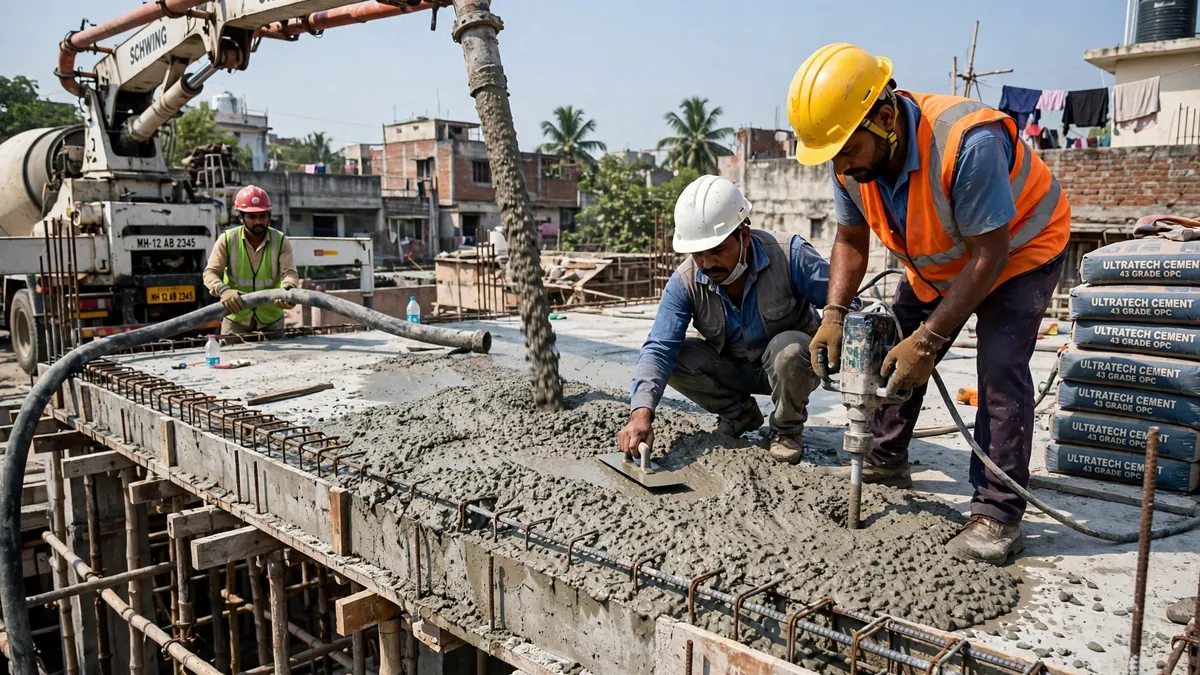
RMC also wins on schedule. A transit mixer empties in well under an hour with a pump; the same volume by site mixer and head-load can take a full day of shuttering under load, labour and weather risk. It is also the right choice where the drawing specifies a grade above M20, or where the engineer wants an admixture a site mixer cannot dose accurately — a waterproofing admixture for a basement, for example. If your plot is in a city with a plant within 30 minutes, and the pour is a slab or columns, the default answer should be RMC unless there is a specific reason not to use it.
8. Five mistakes homeowners make with concrete
First, choosing on per-cubic-metre price alone and ignoring labour, wastage and rework — the site-mix number that looks cheaper usually is not. Second, ordering RMC without checking access: the truck cannot enter the lane, and the pour is delayed while concrete sets in the drum. Third, letting anyone add water to a delivered load. A stiff mix is the plant's problem, not a hose's — extra water is the easiest way to destroy a grade. Fourth, skipping cube tests because "the plant tested it" or "we have always mixed it this way". Without a 7-day and 28-day result from your own pour, you have no proof. Fifth, forgetting the pour is only half the job: concrete that is not cured properly never reaches its grade. Our curing guide for Indian summers explains why 7–14 days of continuous moisture matters.
9. Your decision checklist
Before the pour, answer five questions in writing. How many cubic metres — above 30, and RMC is usually the better total cost? Can a transit mixer reach the plot, turn and leave — and has the plant's supervisor confirmed it? What grade does the drawing specify, and does the order match it? Who will do the slump test and cast the cube samples, and where will the results be filed? And what is the curing plan for the 7–14 days after the pour? If you can answer all five, the choice is usually obvious. Our M sand vs river sand guide covers the fine aggregate in either mix; our turnkey construction timeline shows where each pour sits in the build.
Final grade and mix design need project-specific assessment by a qualified structural engineer. Prices are illustrative ranges from web listings checked on 20 November 2026 — confirm current rates with your supplier.