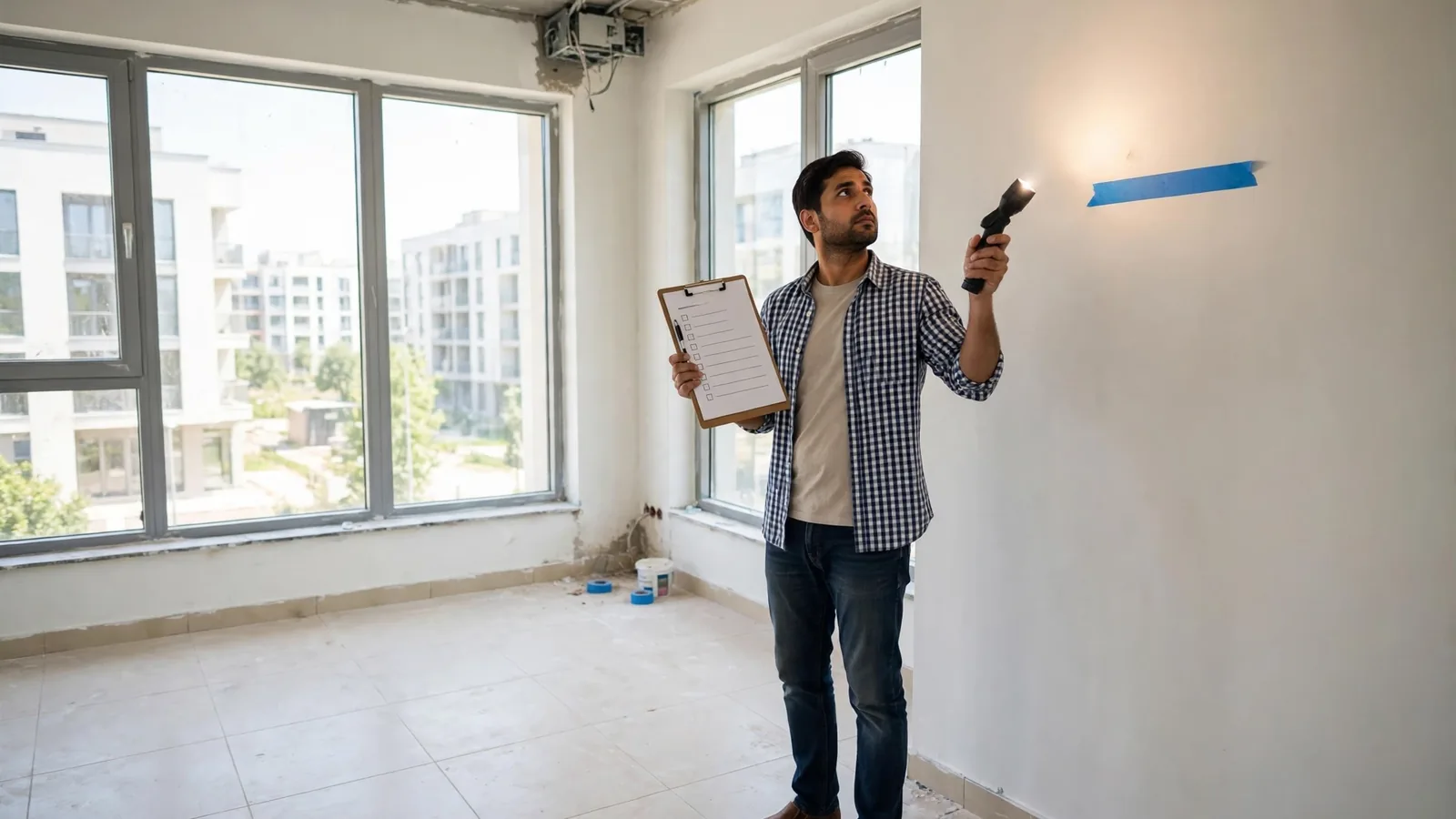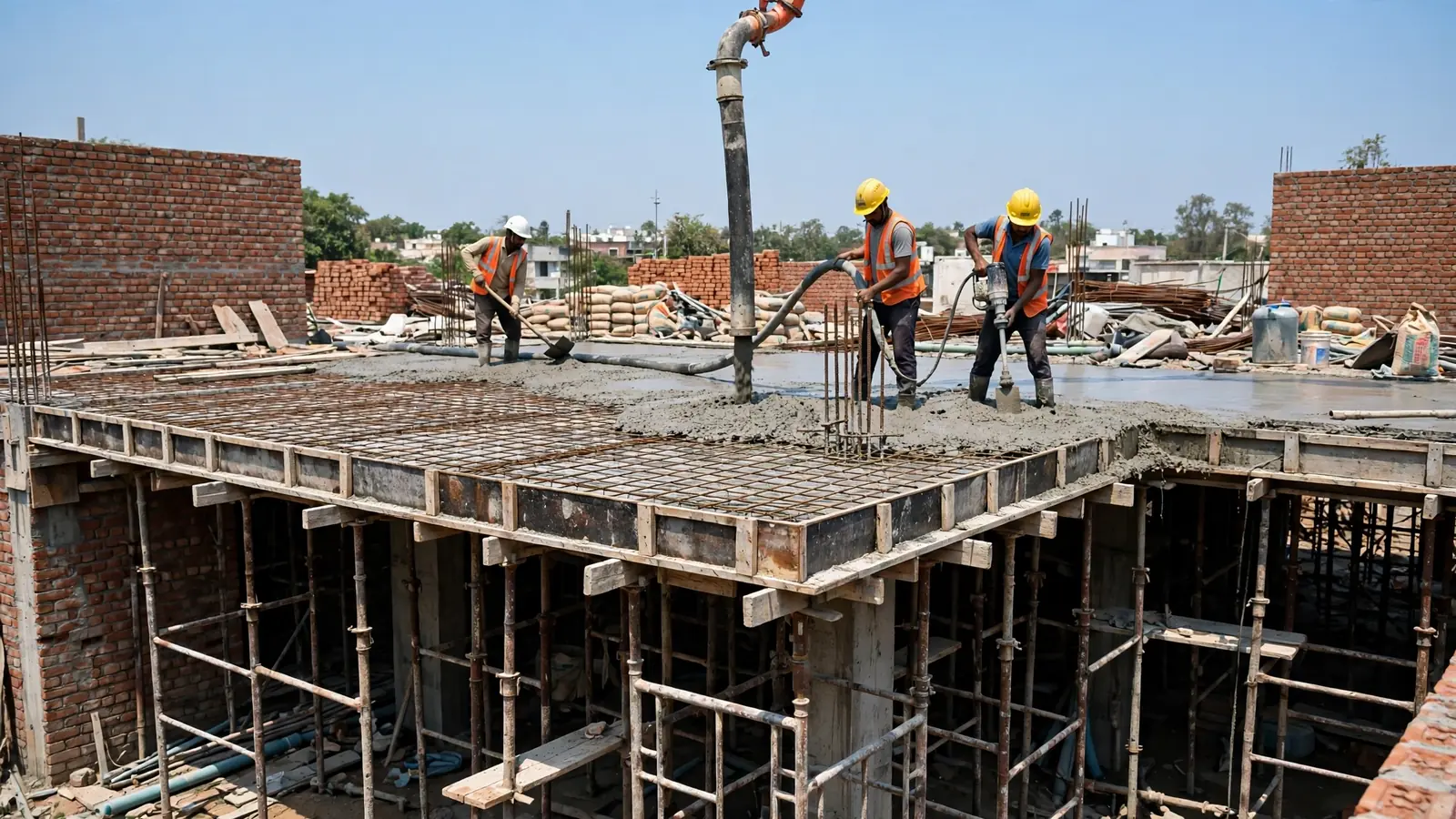
In a May afternoon in Delhi, Lucknow or Jaipur, a freshly cast slab can lose its surface water within an hour of finishing. The concrete underneath may still be sound, but the top layer — the part that keeps rain out and protects the steel — dries before it has finished hardening. That is the problem of concrete curing in Indian summers: the season does not forgive a missed day.
Curing is the least glamorous job on a house site, and the easiest to skip. It needs no material the contractor has to buy and no skill beyond discipline — water, coverings, and someone who keeps coming back for two weeks. Yet it decides whether a slab reaches its design strength and whether the roof leaks in the first monsoon.
Why Indian summer is the hardest season for fresh concrete
Concrete hardens by hydration — cement reacting chemically with water over days and weeks. In a north Indian summer, three things work against it at once: air temperatures above 40°C, dry winds, and direct sun on an exposed slab. Evaporation from a fresh surface can pass 1.0 kg/m² per hour, the danger band (ACI 305R) — at that rate the surface dries faster than bleed water can replace it.
The result is plastic shrinkage: the surface contracts while the concrete below is still soft, and fine cracks open across the slab within hours of the pour. They are shallow, but they are not cosmetic — they are open paths for rainwater, and in a roof slab they are the start of the leakage that shows up in the first monsoon. The same drying stops hydration in the top 25–50 mm, which never reaches its design strength and stays weak, porous and dusty for the life of the structure. Summer also changes the pour: concrete placed hot sets faster and loses slump. IS 7861 Part 1, the Indian standard for hot-weather concreting, puts the maximum concrete temperature at placement at 38°C — above that, cool the aggregates, use chilled water, or pour early in the morning.
What curing actually does — and what stops it
Curing is simply keeping concrete moist so hydration can continue. Cement needs a water–cement ratio of about 0.40 to hydrate fully, and most house mixes are made at or above that ratio — the water is already inside the concrete at the pour. Curing stops it escaping before the reaction has used it.
In the first hours, covering the surface — wet hessian, a polythene sheet, or a curing compound — slows the loss to sun and wind. Over the following days, ponding or continuously wet coverings keep feeding water in. Stop the supply on day three, and hydration in the surface layer stops on day three; it does not resume when you water it again on day five. That is why "sprinkle twice a day" is not curing in summer — in April or May heat, a sprinkled surface is dry within an hour.
The curing durations in this article are the minimums in IS 456:2000, Clause 13.5. The project specification or the structural engineer may require longer curing, and the longer requirement governs. Final member sizing, reinforcement and de-shuttering decisions need project-specific assessment by a qualified structural engineer.
How long should you cure? The IS 456 answer
IS 456:2000, Clause 13.5, sets minimum moist-curing periods — floors, not targets. The code expects curing to continue until the concrete has attained about 70% of its specified strength.
| Cement / condition | Minimum curing | Summer practice |
|---|---|---|
| OPC, normal conditions | 7 days | 10 days in hot, dry weather |
| PPC / PSC / mineral admixtures | 10 days | 14 days in hot, dry weather |
| OPC in hot, dry weather | 10 days | 10–14 days for exposed slabs |
| Blended cement, severe exposure | 14 days | 14 days minimum |
| Roof / terrace slab (any cement) | 10–14 days | 14 days, up to 21 in peak heat |
The cement type matters because PPC and other blended cements hydrate more slowly than OPC. PPC is now the most common cement in Indian residential construction, and it needs its full 10 days as a minimum — stopping at 7 days can leave 28-day strength measurably below design values. In summer, treat 14 days as normal practice for a PPC roof slab. Do not confuse 28 days with a curing period: that is the age at which concrete strength is specified and tested.
When to start curing — the first 30 minutes matter
Curing does not begin the next morning. In summer it should begin within about 30 minutes of finishing, as soon as the surface can take it without damage — the gap between finishing and the first water is when plastic shrinkage cracks form, and no amount of later curing closes them. On a slab, cover the surface immediately with wet hessian or a polythene sheet, and build the ponding bunds after about 24 hours. On columns and beams, the formwork protects the concrete for the first days; curing begins when the shuttering comes off, and the member should be wrapped in wet hessian the same day.
If you can see the surface drying — going pale, or the water sheen disappearing — curing has already started late. Hessian, polythene, bund material and a water source should be on site when the concrete arrives.
Which curing method for which part of the house
No single method suits every element — slabs can hold water, columns cannot. Choose by the member's shape, the water available, and how reliably someone will keep at it.
| Method | Best for | How it works |
|---|---|---|
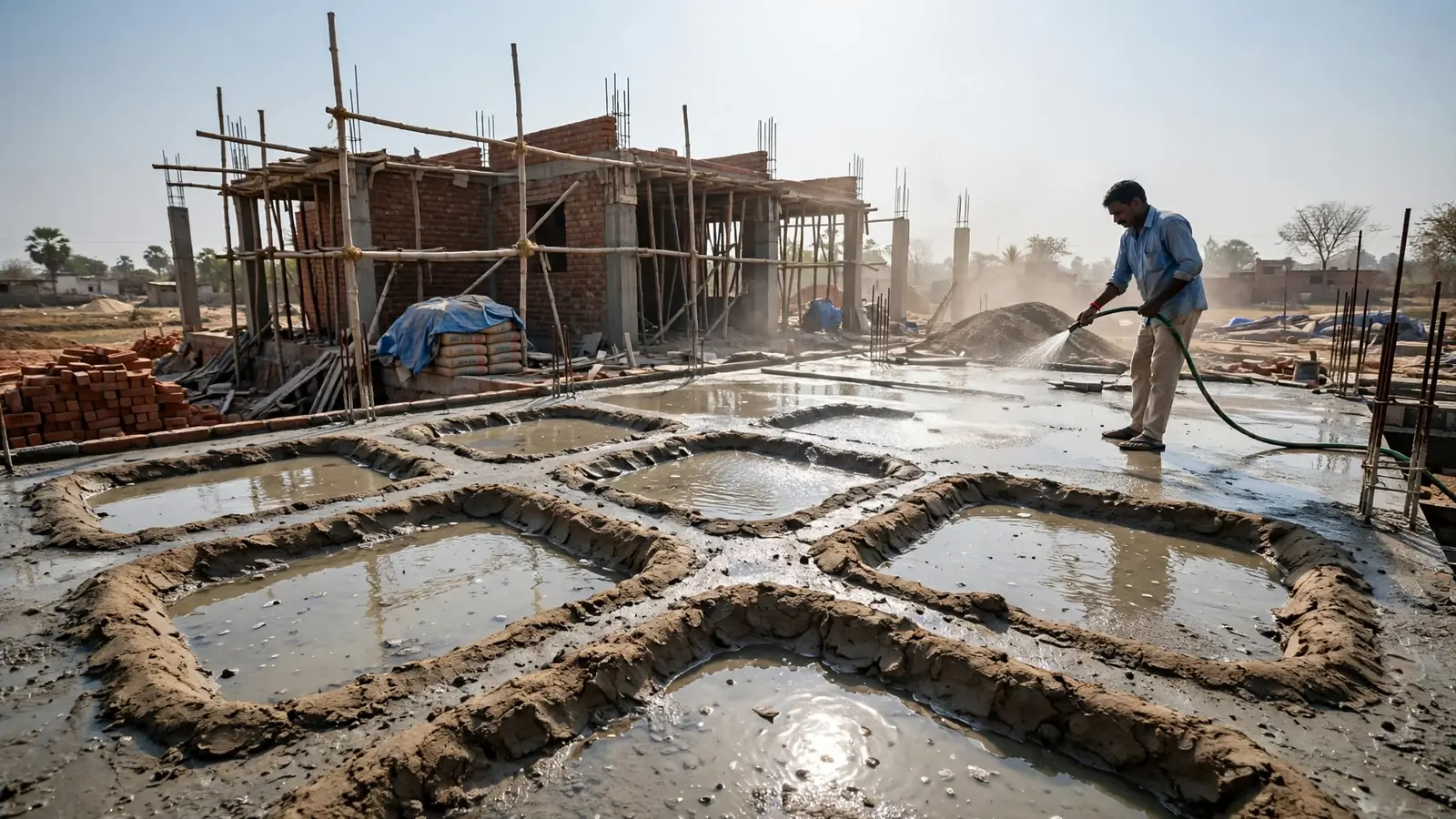
| Ponding | Roof slabs, floors | Clay or sand bunds divide the slab into squares; keep 25–50 mm of water standing |
| Wet hessian / gunny | Columns, beams, walls | Wrap the member in hessian and keep the cloth saturated all day |
| Sprinkling | Walls, plaster, small areas | Spray water several times a day — twice a day is not curing in summer |
| Polythene sheet | Slabs where water is scarce | Cover the wet surface and weight the edges to trap moisture |
| Curing compound | Columns, beams, large areas | Spray a membrane-forming liquid within 30–60 minutes of finishing |
Ponding — the best method for slabs
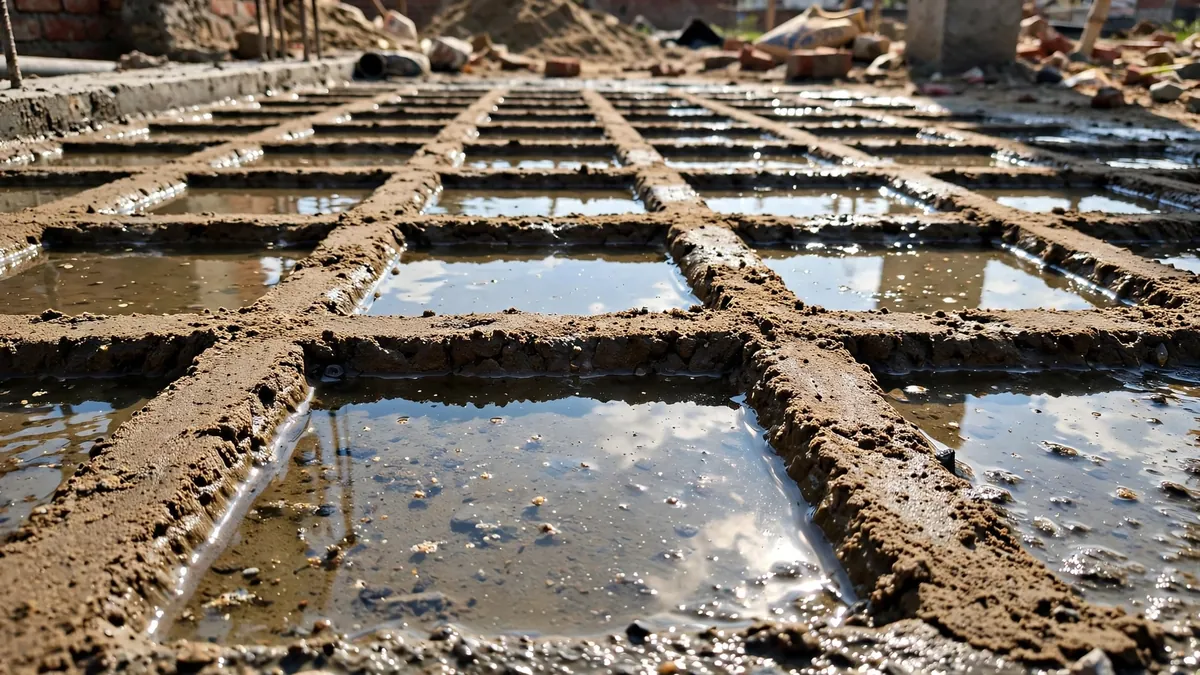
For a flat roof slab, ponding is the most reliable method there is. A thin layer of water is applied within 30 minutes of finishing, then low bunds of clay or sand divide the slab into squares, each kept filled with a few centimetres of water for the full curing period. Standing water keeps the surface saturated without anyone having to remember a schedule, and it cools the slab. In a hot, dry week, raise the depth from 25 mm towards 50–75 mm and check the level daily.
Wet hessian — for columns, beams and walls
Vertical members cannot be ponded, so wet hessian or gunny cloth is the standard answer. Wrap the column or beam after the shuttering comes off and keep the cloth wet — in summer that means re-wetting several times a day, because a single morning soaking dries out by noon in a dry wind. A polythene sheet over the wet hessian slows evaporation.

Curing compounds — when water curing is hard
A curing compound is a liquid sprayed on fresh concrete that dries into a thin membrane, sealing moisture inside. It is applied within 30–60 minutes of finishing, and specified compounds should conform to ASTM C309. Coverage is typically around 3.5–5.0 m² per litre, and a thin, patchy coat is little better than nothing. Compounds earn their place where water is unreliable, but they are less ideal for PPC and other blended-cement mixes, which gain strength slowly and benefit more from water curing.

How often, and how much water
The honest answer is "continuously", not a number of rounds per day. But homeowners planning water and labour still need a working figure. Field practice reported in Indian curing guides suggests roughly 5 litres per square metre per day for ponding, about 4.5 for wet hessian, and about 3 for spraying, with a hot, dry climate multiplying the figure by about 1.2. These are field-practice figures, not IS code requirements — the code sets durations, not litres.
A worked example makes the scale clear. Take a 100 m² roof slab, PPC concrete, cured by ponding for 14 days in a moderate climate: 100 × 5 × 14 = 7,000 litres. In hot, dry conditions the same slab needs about 8,400 litres — less than a single water tanker load. The cost that actually matters is labour: someone has to keep the hessian wet or the pond topped up every day for two weeks. Put a name to that job before the pour.

What happens if you skip curing
Skipped or half-hearted curing does not make concrete collapse. It makes it weaker where it matters most — at the surface, where rain, carbonation and wear attack it first. Plastic shrinkage cracks appear within hours of the pour; drying shrinkage cracks follow over days and weeks. The top layer turns dusty underfoot, because the cement paste at the surface never hardened properly. Permeability rises, so rainwater reaches the steel faster, and the cover concrete that was supposed to protect reinforcement for decades starts its life already porous.
None of this is repairable by curing later. Once the surface layer has dried and hydration has stopped there, re-wetting does not restart it. The only fixes afterwards are surface treatments, replastering, or waterproofing coatings.

Planning a summer pour
Curing starts before the pour, in the planning. A summer slab cast at noon in May is a curing problem that no amount of water afterwards fully solves, so the schedule matters as much as the method. Pour early in the morning. Keep the aggregates shaded and, where the specification allows it, use chilled mixing water. Have hessian, polythene sheets and bund material on site before the concrete arrives, and have the water source tested — a borewell that runs dry on day four is a curing failure waiting to happen. Agree the curing plan with the contractor in writing before the pour: which method for which element, how many days, and whose job it is each day. Curing and de-shuttering are separate decisions — the formwork period depends on span, loading, concrete strength and the engineer's approved method, and curing continues after the shuttering comes off. For the wider sequence, see our RCC slab casting checklist and cement grades guide; a poorly cured roof slab is the most common cause of terrace leaks, so read the terrace waterproofing guide alongside this one.
A homeowner's curing checklist
- Before the pour: hessian, polythene, bund material and a tested water source on site; method, duration and the responsible person agreed.
- Within 30 minutes of finishing: surface covered with wet hessian or polythene; first water applied before the sheen disappears.
- Day 1: ponding bunds built after 24 hours; columns and beams wrapped in wet hessian the day shuttering comes off.
- Every day: surface never dry — pond full, hessian saturated, polythene edges weighted.
- Day 7 (OPC) / Day 10 (PPC): minimum reached — keep going to 10–14 days for slabs in summer heat.
- Day 14: curing complete for most house slabs; check for new cracks or dusty patches.
Concrete curing in Indian summers is not a technical mystery. It is water, coverings and two weeks of discipline, against a season that dries a fresh surface in an hour. The slab you pour this summer will carry your house for decades — the curing you give it in its first fortnight decides how well it does that job. If you are planning a house build, talk to RTPL Constructions about your project.