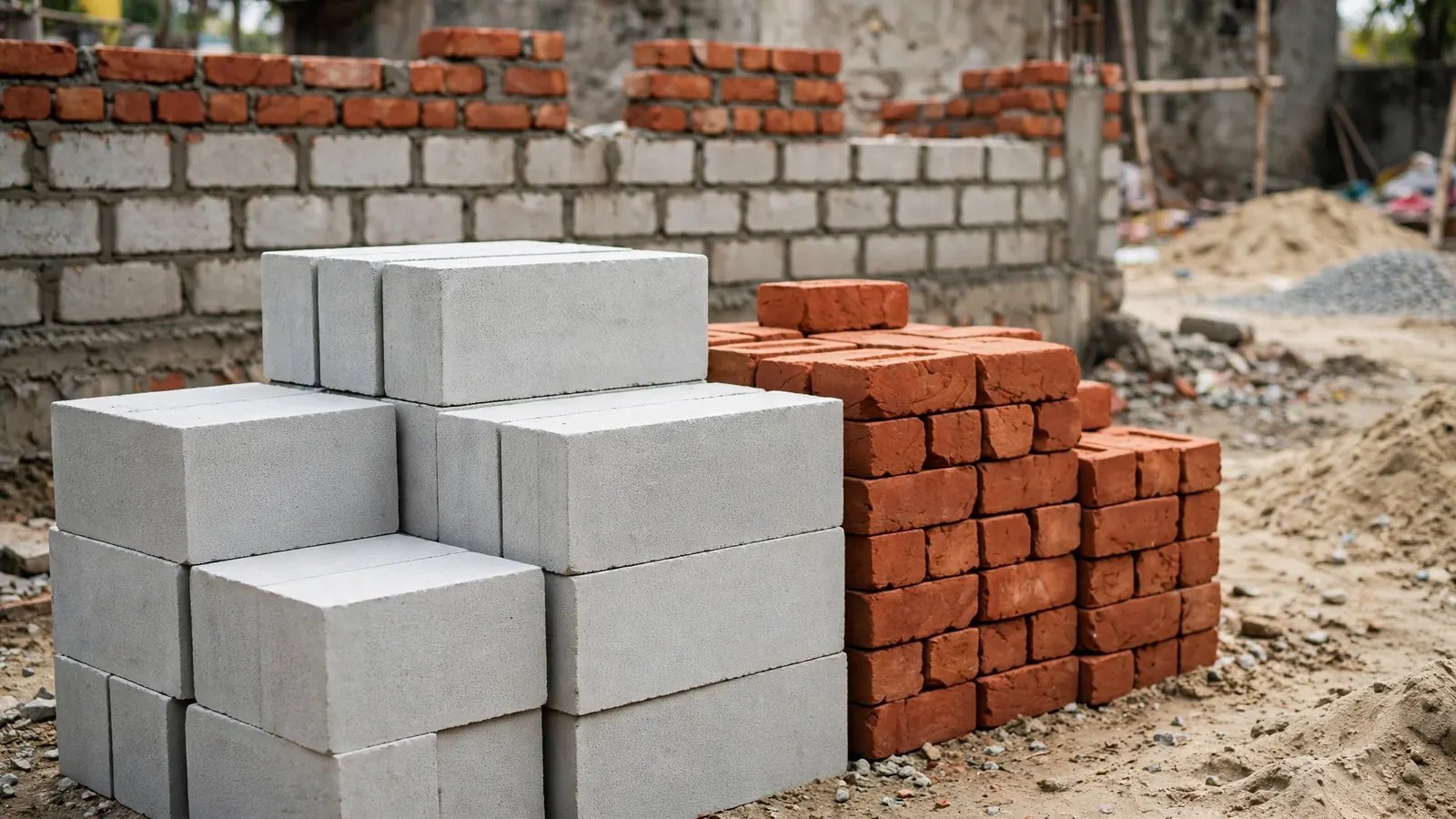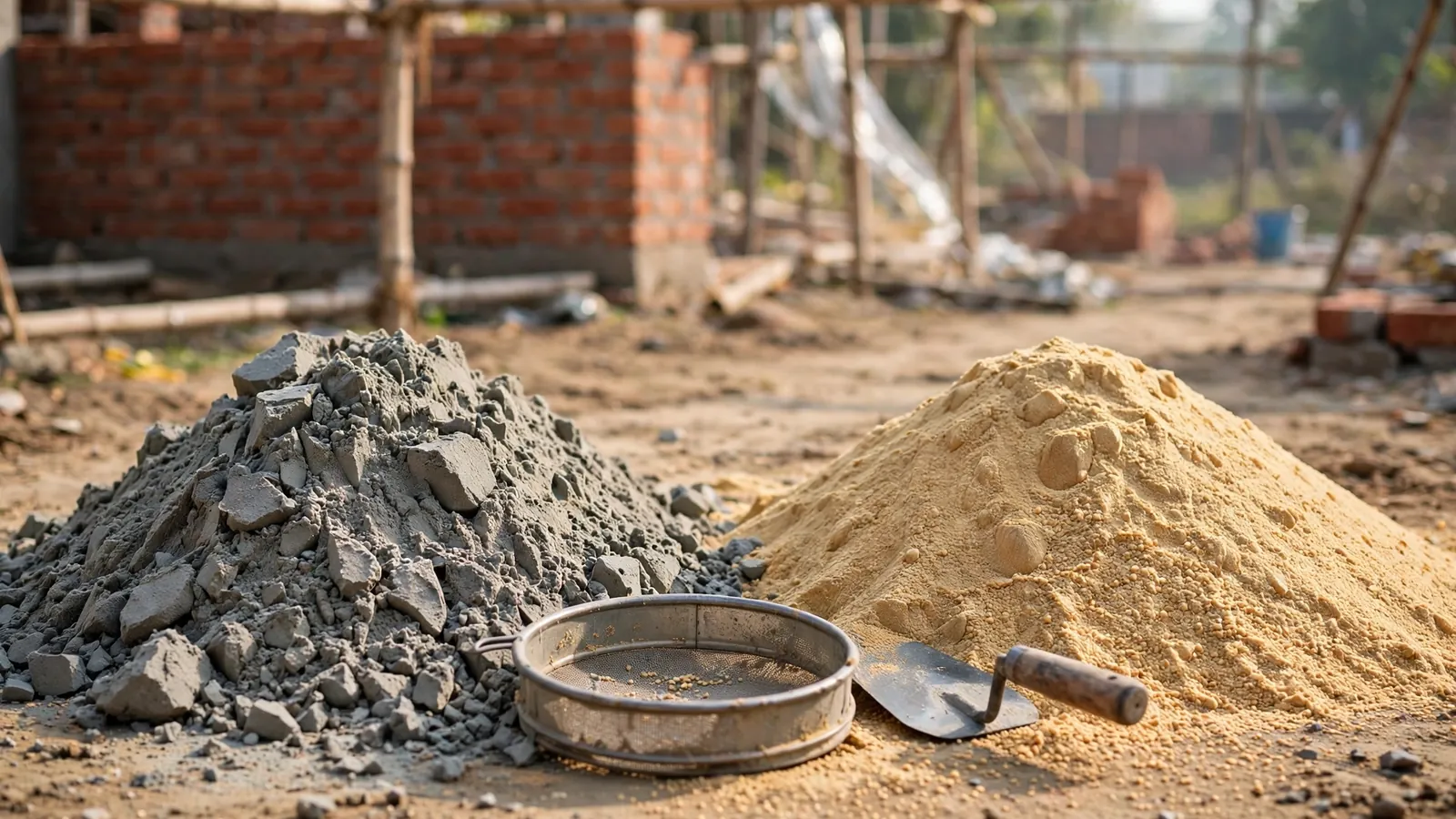
Every truckload of sand on your site is a decision about your slab and your walls. Sand is the largest ingredient in concrete after stone, and the only one in plaster. Get it wrong and the concrete loses strength, the plaster cracks, or the finish turns rough no matter how good the mason is.
For decades the default was river sand, dug from riverbeds. Today, in most Indian cities, the truck that arrives is just as likely to carry M-sand, manufactured sand made by crushing granite or basalt rock. Both can build a good house, and both can build a bad one if the wrong type lands in the wrong job.
1. The short answer: use both, in the right places
If you want one sentence: use washed, well-graded M-sand for structure (footings, columns, beams, slabs) and use P-sand or clean river sand for plaster and finishing. That split is what most Indian site engineers follow.
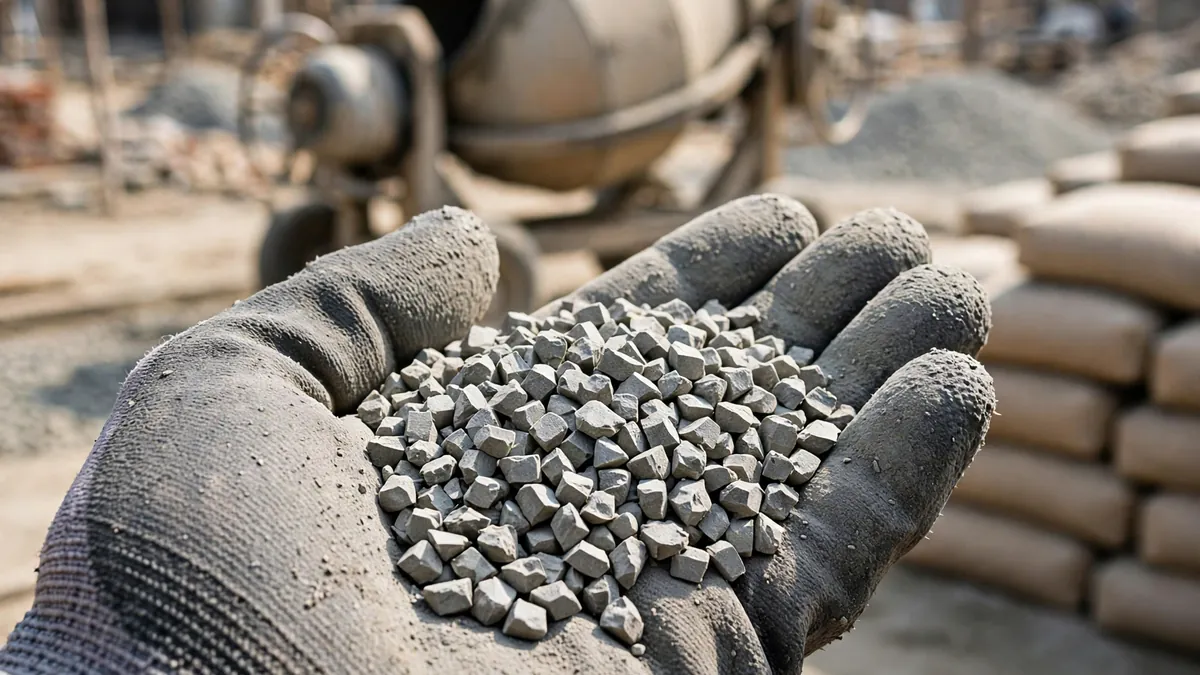
The reason is the grain. M-sand grains are angular and cubical, so they lock together and bond strongly with cement paste. That suits concrete, where strength matters most. River sand grains are rounded and smooth, so they slide past each other and give a soft, workable mix. That suits plaster, where finish matters most.
The type of sand decides less than its quality. Clean, well-graded sand of either type beats dirty sand of the "better" type every time. So the real question is not only which sand, but whether the sand on your site passes the tests in Section 8.
2. What M-sand actually is
M-sand, short for manufactured sand, is made by crushing hard rock, usually granite or basalt, and then screening and washing the output to sand size. Modern plants use a vertical shaft impactor (VSI) crusher, which shapes the particles into cubical grains rather than flat flakes. The result is a factory product, so its grading can be controlled to a target.
Under IS 383:2016, the Indian standard for coarse and fine aggregates, manufactured sand is graded into zones, and Zone II is the usual target for concrete work. A typical washed M-sand has a fineness modulus around 2.5 to 3.0, silt content below 3%, and bulk density roughly 1,600 to 1,800 kg per cubic metre loose. Because it is produced from quarried rock, it is available through the year at a stable quality, as long as the plant is genuine and not a roadside crusher selling unwashed output as M-sand.
That is the catch. "M-sand" is also the label on a lot of poor material. Unwashed crusher dust, sold as M-sand, carries excess micro-fines that soak up water, increase shrinkage, and weaken the mix. The difference between good M-sand and crusher dust is washing, screening, and a grading report, not the name on the truck.
3. What river sand actually is
River sand is natural sand taken from riverbeds and banks. Years of flowing water have rounded its grains and sorted them, so it arrives naturally well-graded and smooth. Good river sand has low clay content when properly washed, a fineness modulus around 2.6 to 3.0, and excellent workability. Masons like it because it spreads easily, finishes smooth, and needs slightly less water than M-sand.
Its problems are supply and consistency. River sand mining is restricted or banned in 14 or more Indian states, with the National Green Tribunal involved in enforcement, because uncontrolled mining erodes riverbeds and damages ecosystems. Legal supply is therefore irregular, and price and quality swing from load to load and from season to season. One truck can be clean and well-graded; the next can carry silt, clay, and organic matter from the riverbank. In many cities, much river sand is also mined without permits, so there is no test certificate and no supplier to hold accountable if the concrete fails a cube test.
4. M-sand vs river sand: head-to-head
| Property | M-sand | River sand |
|---|---|---|
| Grain shape | Angular, cubical, interlocks in concrete | Rounded, smooth, flows easily in plaster |
| Grading control | Controlled, usually Zone II (IS 383) | Natural grading, varies load to load |
| Silt and clay | Under 3% when washed properly | Often higher; unwashed loads exceed limits |
| Workability | Needs slightly more water | Smoother, needs less water |
| Concrete strength | Matches or slightly beats river sand | Proven baseline, depends on cleanliness |
| Plaster finish | Can feel rough; use P-sand instead | Smooth finish, the traditional choice |
| Availability | Year-round from quarries | Irregular; restricted in 14+ states |
| Consistency | Stable from a genuine plant | Varies by source and season |
M-sand wins on consistency, availability, and concrete strength. River sand wins on workability and plaster finish. The deciding factor is usually which job the sand is going into, and whether the supplier can show a grading report.
5. M-sand for RCC: where it wins
For structural concrete, footings, columns, beams, and slabs, washed M-sand is the safer default for most Indian homes today. The angular grains interlock with each other and with the cement paste, which gives the hardened concrete a dense structure. Published comparisons report that properly graded M-sand matches or slightly exceeds river sand in compressive strength for the same mix design. The exact result depends on the mix, the cement, the curing, and the grading of the load.
Two adjustments matter when switching to M-sand. First, workability drops, and adding water freely is the fastest way to lose strength. The correct fix is a plasticiser dosed as per the manufacturer's guidance and the mix design, not extra water from a hose. Second, check the fines content. Excess stone dust below 150 microns drinks water, raises shrinkage, and can show up later as surface cracking. That is why washing matters, and why the silt test in Section 8 is not optional.
Order M-sand by grade, not just by name. Ask the supplier for the IS 383 grading report for the batch, and check that the sand is Zone II for concrete. If the supplier cannot produce one, treat the load as unverified and test it yourself before it goes into a slab.
6. Plaster: why river sand and P-sand still lead
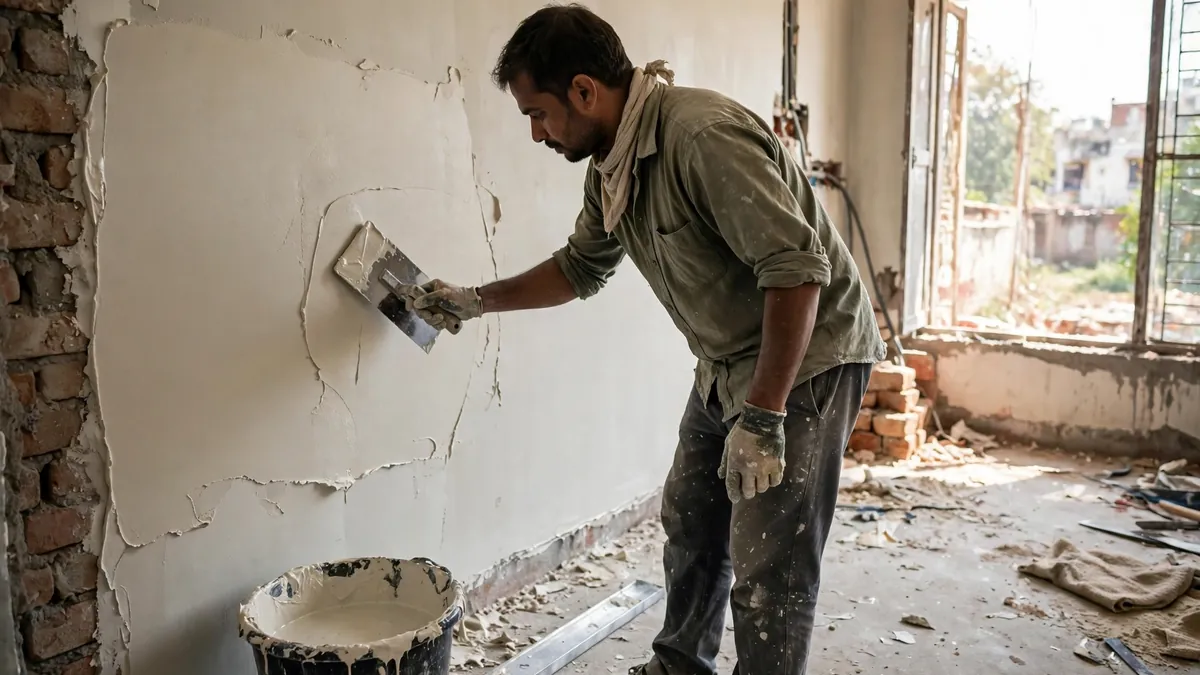
Plaster is a different job from concrete. The mix is thinner, the layer is 12 to 20 mm, and the finish is the surface you live with. Rounded grains spread smoothly under a trowel and close into a dense, even face. Used straight for plaster, M-sand can leave a rough, open texture that shows through paint and takes more putty to correct.
That does not mean M-sand is banned from plaster. It means the right product for plaster is P-sand, plastering sand, a finer manufactured sand graded to Zone III and covered by IS 1542:1992. P-sand is screened finer than concrete M-sand, so it finishes far better, and it is the standard choice where river sand is scarce. If P-sand is unavailable, clean river sand remains the best plaster sand. If neither is available, M-sand can be used for the first coat only, with a P-sand or river sand finish coat on top.
Two plaster mistakes show up repeatedly on Indian sites: using the same coarse M-sand for plaster that went into the slab, and plastering over a dusty, dry wall without wetting it, so the wall sucks water out of the plaster and the coat cracks as it dries. Both cost more to fix than to prevent.
7. Cost in 2026: what the guides actually say
Sand prices are local. Transport often costs as much as the sand itself, so a rate in Bengaluru says little about a rate in Mainpuri or Lucknow. Published 2026 Indian guides disagree with each other: treat every figure below as an illustrative band, not a quotation, and get a written rate from two local suppliers before budgeting.
| Sand type | Indicative rate per tonne | What moves the price |
|---|---|---|
| M-sand (washed) | ₹900–2,200 | Plant distance, washing, grade |
| River sand | ₹2,000–3,500 | Legality, scarcity, transport, season |
| P-sand (plastering) | ₹1,200–2,500 | Finer screening, plant distance |
Some guides quote M-sand cheaper than river sand by 15 to 30%, while others show river sand cheaper where legal local supply still exists. M-sand pricing is steadier through the year, while river sand pricing spikes when mining is restricted or the monsoon stops transport. Over a full build, the steadier price is often the cheaper one. For the full cost picture, see our guide to house construction cost in India 2026.
8. Three site tests before a truck is unloaded
Do these before the sand is tipped on your plot. Once it is mixed into a pile with yesterday's load, testing tells you nothing.
1. The jar silt test. Fill a clear glass jar one-third with sand, add water to near the top, shake hard, and leave it undisturbed for 24 hours. Silt settles as a distinct layer above the sand. If that layer is more than about 3% of the sand height for concrete use, or 5% for plaster, the load needs washing or rejection, per IS 456:2000 guidance as cited in published guides.
2. The hand test. Take a handful of dry sand and rub it between your palms. Clean sand feels gritty and leaves your hands nearly clean. If your palms come away dusty or stained, the fines or clay content is high. Squeeze a moist lump: if it holds together like modelling clay instead of crumbling, clay is present.
3. The grading check. Run a handful through a 4.75 mm sieve if one is on site. Good concrete sand is mostly between 150 microns and 4.75 mm, with a spread of sizes rather than all one size. Ask the supplier for the IS 383 grading report and check it against the Zone II limits.
If a load fails the jar test, do not accept the argument that extra cement will fix it. Silt coats the grains so cement cannot bond to them. Reject the load, or wash it, and record the supplier.
Sand selection does not replace mix design. Final concrete proportions, member sizing, and foundation decisions require project-specific assessment by a qualified structural engineer, based on your drawings, soil report, and the materials actually delivered to site.
9. The decision rule for your house
For footings, columns, beams, and slabs: washed M-sand, Zone II grading, silt under 3%, with a grading report from the plant. This is the default for a modern Indian home.
For brickwork and blockwork: washed M-sand works well and is what most sites use today. It also suits AAC block mortar when the mix is specified for it; see our AAC blocks vs red bricks comparison.
For plaster and finishing: P-sand first, clean river sand second. Keep coarse concrete M-sand out of the finish coat. The extra cost of a separate plaster sand order is small against the cost of re-plastering a rough wall.
If the budget is tight: save money on the finish, the fittings, or the paint, never on the sand in your slab. The slab is the one part of the house you cannot redo without demolishing it. For foundation choices that pair with this decision, see raft foundation vs isolated footing in India.
Sand looks like the cheapest material on site, which is why it gets the least attention. A jar test, a grading report, and the right sand in the right job pay for themselves in a slab that reaches its strength and walls that stay smooth. Ask for the report before the truck leaves the plant, not after it reaches your gate.
Planning a build and want the material choices checked against your drawings? Talk to RTPL Constructions for a site-specific review before you order.