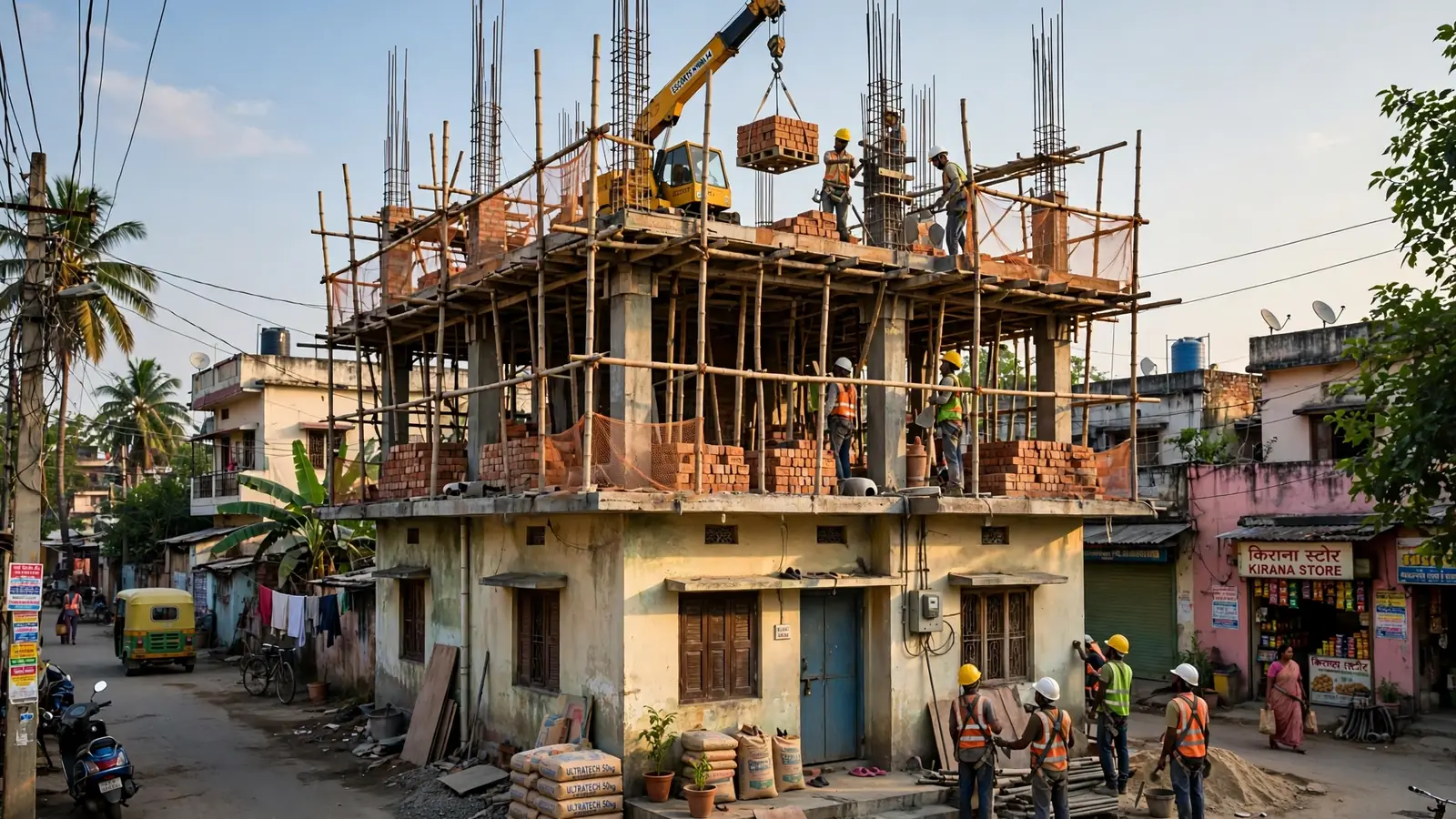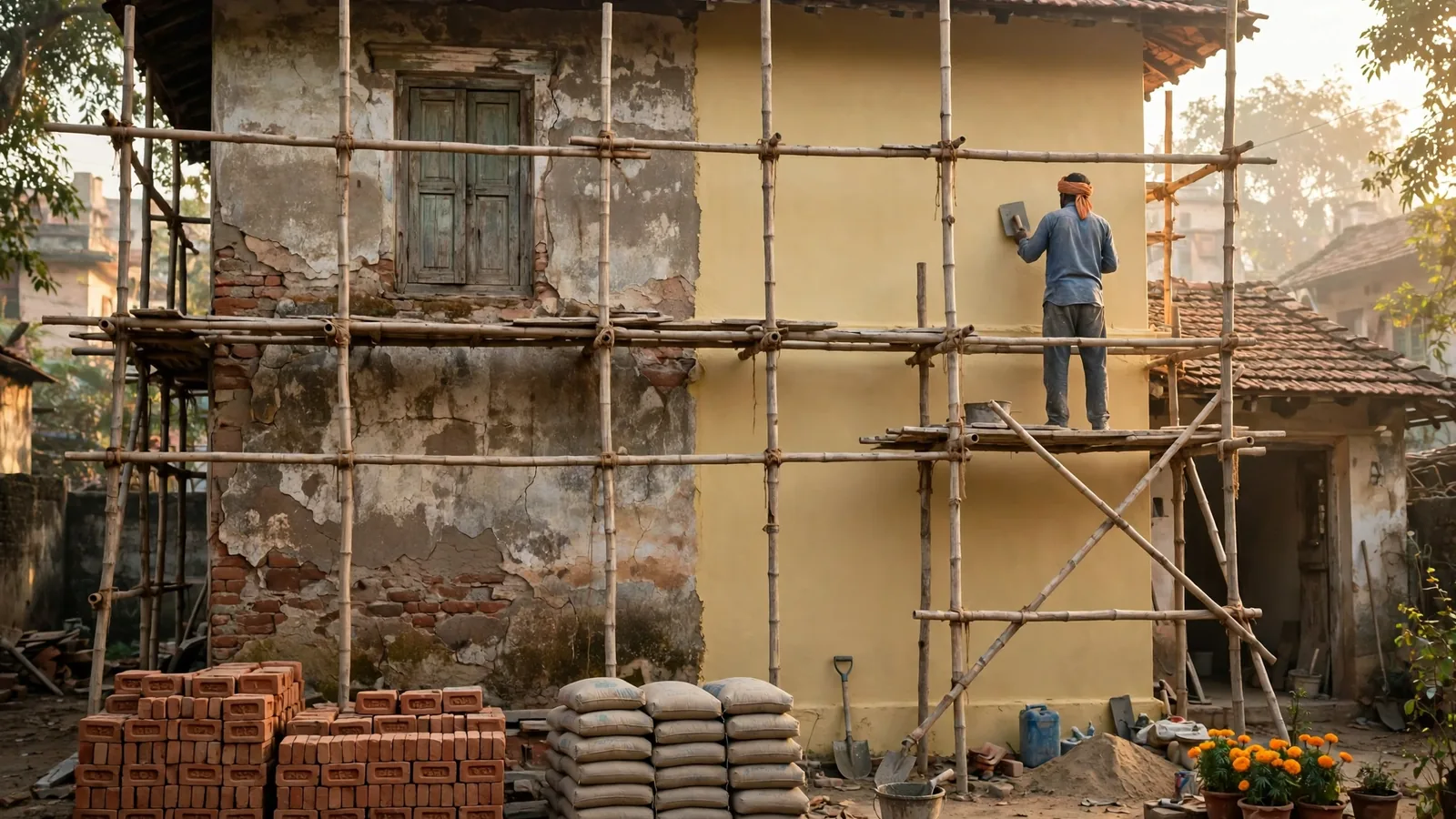
A 20-year-old house never renovates like a new flat. Behind the tiles there is old wiring, corroded plumbing and damp nobody can see until the walls open — and that is exactly where renovation budgets die. Price the job room by room: kitchen and bathrooms first, then the hidden layer of structure, wiring and plumbing, then the visible finishes.
1. The short answer
There is no single renovation rate — the range is wide because the scope is wide. City guides checked in November 2026 put a cosmetic refresh at roughly Rs 150–400 per sq ft in Bangalore and Rs 900–1,400 in Delhi NCR. A standard renovation runs about Rs 800–1,500 per sq ft in Bangalore, Rs 1,400–2,200 in Delhi NCR and Rs 1,500–2,000 in Noida. Premium work is quoted at Rs 2,200–3,500 per sq ft, and a structural overhaul at Rs 2,800–3,500 and above. All-India guides quote Rs 500–2,500 per sq ft overall, up 12–18% since 2024. For a 1,000 sq ft flat, a full standard renovation is roughly Rs 15–30 lakh in a Noida guide. Illustrative ranges — city, scope and condition move the number more than any rate card.
The first decision is the scope, not the rate. A cosmetic renovation changes surfaces: paint, flooring, fixtures, kitchen shutters, bathroom fittings. A standard renovation goes deeper: kitchen and bathroom rebuilds, rewiring, plumbing replacement, false ceilings, wardrobes. A structural renovation adds strengthening and layout changes. The per-sq-ft quote means nothing until someone has inspected the house and named which of the three it is.
Cosmetic renovation
- Best fit: A sound house under 15 years old that looks tired
- Trade-off: Cheapest, but old wiring and pipes stay old
- Site check: Confirm structure, wiring and plumbing are genuinely sound
Structural renovation
- Best fit: Houses over 25–30 years old, or any with cracks and damp
- Trade-off: Costs most and takes longest, but fixes the real problems
- Site check: A structural engineer assesses columns, beams and slabs before design
2. What "old" means for the budget
The age of the house decides how much of the budget goes to work nobody will ever see. Under 15 years old, a house usually needs finishes and fixtures — structure, wiring and plumbing are normally still serviceable. Between 15 and 30 years, the hidden layer appears: full rewiring and plumbing replacement become likely, roughly Rs 1.5–4 lakh. Above 30 years, assess the structure before any design decision — columns, beams and slabs first, finishes second.

Where strengthening is needed, guides quote roughly Rs 300–600 per sq ft — on a 1,000 sq ft house, Rs 3–6 lakh — which is why the structural assessment comes before the kitchen catalogue. Demolition and debris removal add Rs 15–40 per sq ft. And the real condition is discovered only after work begins: seepage behind tiles, corroded pipes, dead wiring in the walls. Every old-house budget needs a line for what has not been found yet — the contingency in Section 8.
3. The kitchen: where the biggest cheque goes
The kitchen is the most expensive room in a renovation, and the one where the range is widest. City guides put a modular kitchen at roughly Rs 1.5–12 lakh: basic Rs 1.5–2.5 lakh, mid-range Rs 3–5 lakh, premium Rs 6–12 lakh and above. NCR guides quote standard at Rs 3.5–6 lakh and premium at Rs 8–15 lakh. What moves the number is the carcass material, the finish, the countertop and the hardware — not the size of the room.
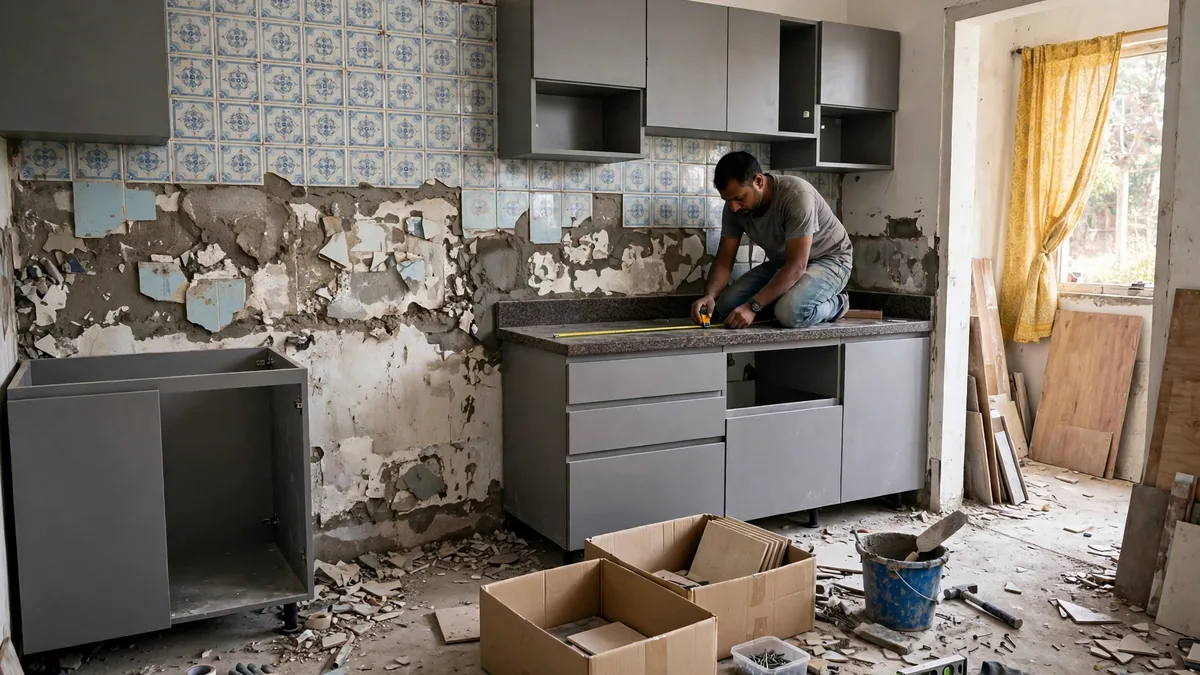
Three decisions control most of the kitchen budget. First, the carcass: BWR plywood or HDHMR lasts in Indian kitchens; particle board swells near the sink and the floor. Second, the countertop: granite is the workhorse, quartz costs more and needs less sealing. Third, what stays: keeping the existing plumbing and gas points saves a surprising amount — moving a sink or a gas line means breaking and rebuilding the wall behind it. Our guide on modular wardrobe cost in India covers the same carcass and hardware choices.
4. Bathrooms: the second-biggest spend
After the kitchen, bathrooms take the next-biggest share — kitchen and bathrooms together eat roughly 40–50% of a renovation budget. Each bathroom is quoted at about Rs 1–3 lakh standard, Rs 1.8–3 lakh in Delhi NCR guides, and Rs 4–7 lakh for premium. A 2BHK with two bathrooms can therefore carry Rs 2–6 lakh of bathroom work.

The expensive part of a bathroom is not the fittings — it is the waterproofing and the plumbing underneath them. Old bathrooms leak because the waterproofing layer failed years ago, and the only reliable fix is to strip the floor and walls back to the slab and redo the membrane, the slope to the drain and the pipe joints. Re-tiling over the old surface is the most common false economy in a renovation: the new tiles look good for a season, and the leak comes back through the ceiling below. Test the waterproofing with a water-holding test before the tiles go on, and keep the record.
5. The hidden layer: structure, rewiring and plumbing
This is the work that never appears in a photograph, and it decides whether the renovation lasts. In houses older than 15 years, guides say full rewiring and plumbing replacement are usually needed — old aluminium or undersized copper wiring cannot carry today's loads, and old galvanised iron pipes corrode from the inside. Rewiring is quoted at roughly Rs 100–250 per sq ft. Together with the structural checks, the plumbing replacement forms the Rs 1.5–4 lakh layer from Section 2.
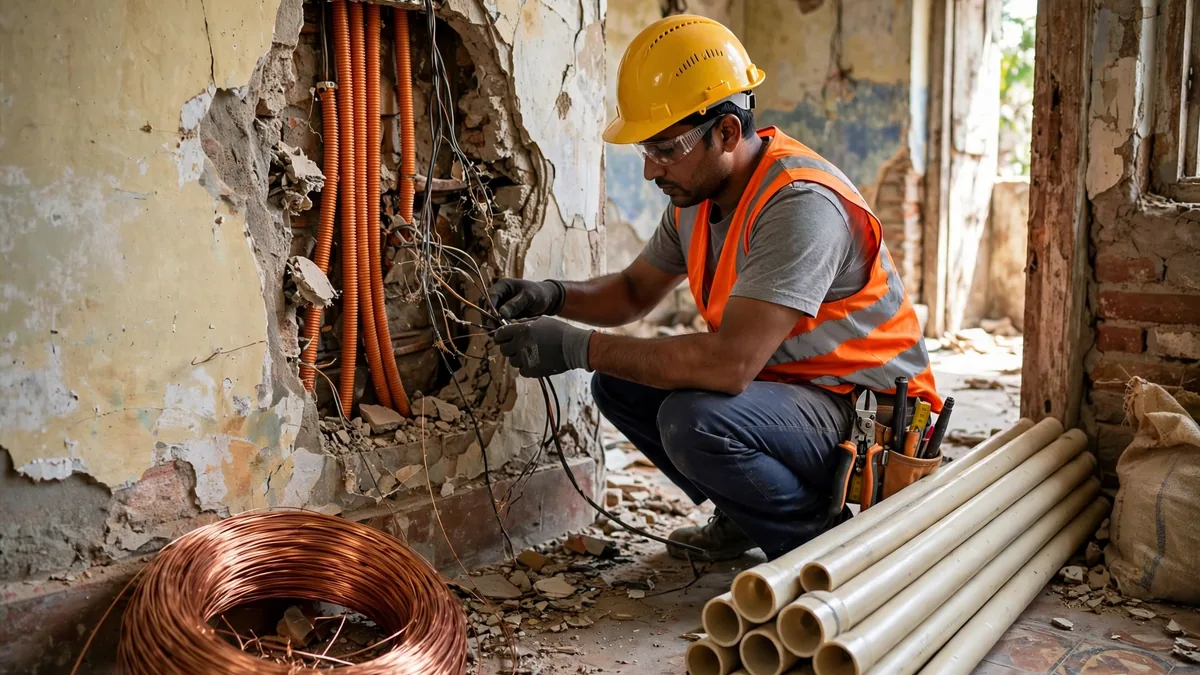
Do this work before the finishes, never after. Wiring and plumbing live inside the walls, so they must be finished, tested and photographed before plaster and tiles close them in. Count the plug points room by room before chasing starts — too few points means extension boards everywhere. Our guide on house wiring in India covers earthing, MCBs and load planning, and our plumbing layout guide explains the slopes and joints that keep new pipes from leaking. If the renovation includes adding a floor, read our guide on adding a floor to an existing house first.
6. Floors, walls and ceilings: the visible half
Once the hidden layer is done, the visible half changes the house's character. Flooring is quoted at roughly Rs 80–250 per sq ft for standard vitrified tiles and Rs 350–700 per sq ft for premium finishes. Painting runs about Rs 20–40 per sq ft for emulsion and Rs 40–70 for premium finishes; a false ceiling is roughly Rs 80–200 per sq ft. Wardrobes are quoted at about Rs 1,200–1,800 per sq ft in standard finishes.
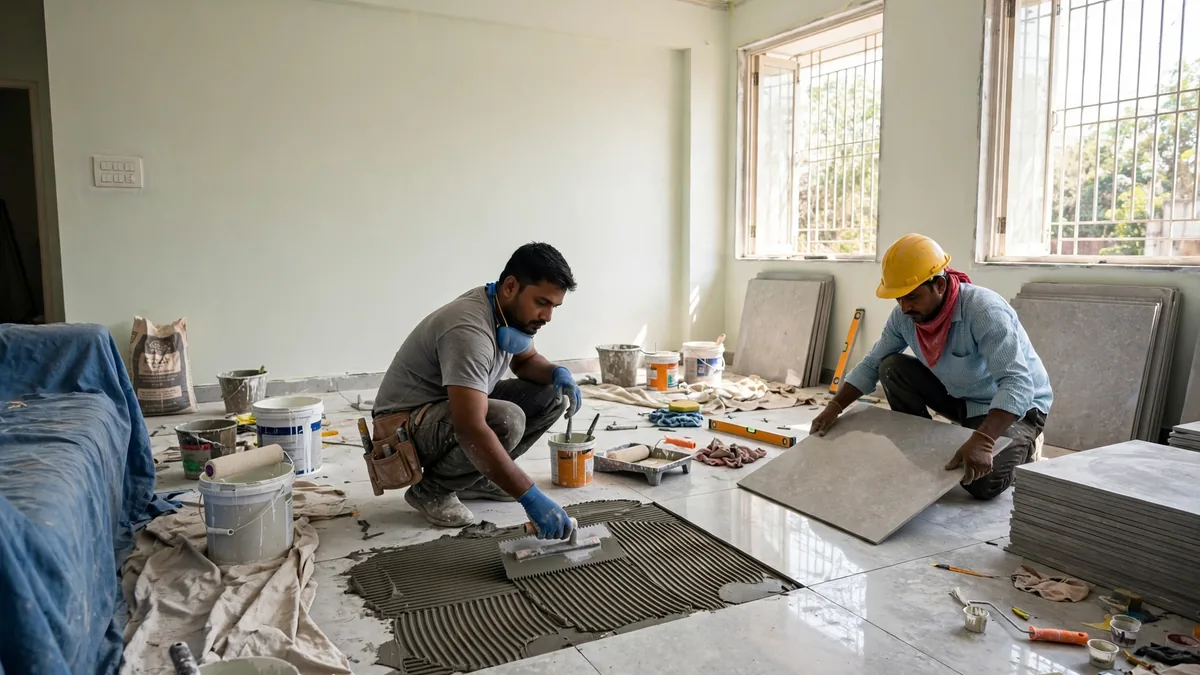
The practical rule for an old house is to finish in the right order: structure, then wiring and plumbing, then waterproofing, then flooring, then ceilings, then paint last, because every earlier trade marks the walls. One detail is worth insisting on: level the floor before the tiles go down, because old slabs are rarely flat and a thin tile bed over an uneven slab cracks. Our guide on false ceiling cost in India covers gypsum, POP and wood options for the ceiling layer.
7. A worked example: a 1,000 sq ft 2BHK, standard finish
Putting the ranges together for a 1,000 sq ft 2BHK with one kitchen and two bathrooms, at a standard finish, gives a budget a homeowner can actually use. The figures are illustrative — they come from the city-guide ranges in this article, not from a quoted BOQ — and the real number follows a site inspection.
| Work package | Illustrative range | What decides it |
|---|---|---|
| Kitchen (modular) | Rs 3–6 lakh | Carcass, countertop, hardware |
| Two bathrooms | Rs 2–6 lakh | Waterproofing, tiles, fittings |
| Rewiring + plumbing | Rs 1.5–4 lakh | House age, points, length |
| Flooring (1,000 sq ft) | Rs 0.8–2.5 lakh | Tile grade, levelling |
| Painting + false ceiling | Rs 0.6–1.5 lakh | Finish grade, area |
| Wardrobes + storage | Rs 1–2 lakh | Running feet, finish |
| Demolition + debris | Rs 0.15–0.4 lakh | Breaking scope |
| Contingency (15%) | Rs 1.4–3.3 lakh | Section 8 |
| Total (illustrative) | Rs 10.5–25 lakh | Before GST, design fees |
The table lands inside the Noida guide's rough band of Rs 15–30 lakh for a full standard renovation of a 1,000 sq ft flat. If your quote sits far below the table, something is missing — usually the waterproofing, the rewiring or the contingency. If it sits far above, ask for the itemised reason, line by line. Our guide on hidden costs in home construction covers the same trap from the new-build side.
8. Contingency: the line that saves the budget
Renovation is the one job where the real condition is discovered only after work begins, so the contingency is not optional. Guides recommend 10–15% in Bangalore and 15–20% in all-India guides, on top of the estimate. On a Rs 15 lakh estimate, that is Rs 1.5–3 lakh for what the demolition finds.
Two rules keep the contingency working. First, keep it in the budget from day one — a contingency added after the quote is already spent is not a contingency, it is a loan. Second, do not let the contractor spend it on upgrades. The contingency is for seepage behind tiles, a corroded pipe, a dead wire and a slab that needs levelling. Upgrades come from a separate line. When the contingency is untouched at the end, it is your saving, not the contractor's bonus.
9. Renovate or rebuild? The 70 percent rule
There is a point where renovating stops making sense. A Noida guide puts it plainly: if the renovation quote crosses about 70% of the cost of building new, stop renovating and rebuild. At that point you are paying new-house money for an old structure, old foundations and old walls, while keeping the old house's limits on layout, light and ceiling height.

The rebuild decision also turns on three questions the quote cannot answer. Can the structure take what you want — an extra floor, bigger openings, a different layout? Is the plot's setback and floor-area ratio enough for the house you actually need? And how long will the family live elsewhere — a deep renovation and a rebuild both displace the household. If the first two answers are no, the 70% rule has already answered. Get a new-build quote from the same contractor before deciding; comparing a renovation quote against a rebuild quote is the only honest comparison.
10. Mistakes that cost money later
The same mistakes appear in almost every old-house renovation that runs over budget. Starting the design before the structural assessment, so the layout has to be redrawn. Re-tiling a bathroom without redoing the waterproofing. Rewiring only the visible rooms and leaving old wiring in the walls. Comparing quotes by the headline per-sq-ft rate instead of the itemised BOQ. And the most expensive of all: starting work without a contingency, then borrowing to finish.
An old house hides its condition behind plaster and tiles. Before any design or demolition, have a qualified structural engineer assess the columns, beams and slabs, and have the wiring and plumbing inspected. Final structural, electrical and plumbing decisions need project-specific assessment — this guide gives budget ranges, not site instructions.
11. Before you sign: a five-minute checklist
Get the structural assessment first, in writing. Get an itemised BOQ — kitchen, bathrooms, rewiring, plumbing, flooring, painting, ceilings, demolition and contingency as separate lines — and compare two quotes line by line, not by the headline rate. Confirm what is excluded: GST, design fees, sanitary fittings, lights, hardware and debris removal. Agree the payment schedule against visible stages, with the last 5–10% held until snagging is done — our guide on snag list before handover covers how to inspect the finishing like a site engineer. Keep the 70% rule in your pocket: if the quote crosses it, get a rebuild quote before you sign anything. For a measured recommendation, talk to RTPL with your house's age and area.