A false ceiling is the most-seen surface in any Indian home. You look up at it every time you switch on a light. And it is also the surface where a wrong material choice shows first — a sagging board, a hairline crack across a curve, a damp patch spreading above the bathroom.
In 2026, published Indian guides put a plain gypsum or POP false ceiling at roughly ₹75–120 per sq ft installed, and wood at ₹200–400. Those are national bands, not quotations: metro cities run 15–30% higher than tier-2 towns, and painting, lights and GST are usually extra.
1. What a false ceiling actually costs in India in 2026
Start with what "per sq ft" means. A per-sq-ft rate should cover the material, the metal framework, the fixing and the labour to finish the surface. What it usually does not cover: painting (₹15–30 per sq ft extra), light fittings (₹300–3,000 per point), cove profiles, and 18% GST. Ask one question before comparing two quotes: is this inclusive of GST, painting and lights?
| Material | Cost per sq ft | 10×10 ft room | Install time | Typical life |
|---|---|---|---|---|
| Gypsum board | ₹75–120 | ₹7,500–12,000 | 2–4 days | 15–20 years |
| POP (Plaster of Paris) | ₹75–120 | ₹7,500–12,000 | 7–10 days | 10–15 years |
| Wood / veneer | ₹200–400 | ₹20,000–40,000 | 3–5 days | 20–30 years, with treatment |
| PVC panels | ₹40–60 | ₹4,000–6,000 | 1–2 days | 8–12 years |
Some guides quote wider ranges — POP ₹50–150, gypsum ₹60–150, wood up to ₹650+ for veneer finishes — because a plain ceiling and a designer multi-level ceiling with cove lighting are different jobs. A standard cove design runs roughly ₹110–170 per sq ft, designer multi-level work ₹170–300+. A peripheral or border-only ceiling costs less than a full ceiling because it covers a smaller area.
2. Gypsum: the default choice for most Indian homes
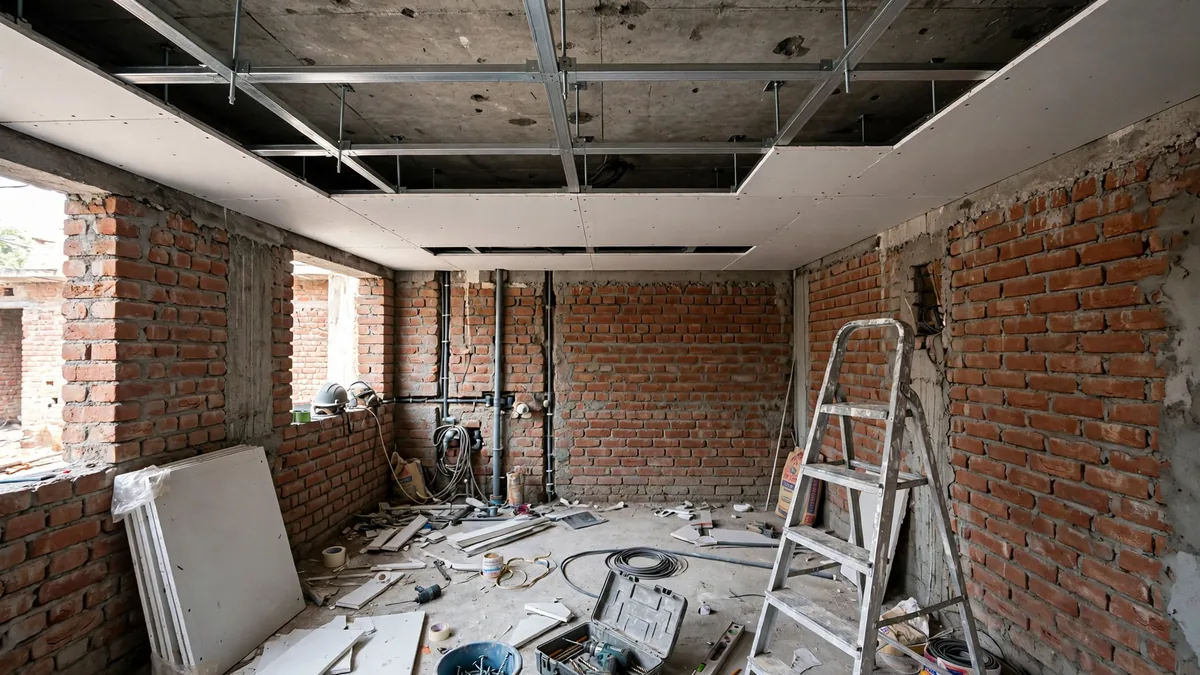
Gypsum is a factory-made board — typically 12 mm thick, with paper or fibre facings — fixed to a galvanised metal (GI) channel framework suspended from the concrete slab above. The boards arrive ready to install, so the work is fast and clean — no wet plaster, little dust, a predictable finish. That is why gypsum dominates urban apartments and new homes.
The finish is its strongest point. Factory boards give flat, consistent planes and crisp straight lines, and the joints — taped and filled properly — disappear under paint. Gypsum handles temperature variation well, which matters in top-floor rooms, and works neatly with concealed lighting and AC ducts. Fire-rated and moisture-resistant boards are available.
The weakness is water. A leak from the slab, the bathroom or the plumbing above will stain and soften a standard board, and a sagging patch needs the board replaced, not patched over. Fix every leak above the ceiling first.
3. POP: curves, character and craftsmanship
POP — Plaster of Paris — is mixed on site and shaped by hand, usually over a chicken mesh or fibre-board base fixed to a framework. It is the older craft, and it is still the only sensible choice when the design needs curves, domes, floral mouldings or a traditional ornate look. No factory board can be sculpted the way wet POP can.
The trade-off is time and dependence on the craftsman. POP work is slower — a standard room takes 7–10 days against 2–4 for gypsum — and messier, with wet plaster and dust through the house. The result depends almost entirely on the workmanship: mix, curing, thickness and drying. Poorly executed POP develops hairline cracks over time, especially in humid conditions. A good POP ceiling lasts 10–15 years; a rushed one shows cracks within a season or two.
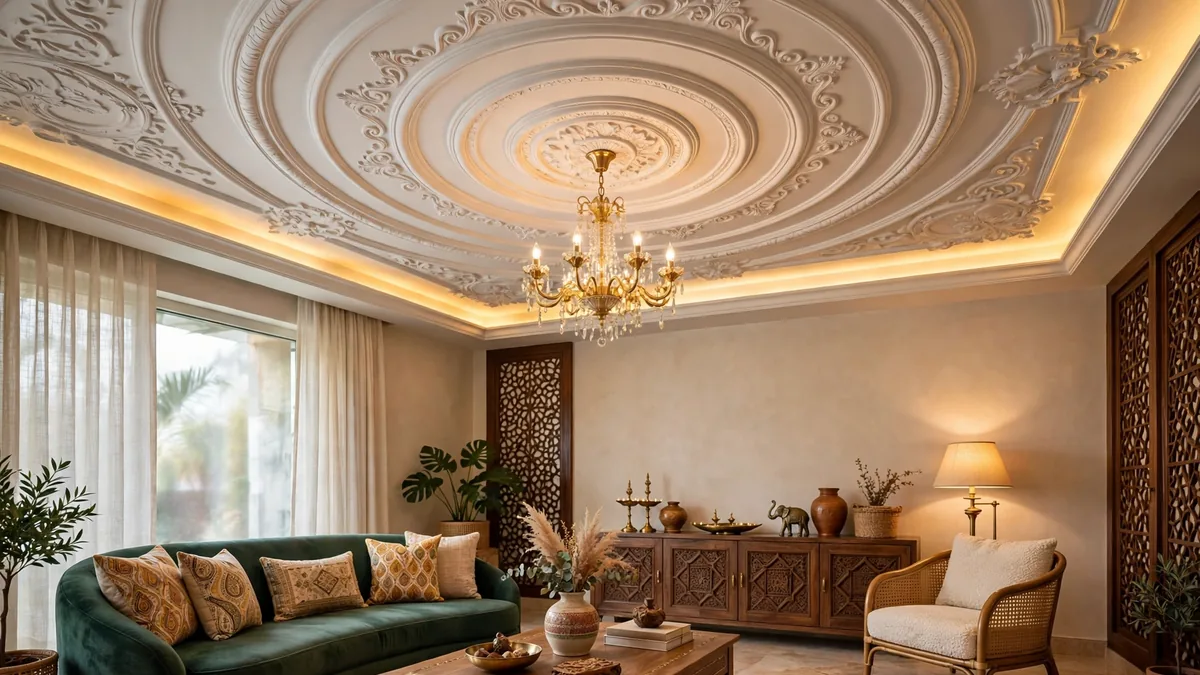
Choose POP when the design is the decision — curves, cornices, traditional luxury interiors. Do not choose POP for a plain flat ceiling: you pay the slower, messier process and gain nothing over gypsum. Never start POP work on a damp slab or before the plumbing above has been tested.
4. Wood: warmth, weight and the premium bill
Wooden false ceilings — slats, panels, battens or veneer finishes — bring a warmth no white board can match. It is the natural choice for a feature ceiling: one warm zone in a hall, a slatted panel above the dining table, a veneer band framing a cove. Published guides put wood at roughly ₹200–400 per sq ft installed, slats from ₹150–280, veneer finishes to ₹900–1,200 in some rate cards.
The cost is only half the story. Wood needs sealing against humidity, polishing on a schedule, and protection from termites. It is not fire resistant, and in a damp room it can warp or stain. That is why most good interiors use wood as an accent — 20–30% of the ceiling area — with gypsum carrying the rest.
5. Gypsum vs POP vs Wood: the honest comparison
| Feature | Gypsum | POP | Wood |
|---|---|---|---|
| Cost per sq ft | ₹75–120 | ₹75–120 | ₹200–400 |
| Design flexibility | Good — lines, coves | Excellent — curves | Good — slats, panels |
| Installation | Fast, clean, 2–4 days | Slow, messy, 7–10 days | 3–5 days, carpentry work |
| Moisture behaviour | Poor unless resistant boards | Poor — stains, cracks | Poor — warps |
| Maintenance | Low to moderate | Moderate | High — polish, termites |
| Best for | Living rooms, bedrooms | Ornate, traditional designs | Feature ceilings, premium rooms |
The decision rule is simple. Clean modern ceiling, fast, low maintenance — gypsum. Curves and traditional detailing with a craftsman you trust — POP. One warm statement zone and the budget allows — wood as an accent, gypsum everywhere else. And if the room is wet — kitchen, bathroom, balcony — PVC panels at ₹40–60 per sq ft beat all three on practicality.
Fix every leak in the slab and test the plumbing above before any ceiling work starts. A false ceiling hides a leak until the stain, sag or crack appears — and by then the repair means opening the ceiling.
6. Room-wise budgets: what a whole house costs
Per-sq-ft rates only become real when you multiply them by your rooms. The examples below use the consensus bands and exclude painting, lights and GST. A typical home of about 1,000 sq ft of ceiling area works out to roughly ₹75,000–1,20,000 for gypsum or POP, and ₹2,00,000–4,00,000 for wood throughout. Most families land in the middle: gypsum everywhere, wood as one feature panel.
| Room | Area | Gypsum / POP | Wood |
|---|---|---|---|
| Bedroom | 10 × 10 ft (100 sq ft) | ₹7,500–12,000 | ₹20,000–40,000 |
| Living room | 12 × 15 ft (180 sq ft) | ₹13,500–21,600 | ₹36,000–72,000 |
| Living + dining | 15 × 20 ft (300 sq ft) | ₹22,500–36,000 | ₹60,000–1,20,000 |
| Bathroom (PVC) | 8 × 5 ft (40 sq ft) | ₹1,600–2,400 | Not recommended |
Three extras catch people out. Painting adds roughly ₹15–30 per sq ft — on a 1,000 sq ft ceiling that is ₹15,000–30,000. A living room with a cove, six downlights and a fan point can add ₹5,000–15,000 in fittings and wiring. And 18% GST on the whole bill is the line most first-time budgets miss — always confirm whether a quote is inclusive or exclusive.
7. Design choices that move the price
The material is only half the bill. Ceiling height is the first decision. A false ceiling typically drops 4–6 inches below the slab, and a multi-level design with a cove can drop 8–12 inches in places. In a compact apartment with an 8-foot slab, a deep multi-level ceiling makes the room feel low — use a shallow single-level or a peripheral border ceiling instead, which keeps the centre of the room at full height. Our guide to 20×50 house plans covers the same height logic at the plan stage.
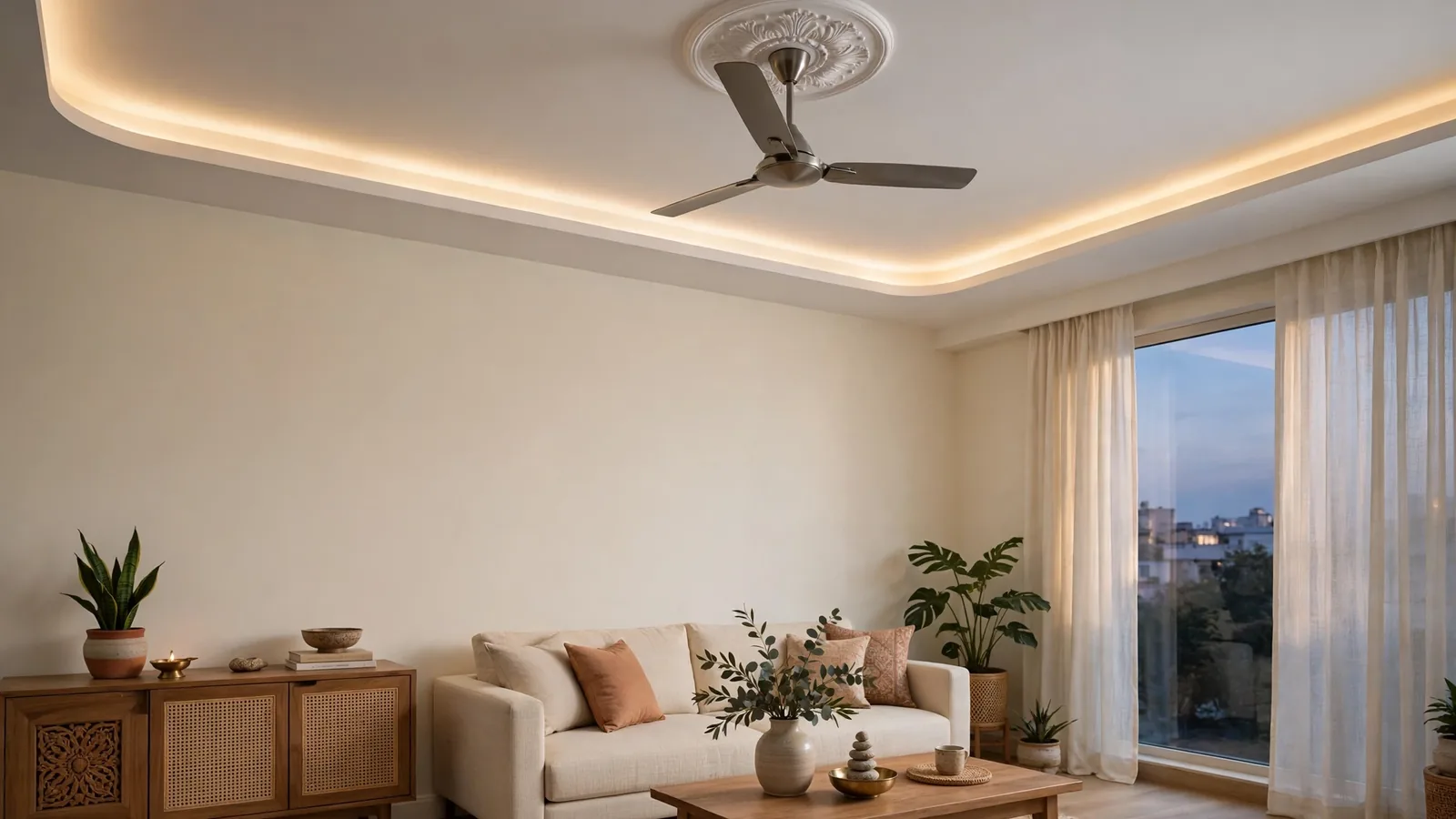
Cove lighting is the second decision. A recessed cove with an LED strip is the most popular false-ceiling feature in 2026 — and the one that most often goes wrong: a shallow cove shows the strip as a harsh line, and a cove with no access panel makes a failed driver a ceiling-opening job. Ask for a cove deep enough to hide the strip from a standing eye line, and a driver in an accessible spot.
Multi-level designs are the third. Each extra level adds framework, boards and finishing time, which is why designer ceilings run ₹170–300+ per sq ft against ₹75–120 for a plain one. One level with a good cove usually reads better than three levels fighting for attention — and costs half as much. Keep one idea per room: a cove in the living room, a tray in the bedroom, a slat panel above the dining table.
8. Site checks before you pay: the frame, the joints and the level
Most false-ceiling failures are framework failures, not material failures. A board is only as flat as the frame behind it. Before the boards go up, check the framework with a spirit level and a tape: hangers anchored firmly to the slab, channels at the specified spacing, the whole grid level. A frame out of level by even half an inch shows as a wavy ceiling once the lights go on.
For gypsum, check boards and joints: a known brand, 12 mm boards, joints fibre-taped and filled in two coats, screws just below the surface. For POP, check the base and the drying: mesh firmly fixed, plaster in even layers, full drying before painting. For wood, ask whether it is seasoned and sealed on all faces, and whether termite treatment is done.
Agree the payment in stages: framework complete and levelled, boards fixed and joints done, finishing and painting complete. Never pay in full before the joints are finished — that is where a rushed job shows, and the stage a contractor is least keen to return to. Keep 10% back until painting is done and the lights are on — that is when defects show.
9. Mistakes to avoid, and your checklist before you build
The most expensive mistake is choosing by photograph. A ceiling that looks spectacular in a showroom photograph may be a three-level POP design in a 12-foot-high hall — in your 9-foot bedroom it will look low, dark and crowded. Match the design to your room, not to the photograph. The second is skipping the leak check: dampness in the slab, seepage above, plumbing never pressure-tested — fix it first, or the ceiling hides the problem for a season and then presents the bill. The third is the quote comparison: two quotes at ₹90 and ₹120 per sq ft are not comparable until you know whether each includes GST, painting, lights and the framework brand. Get the inclusions in writing, in the same format, from every contractor.
Checklist before the work starts: confirm room heights and choose shallow designs where the slab is low; pick the material by room — gypsum for living and bedrooms, PVC for wet rooms, wood as an accent, POP only where curves matter; fix leaks and test plumbing above first; check the framework level before boards go up, the joints before painting, and the lights before final payment; keep 10% back until the ceiling is painted and lit.
A false ceiling done well changes how a home feels — softer light, cleaner lines, a room feels finished. Done badly, it is the first thing you notice and the hardest to fix. Choose the material for the room, not for the photograph, and check the frame before you pay for the finish. Our guide to house construction cost in India puts these numbers in context for the whole build. If you want help planning the ceiling for your home, talk to RTPL Constructions.