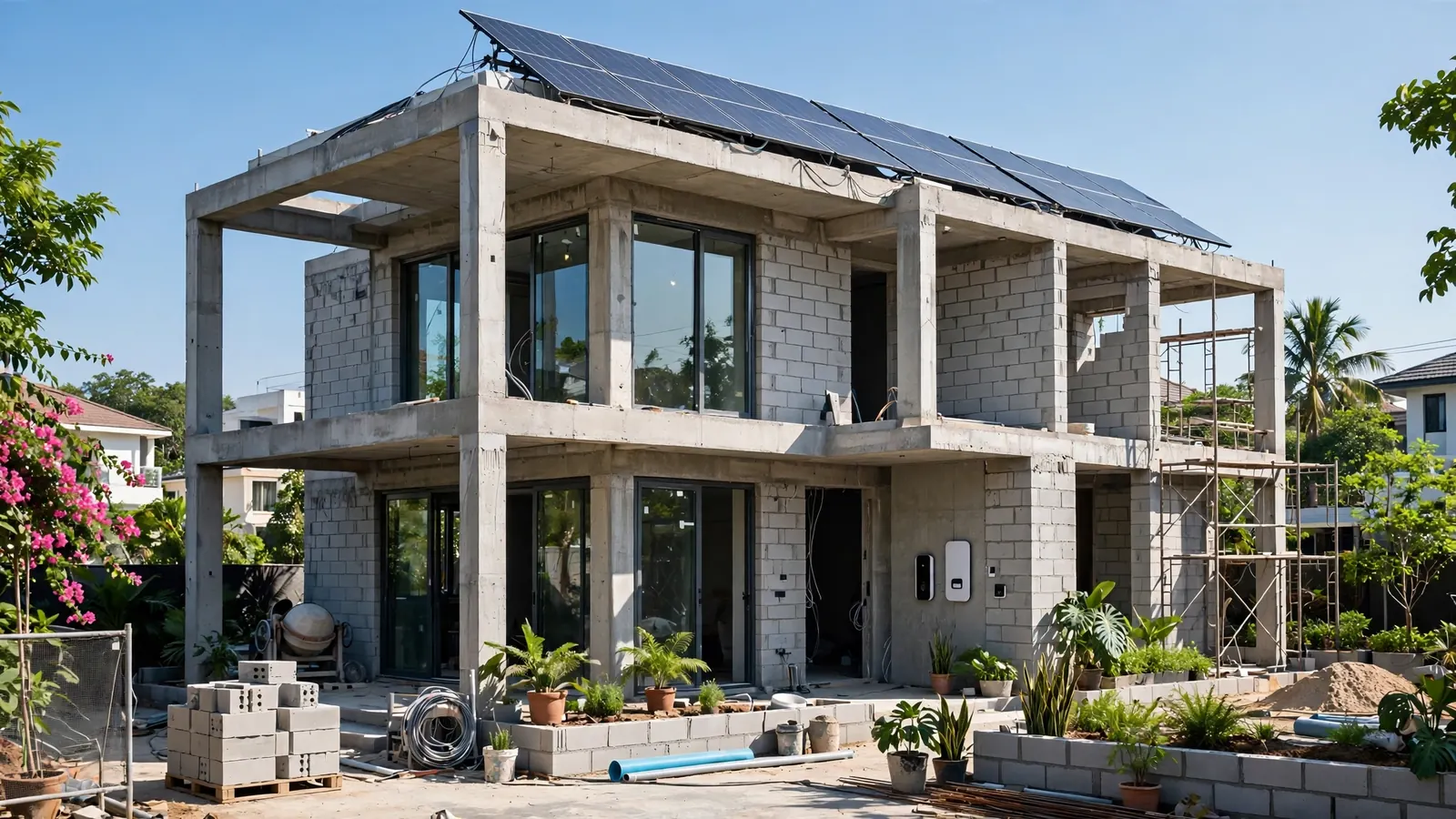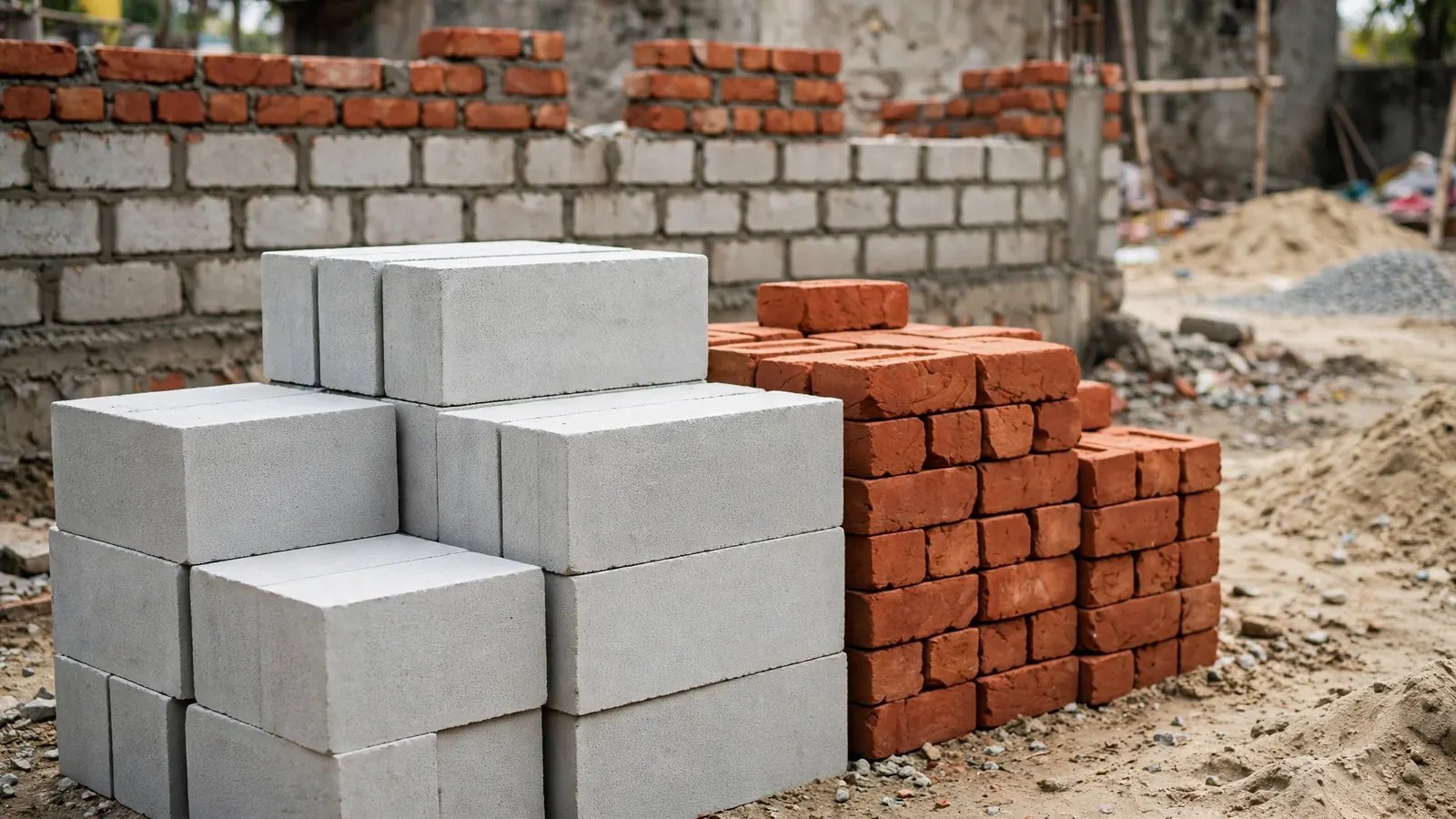
Your mason has quoted red bricks; your neighbour swears by AAC blocks. The two walls will look the same once plastered, but they will not behave the same — one is three times heavier, one needs a different mortar, and one will change what your rooms feel like on a Noida afternoon in May. This aac blocks vs red bricks comparison works through the standards, the site checks, and the real cost, so the choice stays on your house.
Short answer, for a framed house in Noida or Delhi NCR: AAC blocks usually win for partitions and infill walls inside an RCC frame — lighter, faster, better at keeping heat out, and often cheaper per finished wall. Red bricks still win with no RCC frame, scarce AAC supply or masons, and for small repairs.
1. What each material actually is
AAC stands for Autoclaved Aerated Concrete: cement, lime, fly ash or fine sand, and aluminium powder, mixed with water, cut to size, and cured in high-pressure steam. The aluminium powder creates millions of tiny air pockets — they make the block light, slow heat down, and need careful protection from water.
A red clay brick is simpler and older: clay and shale, shaped, dried, and fired in a kiln. Quality depends on the clay, the firing, and the kiln — two truckloads of "first-class" bricks from different kilns can behave like different materials.
A common AAC block face is 600 × 200 mm (75–300 mm thick); 200 mm suits external walls, 100–150 mm partitions. A standard red brick is about 230 × 110 × 75 mm, so one 600 × 200 × 200 mm AAC block covers roughly 8–10 bricks.
2. Strength: read the standard, not the headline
Both standards work the same way: a minimum strength for a stated density or class, which the batch you receive has to meet. A headline number without the grade or class behind it means very little.
For AAC, the reference most manufacturers cite is IS 2185 (Part 3):1984. In the density band most Noida suppliers stock — 551 to 650 kg/m³ — Grade 1 needs a minimum of 4.0 N/mm² and Grade 2 needs 3.0 N/mm². Some guides cite the same material as IS 2185 Part 4:2008; the values match, but the part number differs, so read the batch test certificate and look for the BIS Standard Mark.
For red bricks, the reference is IS 1077:1992: classes run from Class 3.5 (minimum 3.5 N/mm²) up to Class 35, and water absorption is capped at 20% of the brick's weight after 24 hours in cold water for classes up to 12.5, and 15% for higher classes.
The honest reading: a good red brick can beat a standard AAC block on raw strength, and a poor brick can fall well below it, while AAC strength is more consistent because it is factory-made to a grade. But raw strength is not the deciding test in an RCC framed house, where the frame carries the load — what matters is that the block meets its grade, the mortar suits it, and the wall is tied to the frame.
Final member sizing, reinforcement, foundation selection, and any load-bearing masonry decision need project-specific assessment by a qualified structural engineer, based on your soil report and approved drawings. No article or supplier claim replaces that check.
3. Weight, and what it does to your frame
This is where AAC earns its keep: AAC masonry at 550–650 kg/m³ weighs roughly a third of red brick masonry at about 1,800 kg/m³ — a real cut in dead load on a two- or three-storey house. It does not let you shrink columns on your own say-so, but it gives your structural engineer less to design for. Treat any fixed percentage of steel saved with care: it depends on soil, spans, floors, and design.
Weight also matters in an earthquake: heavier walls generate higher inertial forces, putting more demand on columns, beams, and foundations. AAC infill still needs proper ties to the frame, and the frame still needs ductile detailing to IS 13920 where your design calls for it. Light walls do not fix a bad frame.
4. Heat: the Noida summer test
Noida summers are the fairest test of a wall — it is the largest surface between your rooms and the heat. Heat moves at a rate set by thermal conductivity, k in W/mK; lower k means slower heat flow. Under IS 2185 (Part 3), the cap for the common 551–650 kg/m³ AAC band is 0.24 W/mK, and manufacturers typically declare 0.16–0.20 W/mK. Red clay brick typically sits around 0.6–0.9 W/mK.
A worked example makes the gap concrete: a 200 mm AAC wall at k = 0.16 has thermal resistance R = 0.20 ÷ 0.16 = 1.25 m²K/W, while a 230 mm brick wall at k = 0.81 has R = 0.28 m²K/W — roughly four times better, and about three times better even at the standard's 0.24 cap. Rooms stay cooler for longer — but manufacturers' estimates of up to about 30% lower cooling load are direction, not a promised bill cut. Your saving depends on orientation, glazing, roof insulation, and shading.
5. Water, damp, and cracks — the part most comparisons skip
AAC's air pockets are a double edge: the same structure that insulates also takes up water if left exposed, and most AAC complaints begin with the detailing, not the block. IS 2185 (Part 3) sets no water-absorption cap; it controls moisture through density classes and a drying-shrinkage limit of 0.05% for Grade 1 and 0.10% for Grade 2. Manufacturers typically declare absorption around 10% or less after 24-hour immersion, against 15–20% for ordinary clay bricks — confirm it on the data sheet.
That means three non-negotiables for external AAC walls: proper external plaster, waterproof paint or coating where the wall faces driving rain, and correct damp-proofing at plinth, parapet, and wet areas. Bathrooms and sunken slabs need their own waterproofing whatever the wall is. Store blocks off the ground, under cover, never in standing water.
AAC walls can show hairline cracks when the wrong mortar is used, joints are too thick, the wall dries too fast, or the frame-infill junction is not detailed. The fixes work: thin-bed mortar at 2–3 mm joints instead of thick site-mixed mortar at 10–12 mm, fibre mesh at column-wall and beam-wall junctions, and services planned before the masonry starts. Red brick walls crack at the same junctions for the same reasons.
6. Speed, mortar, plaster, and the real cost
Speed is AAC's most visible site advantage: a mason lays one large block where nine bricks would go, with a 2–3 mm thin-bed joint instead of a 10–12 mm cement-sand joint. Site guides report masonry going about 25–30% faster, mortar use falling by roughly half to two-thirds, and internal walls needing only a thin skim coat instead of 12–15 mm of plaster.
One AAC block costs more than one red brick — expected, since it covers far more wall. The only fair comparison is the finished wall: material, mortar, labour, plaster, and any structural change, per square foot.
| Item, per 100 sq ft of wall | AAC blocks | Red bricks | What it assumes |
|---|---|---|---|
| Finished wall cost | About ₹6,690 | About ₹11,144 | 2026 averages |
| Cost per sq ft of wall | About ₹67 | About ₹111 | Excludes paint, putty |
| Unit prices in the example | ₹55 per block | ₹10 per brick | Your city will differ |
| Joints | 2–3 mm thin-bed adhesive | 10–12 mm cement-sand mortar | Thick joints erase the AAC saving |
Read that table as a worked example, not a promise — a published manufacturer comparison on 2026 averages, excluding paint and putty. Other comparisons point the other way: a May 2026 Chennai comparison put AAC at ₹145–170 per sq ft against red brick at ₹125–155. Get a like-for-like Noida quote for the same wall from two or three suppliers — a per-block price with no wall rate has not answered your question.
7. Fire, sound, and hanging heavy things
AAC is non-combustible, with walls typically rated for 2–6 hours of fire resistance depending on thickness and plaster — a real advantage for stair and shaft walls, against around 2 hours for red brick. Both need the right thickness and finish to earn their rating. Sound is similar: manufacturers publish about 45 dB reduction for a 200 mm AAC wall against about 30 dB for a 230 mm brick wall — figures for the tested assembly, since doors, windows, and gaps decide most of what you hear.
Hanging heavy things needs a different habit: a red brick wall takes a normal rawl plug, but an AAC wall is softer, so a TV, a geyser, or a loaded cabinet needs AAC-specific anchors, through-bolts for heavy loads, or a fixing into the RCC frame. Plan the fixings before plastering.
8. When red bricks still win
AAC is the default for most framed homes, but there are honest cases for red bricks. If your house has no RCC frame and the masonry itself must carry the load — a small single-storey, frameless house — red bricks, or a block your structural engineer has approved for that use, are the safer conversation. AAC is made for partition and infill walls inside a frame, not as a general load-bearing substitute in multi-storey work.
Supply and skill decide the rest: if AAC blocks, thin-bed mortar, and experienced masons are not reliably available near your site, the "better" material is the one your crew can build well. Red bricks are available almost everywhere, and small repairs are often simpler in brick.
Option A: AAC blocks
- Best fit: Partitions and infill walls in an RCC framed house, especially external walls in summer heat.
- Trade-off: Needs thin-bed mortar, trained masons, proper plaster and damp detailing, and the right anchors.
- Site check: Test certificate to IS 2185 (Part 3), BIS mark, correct grade, fibre mesh at junctions.
Option B: Red clay bricks
- Best fit: Frameless load-bearing low-rise work, small repairs, and sites without reliable AAC supply or labour.
- Trade-off: Heavier walls, more mortar and plaster, slower masonry, more heat in summer.
- Site check: Class to IS 1077:1992, absorption within the class limit, uniform firing, no soft bricks.
9. The decision rule, and your pre-order checklist
Use this rule: if your house has an RCC frame, your supplier can show a current test certificate and BIS mark, your mason has laid AAC before with thin-bed mortar, and your external walls will get proper plaster and damp detailing — choose AAC. If any one of those four is missing, fix it first, or choose red bricks for that part and revisit AAC when the supply and skill are in place.
Before you order, check a sample — an AAC block should be uniform, sharp-edged, and close to its stated size; a brick should ring when struck and not crumble. Get the batch test certificate and the grade or class in writing, matched to your structural drawings. Confirm the mortar and plaster scope in the same quote, mark where heavy items will hang, agree the fixings before plastering, and agree who supplies fibre mesh and checks the first courses for level and plumb.
Want a second pair of eyes on the choice for your plot? Talk to the RTPL team before you order, with your structural drawings and the supplier's test certificate.
Last reviewed: 8 November 2026. Confirm the current IS editions and get fresh Noida quotes before you buy.
Related reading: 5 Trends Shaping Modern Home Construction in 2024 — AAC in brief; this article is the deeper comparison. More: RTPL Journal & Field Notes.