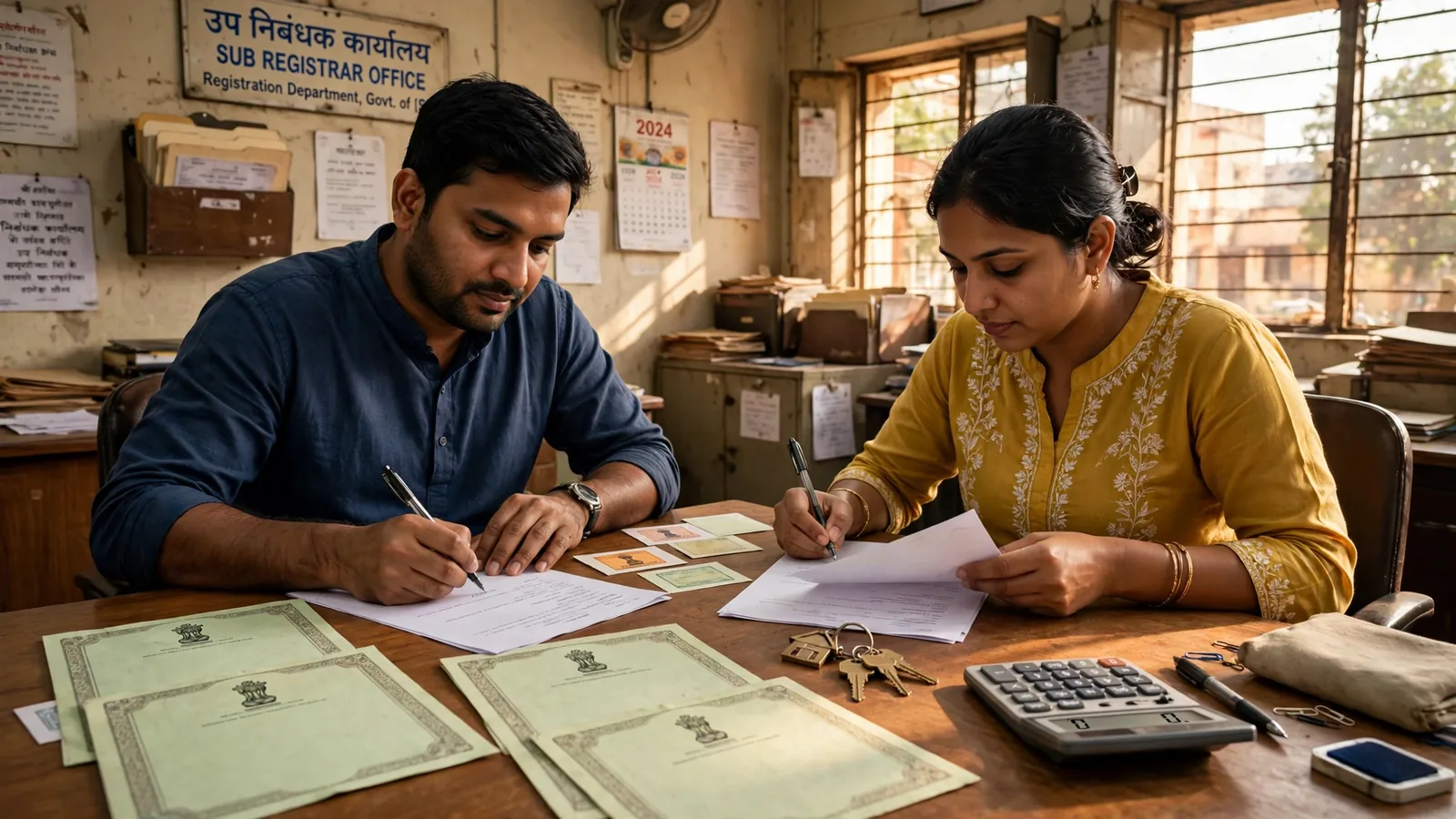
A buyer in Uttar Pradesh agrees to pay ₹50 lakh for a plot, arranges the loan, signs the agreement — and at the sub-registrar's office discovers he owes another ₹4 lakh before the property is his. That is stamp duty and registration, the most common budgeting shock in Indian home buying: roughly 5 to 9 percent on top of the price, paid in cash from your own funds, due at registration — not through the home loan.
The key point first: stamp duty is charged on the plot or property you buy, not on the cost of building the house. Own a plot and build on it, and no stamp duty is due on the construction — you pay it only when the plot or property is bought and registered.
1. The short answer
Stamp duty is a state tax on the document that transfers ownership; registration charges are the fee for recording it with the sub-registrar. Both are calculated on the registered value — the higher of the deal price or the circle rate — and paid at registration.
Across India's top ten property markets the two charges together run from about 5.9 percent to 11 percent. In Uttar Pradesh the combined rate is 8 percent: ₹4 lakh on a ₹50 lakh plot, ₹8 lakh on a ₹1 crore property. Women buyers pay less in several states; under-construction property also attracts 5 percent GST, a ready home does not.
2. Stamp duty and registration charges are two different payments
Homebuyers use the two terms as if they were one charge. They are not — and the difference matters on a demand notice or a builder's cost sheet. Stamp duty is a state-level tax on the sale deed — the document that transfers ownership — governed by the Indian Stamp Act, 1899, as modified by each state's own Stamp Act, which is why the rate changes the moment you cross a state border. An unstamped or under-stamped deed can be refused as evidence in a dispute.
Registration charges are the fee for recording that transfer with the sub-registrar — the step that puts your name on the government's record as the owner. The fee is usually 1 percent of the property value, though some states cap it: in Maharashtra registration is capped at ₹30,000, and in Haryana it runs on a fixed slab of ₹15,000 to ₹50,000. If a builder's cost sheet shows one line for both, ask for the split — they are paid through different channels.

3. How the amount is calculated: the higher of deal price or circle rate
The duty is a percentage of the property's registered value — whichever is higher, the agreed deal price or the circle rate for that area. The circle rate — the ready reckoner rate or guidance value in some states — is the minimum value the government has fixed for a locality, and it stops under-reporting: a deal written below the circle rate is still charged duty on the circle rate.
Example: a flat with a circle-rate value of ₹80 lakh sells for ₹75 lakh — duty is charged on ₹80 lakh; pay ₹90 lakh and duty is charged on ₹90 lakh. The higher figure always wins. Circle rates are revised from time to time, and the rate in force on the registration date applies — check it on the state stamp portal, not the rate your neighbour paid two years ago.
4. Stamp duty rates by state in 2026
Stamp duty is a state subject, so there is no single national rate. The table below gives the consensus 2026 rates from guides checked in November 2026; conflicts are flagged. Verify the current rate on the state stamp portal before transacting.
| State | Stamp duty | Registration | Combined | Note |
|---|---|---|---|---|
| Gujarat | 4.9% | 1% | 5.9% | Cheapest |
| Delhi | 6% men / 4% women | 1% | 7% / 5% | — |
| Maharashtra | 6% men / 5% women | 1% | 7% / 6% | Mumbai: 5% + 1% cess; cap ₹30,000 |
| Rajasthan | 6% men / 5% women | 1% | 7% / 6% | — |
| Karnataka | 5% (slab-based) | 2%* | ~7% | *Sources differ: 1% or 2% since 31 Aug 2025 — verify |
| Telangana | 5.5% | 0.5% + 1.5% transfer duty | 7.5% | Another source: 4% + ₹25,000 — verify |
| West Bengal | 6% up to ₹1 crore, 7% above | 1% | 7% / 8% | — |
| Haryana | 7% men / 5% women | ₹15,000–50,000 slab | ~7% + slab | Fixed slab |
| Uttar Pradesh | 7% (6% women, see §6) | 1% | 8% / 7% | Examples in §5 |
| Kerala | 8% | 2% | 10% | — |
| Tamil Nadu | 7% | 4%* | 11% | Most expensive; *one source says 2% — verify |
Two things stand out. First, the state matters: on a ₹1 crore property, Gujarat costs ₹5.9 lakh, Tamil Nadu ₹11 lakh — a ₹5.1 lakh spread. Second, the women-buyer concession is a 1 to 2 point rebate in at least four of the top-ten states.
5. Uttar Pradesh in focus: what you actually pay
Uttar Pradesh charges 7 percent stamp duty plus 1 percent registration — 8 percent combined. On a ₹50 lakh plot, a male buyer pays ₹3.5 lakh stamp duty and ₹50,000 registration — ₹4 lakh in all. On a ₹1 crore property that is ₹7 lakh plus ₹1 lakh — ₹8 lakh. Both are due in cash, in full, at registration.
The cash point is the one that catches people. Banks fund up to about 80 percent of the property value, and stamp duty is explicitly excluded — the bank will not lend you the duty. On that ₹50 lakh UP plot, the bank may fund ₹40 lakh; the other ₹10 lakh of the price plus the ₹4 lakh of duty — ₹14 lakh in all — comes from your own funds. Budgeting only the 20 percent margin leaves you ₹4 lakh short at the sub-registrar's office, so budget the duty separately from day one.
6. Women buyers pay less — and joint registration unlocks it
Several states charge women less. In Delhi the rate is 4 percent for women against 6 percent for men; in Maharashtra 5 percent against 6 percent; in Haryana 5 percent against 7 percent. In Uttar Pradesh, women get a 1 percent concession — 6 percent instead of 7 percent — on property up to ₹1 crore, approved in July 2025 according to one source; another source lists a 1 percent rebate in some areas only — verify on the UP stamp portal for your district.
The practical route is joint registration: in most states, registering jointly with a woman co-owner — a wife, mother or daughter — unlocks the lower rate on her share, and in some states on the whole property. On a ₹1 crore property that is ₹1 lakh in UP and ₹2 lakh in Delhi. Decide before the sale deed is drawn up — the names on the deed decide the rate, and adding a co-owner later means a fresh transfer and fresh duty.

7. The GST trap: under-construction homes cost 5 percent more in tax
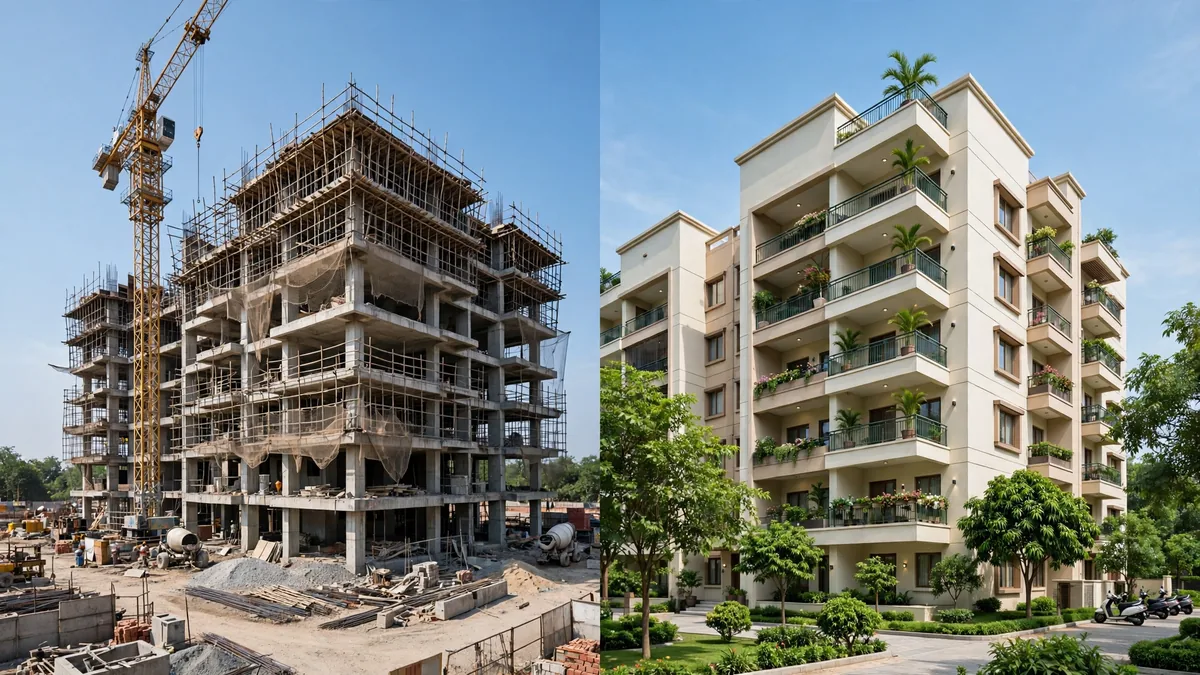
Stamp duty and registration are not the only taxes on a home purchase. A property bought under construction attracts 5 percent GST, charged in addition to stamp duty and registration. A ready-to-move home with an Occupancy Certificate attracts no GST at all.
On a ₹1 crore property in UP, the under-construction flat costs ₹5 lakh in GST plus ₹8 lakh in stamp duty and registration — ₹13 lakh on top of the price. The ready flat with an Occupancy Certificate costs only the ₹8 lakh. That ₹5 lakh difference belongs in the under-construction versus ready comparison alongside the price per square foot — check the Occupancy Certificate before you pay; our guide explains how. Timing differs too: GST is paid in instalments during construction, while stamp duty and registration are paid in one lump at registration.
8. The tax break: Section 80C gives some of it back
Stamp duty and registration charges paid on a residential house qualify for deduction under Section 80C, inside the overall ₹1.5 lakh limit shared with EPF, PPF, ELSS and life insurance premiums. The deduction is available only in the year the charges are paid, and only under the old tax regime, according to a 2026 source.
Keep the scale in perspective: on a ₹50 lakh UP plot the duty totals ₹4 lakh, but the deduction caps at ₹1.5 lakh, shared with everything else in 80C. If your EPF and PPF already use up the limit, it adds nothing. Where the 80C basket has room, a ₹1.5 lakh deduction at the 30 percent slab is worth up to ₹46,800 in tax saved.
9. When and how you pay
Stamp duty is paid at registration — when the sale deed is presented to the sub-registrar, not after. First the deed is drafted with the property details and names. Then the duty is calculated on the higher of deal price or circle rate and paid — through e-stamping in most states, or physical stamp paper where that is still used. Then buyer, seller and witnesses appear before the sub-registrar with identity proof, photographs, the original title documents and proof of duty paid, and the deed is signed and registered; the registration fee is paid at the same visit.
E-stamping has replaced the hunt for stamp paper vendors in most states: generate a certificate online through the state portal or an authorised bank, pay by net banking or UPI, and the sub-registrar verifies its unique number. Keep a printed copy with the deed. Registration can only happen once the property is ready to be transferred — for an under-construction property, after possession — so the duty is the last big payment in the purchase, which is why it catches buyers who have spent their liquid funds on the construction-linked instalments.

10. Your checklist before registration day
The duty itself is arithmetic; the expensive mistakes happen in the paperwork around it. Confirm the circle rate on the state stamp portal and calculate the duty on the higher of that rate and your deal price. Decide the names on the deed before it is drafted, including any woman co-owner for the concession. Check the GST position: under construction means 5 percent GST on top of the duty; a ready home with an Occupancy Certificate means none. Keep the full duty amount in liquid funds, separate from the home loan margin — the bank will not fund it. Carry the original title documents, identity proof, photographs and e-stamp certificate to the sub-registrar, and verify the deed's property details before you sign. File the registered deed, e-stamp certificate and registration receipt together — you will need them for the 80C deduction and any resale.
Stamp duty and registration are not a hidden cost once you know the rules: budget 5 to 9 percent on top of the property price — 8 percent in Uttar Pradesh — in cash, at registration, on the higher of deal price or circle rate. Plan for that number and you negotiate from strength; discover it at the sub-registrar's desk and you negotiate from panic. Building on a plot you already own? No stamp duty is due on the construction.

Stamp duty and registration rates are set by state governments and change by notification — the rates here are the consensus of published guides checked on 18 Nov 2026, with conflicts flagged. Verify the current rate and circle rate on your state stamp portal before transacting, and confirm the deed, deduction and tax regime with your chartered accountant or lawyer; this is general information, not legal or tax advice.
Planning a home in Uttar Pradesh or Delhi NCR? Read our construction cost guide or talk to the RTPL team about your plot, plan and budget.