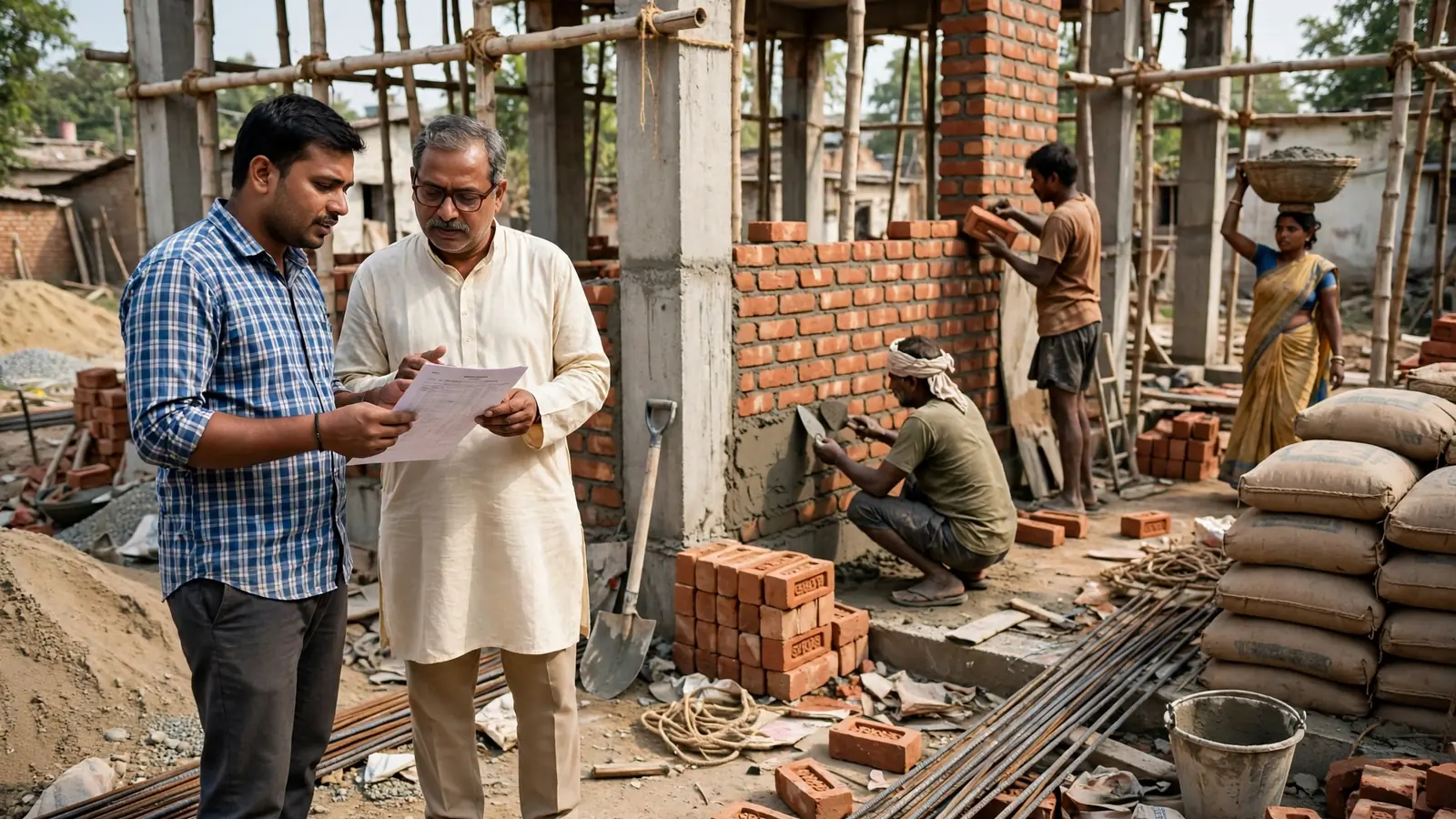
The cheapest quote on a house build is usually a labour-only rate — and the most misunderstood. A labour contract means the contractor supplies only the workforce: masons, steel fixers, carpenters and helpers. You buy all the materials. The per-sq-ft figure looks small next to a turnkey quote, but your money is only safe when payment is tied to work you can see and measure. This guide explains the labour-only rates quoted in 2026, the six ways labour is paid, and a milestone schedule that keeps your cash ahead of the work — never behind it.
1. The short answer
For a standard RCC house — ground floor or ground-plus-one — labour-only rates in 2026 guides run roughly Rs 220 to Rs 550 per sq ft of built-up area for the civil frame, with premium or complex work reaching Rs 750. A 1,000 sq ft house therefore needs roughly Rs 2–4 lakh of labour in total. Pay it in milestones — about 10% advance, then payments at foundation, each slab, brickwork, plaster and finishes, with the last 5–10% held until snagging and handover. Labour is typically 25–40% of total construction cost. A labour contract can save roughly 15–20% against turnkey — but only with site visits three to four times a week.
2. What a labour contract actually covers
Under a labour-only contract, the contractor's job is people, tools and workmanship. He brings the masons, steel fixers, shuttering carpenters and helpers, plus their hand tools. Everything else is yours: cement, sand, aggregate, steel, bricks, blocks, water, electricity and transport to the plot. That split is the point: you control material brands and grades, and pay no contractor margin on them.
The typical scope is the civil frame: footings and plinth, columns, beams, slabs, brickwork and plaster. Finishes are often separate — tiling, painting, plumbing, electrical work, doors and windows may be priced as extras or handed to separate trades. Most disputes start here: the owner assumes the whole house is included, the contractor assumes the frame only. Before any rate is discussed, write down exactly which items are in and which are out, trade by trade. Our comparison of a turnkey vs labour contract explains the full trade-off between the two models.
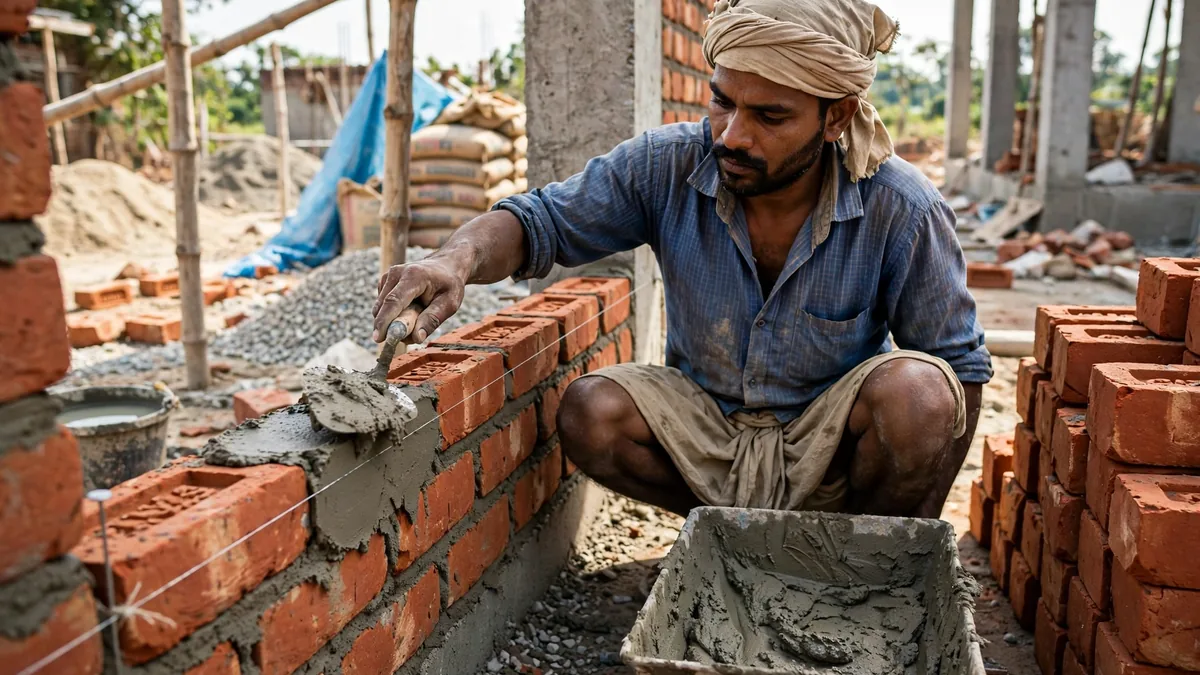
3. Labour-only rates per sq ft in 2026
Guides disagree because they quote different scopes in different cities. Treat every figure below as an illustrative band from 2026 guides, not a fixed market price — and compare itemised BOQs, not headline rates.
| Scope | Indicative band (Rs/sq ft) | Where quoted | What it usually includes |
|---|---|---|---|
| Civil frame, basic | Rs 220–350 | Lucknow / North India guides | Frame, brickwork, basic plaster |
| Civil frame, mid-range | Rs 250–450 | Multiple guides | Frame plus brickwork and plaster |
| Civil frame, metro | Rs 280–420 | Gurgaon guide | Frame, brickwork, plaster |
| Standard RCC house (G/G+1) | Rs 350–550 | One national guide | Full civil work with finishes support |
| Premium / complex work | Rs 550–750 | One national guide | Complex geometry, high-end finishes |
| Full residential construction | Rs 300–450 | Another guide | Civil work through basic finishes |
Two traps hide inside a low quote. First, the area basis: built-up, carpet or plinth? A rate on plinth area can quietly add 10–15% to the bill. Second, the cheapest quote usually hides a specification downgrade — thinner plaster, fewer curing days, loosely measured brickwork. Our guide to reading your contractor's BOQ like an engineer shows what to check.
4. Daily wages in 2026: what each trade actually earns
Behind every per-sq-ft rate sits a daily wage. Knowing the wage helps you judge whether a quote is realistic — a contractor paying below the going rate will either lose his gang mid-project or cut corners to make the numbers work. Figures are 2026 guide ranges.
| Trade | Metro | Tier-2 city | Tier-3 / rural |
|---|---|---|---|
| Mason / head carpenter | Rs 800–1,200/day | Rs 700–900/day | Rs 500–750/day |
| Helper / unskilled labour | Rs 500–800/day | Rs 450–600/day | Rs 400–600/day |
| Skilled trades (bar bender, plumber, electrician) | Rs 900–1,400/day | Lower than metro; confirm locally | Lower than tier-2; confirm locally |
Use these numbers as a sanity check, not a hiring rate. If a quote implies wages far below these bands, something is off — either the gang is underpaid and will leave, or the measurement will make up the difference.
5. The six ways labour is paid
There is no single "labour rate". A house uses six different payment modes, and the contract must name which one applies to each trade.
- Daily wage: workers paid per day on a muster roll. Best for small, undefined jobs — repairs, demolition, odd finishing work.
- Per sq ft: the standard mode for the civil frame — the rate multiplies by the built-up area.
- Per piece: brickwork, plastering and tiling priced per sq ft of work actually done — a wall's area, not the house's. Write the measurement rules — openings, one side or both — into the contract.
- Per point: electrical work priced per point — each switch, socket or light fitting.
- Per kg: steel work — cutting, bending and tying reinforcement — priced per kg of steel fixed. Verify the quantity against the structural drawing.
- Lumpsum: one fixed price for a defined item, such as a staircase or compound wall. Safe only when fully specified in writing.
Most well-run contracts use a mix: per sq ft for the frame, per piece for brickwork and plaster, per point for electrical, per kg for steel, daily wage only for small extras. Agree each trade's mode before that trade starts.

6. The milestone payment schedule
A payment schedule tied to the calendar is a trap. "Rs 50,000 every month" pays the contractor whether the slab is cast or not. The percentages below are a common 2026-guide pattern — adapt them to your BOQ, but keep the principle: every payment follows a completed, checked stage.
| Stage | Share of labour cost | Pay only when |
|---|---|---|
| Mobilisation advance | ~10% | Agreement signed; gang and shuttering material on site |
| Foundation and plinth | ~10–15% | Footings cast, plinth beam complete, levels checked |
| Each floor slab | ~15–20% per floor | Slab cast, shuttering and steel checked before pouring |
| Brickwork | ~10–15% | Walls complete to slab level, openings as per drawing |
| Plaster and finishes | ~15–20% | Plaster complete and cured, surfaces checked for hollowness |
| Snagging and handover | 5–10% retained | Snag list closed, final cleaning done, keys handed over |
Two rules make this schedule work. First, never pay for the next stage before the current one passes inspection — the moment payment runs ahead of work, your leverage is gone. Second, measure before you pay: brickwork by measured wall area, plaster by measured surface, steel by weighed quantity. Our guide to construction contract payment schedules covers the protective clauses.
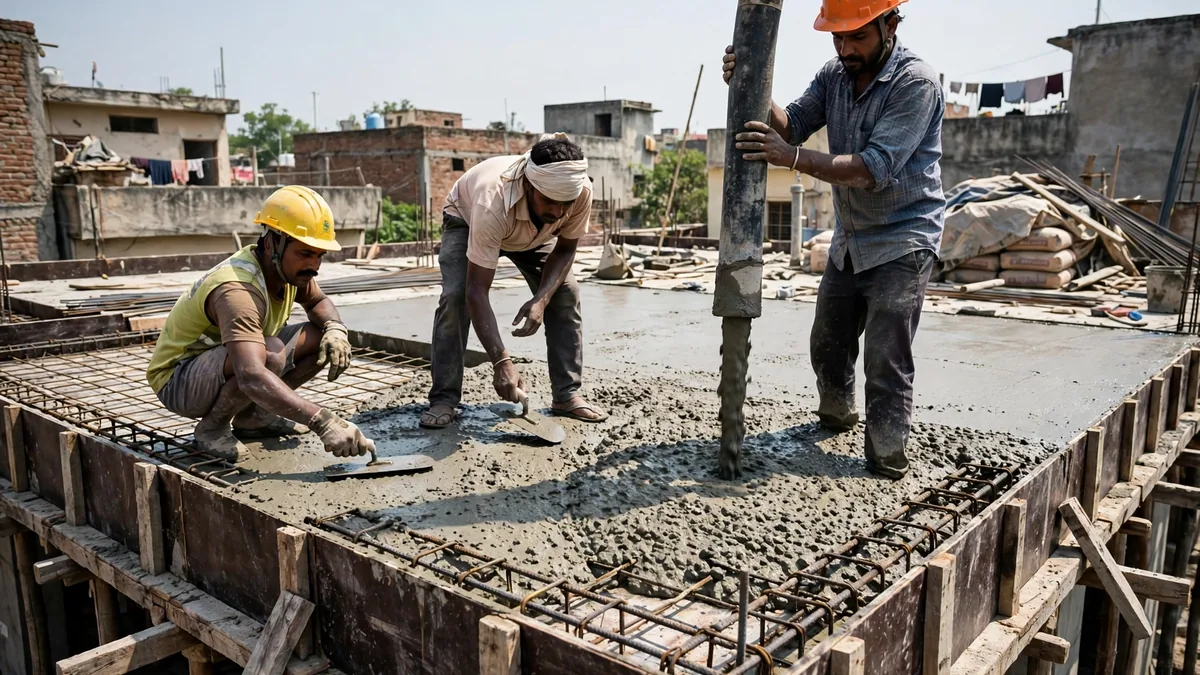
7. Advance and retention: how much money is safe to hand over
The mobilisation advance is the most argued number in a labour contract. Guides converge on about 10% of the labour cost, only against something real: a bank guarantee, or shuttering material and tools delivered to your site. Anything above 15% is a red flag, and cash with no written receipt is never acceptable — every payment needs a dated receipt naming the stage it covers.
Retention is the other half of the same protection. Hold back the last 5–10% until snagging is complete and the house is handed over — this is the money that gets the contractor to return for the cracked plaster, the leaking joint or the door that does not close. Agree both numbers in the written agreement before work starts; a verbal promise to "settle it later" is worth nothing when the gang has moved to the next site.

8. Quality checks before each payment
A milestone payment is not a calendar event — it is a quality gate. Before releasing money at each stage, check the work it covers. For brickwork: joints are full, courses are level, walls are plumb and openings match the drawing. For plaster: tap the surface for hollowness, check thickness and finish, and confirm curing actually happened — plaster that dries too fast cracks, and cracked plaster is paid for twice. For slabs and columns: confirm steel and shuttering were checked before pouring — after that, nobody can see inside.
Keep a simple measurement book. Every stage, record the quantities measured, the rate applied, the amount paid and the balance left. Photograph each stage before the next one covers it — brickwork before plaster, steel before concrete, pipes before flooring. Those photographs are your evidence if a dispute arises.
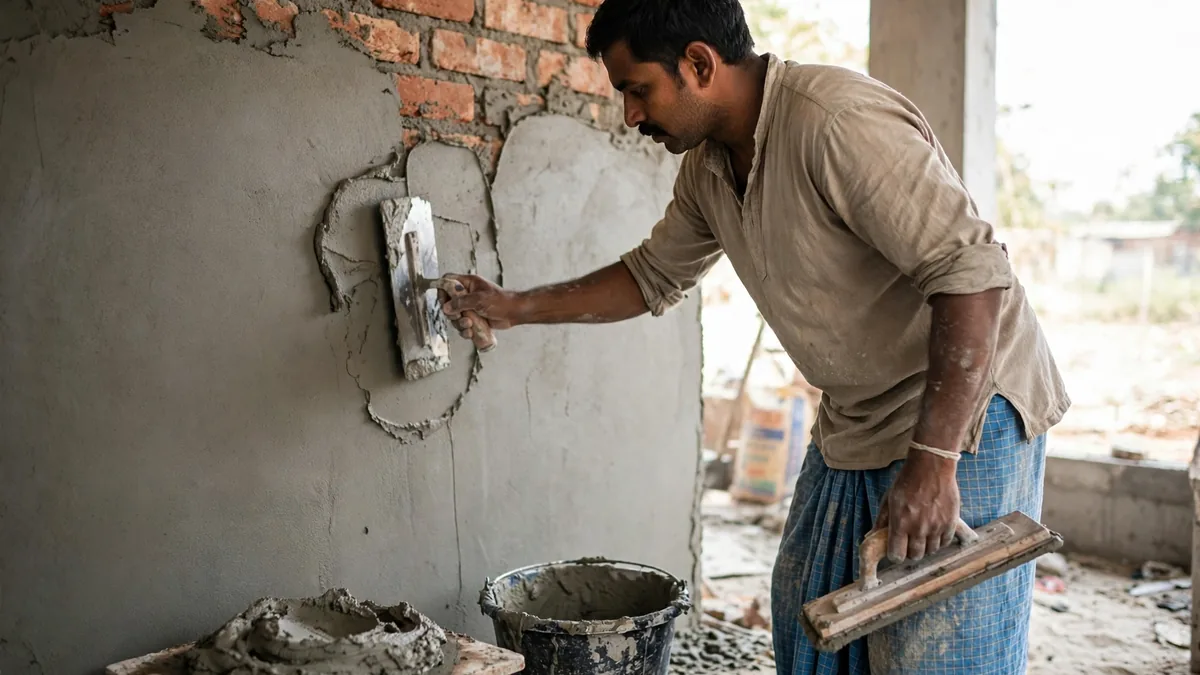
9. Supervision: the cost nobody budgets
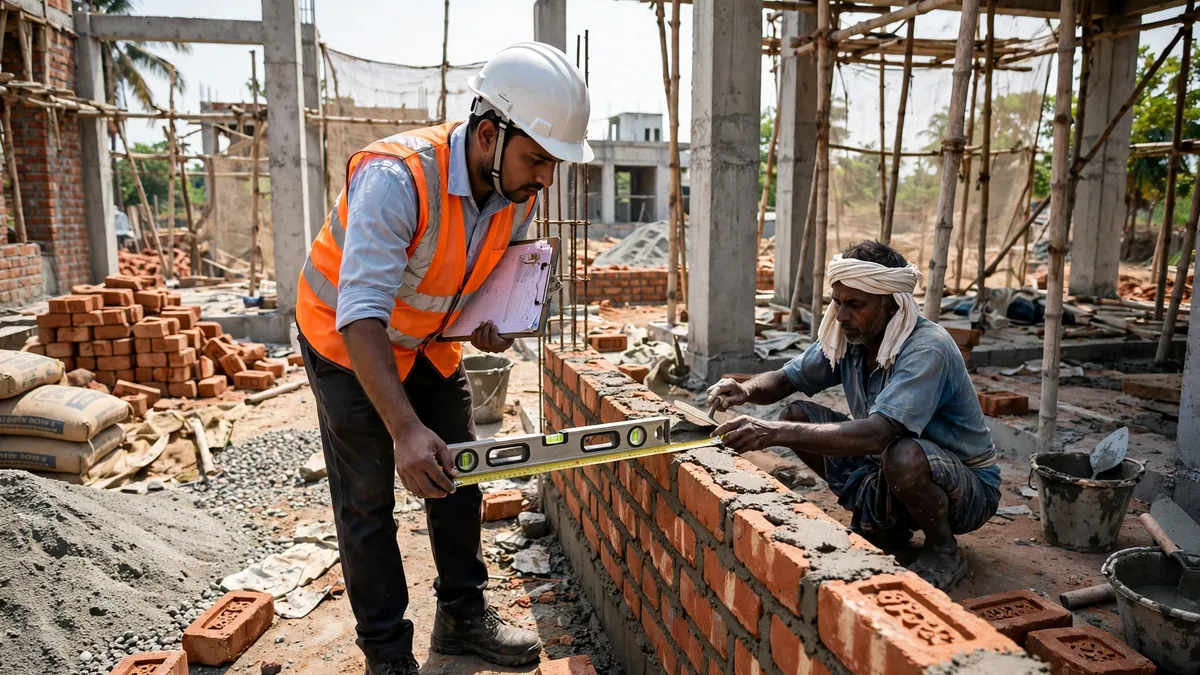
A labour contract buys control, and control costs time. The guides are blunt: the 15–20% saving against turnkey only survives if the owner — or a competent engineer engaged by the owner — visits the site three to four times a week. Each visit checks the day's work against the drawing, the material delivered, and the measurement book.
If you cannot be there, hire a site engineer and give him written authority to stop work that does not match the drawing. Without supervision, the cheapest labour quote usually costs more than turnkey: rework, wasted material, delays and disputes eat the saving. If your job keeps you away for weeks at a time, a turnkey contract is usually the cheaper choice in the end.
10. Worked example: a 1,000 sq ft house
Take a standard 1,000 sq ft ground floor in a tier-2 city. At a mid-range labour-only rate of Rs 300 per sq ft, the civil-frame labour comes to Rs 3,00,000 — inside the guides' typical total of Rs 2–4 lakh for a house this size. Split it by the milestone pattern: Rs 30,000 as mobilisation advance; Rs 30,000–45,000 at foundation and plinth; Rs 45,000–60,000 at the slab; Rs 30,000–45,000 for brickwork; Rs 45,000–60,000 for plaster and finishes; and Rs 15,000–30,000 retained until snagging and handover. Materials are entirely separate — our house construction cost guide breaks down the full picture.
Run the same arithmetic on every quote you receive. A quote of Rs 220 per sq ft puts the labour total at Rs 2,20,000 — ask what is excluded. A quote of Rs 450 puts it at Rs 4,50,000 — ask what extra scope justifies it. The BOQ, the measurement rules and the payment schedule are the rest of it.
11. Red flags in a labour contract quote
Slow down when you see any of these. A quote with no itemised BOQ, only a single per-sq-ft number. An advance demand above 15%, or in cash without a receipt. No retention clause, or a promise to "finish everything first, payment later" with no written stages. A contractor who will not put the measurement rules in writing. A rate far below the local wage arithmetic. And no references you can visit — ask for two completed houses and inspect them before you sign.
12. Your checklist before signing
Scope in writing, trade by trade, with finishes marked in or out. One itemised BOQ, compared line by line across contractors. Area basis named — built-up, carpet or plinth. Payment mode named for every trade. Measurement rules written down, including how openings are treated. Advance around 10%, retention of 5–10% until handover, every payment by bank transfer with a dated receipt. A milestone schedule tied to inspected stages, never to calendar dates. A supervision plan — who visits, how often, and who can stop work. Keep a measurement book and photo record from day one. Get these lines right and a labour contract does what it promises: your materials, your control, and your money released only for work you have seen. If you would like help, choosing the right contractor is the next step — RTPL can review your BOQ and payment schedule before you sign.
Structural decisions require project-specific assessment by a qualified structural engineer. All rates here are illustrative 2026 guide bands — confirm them with an itemised BOQ for your city and scope.